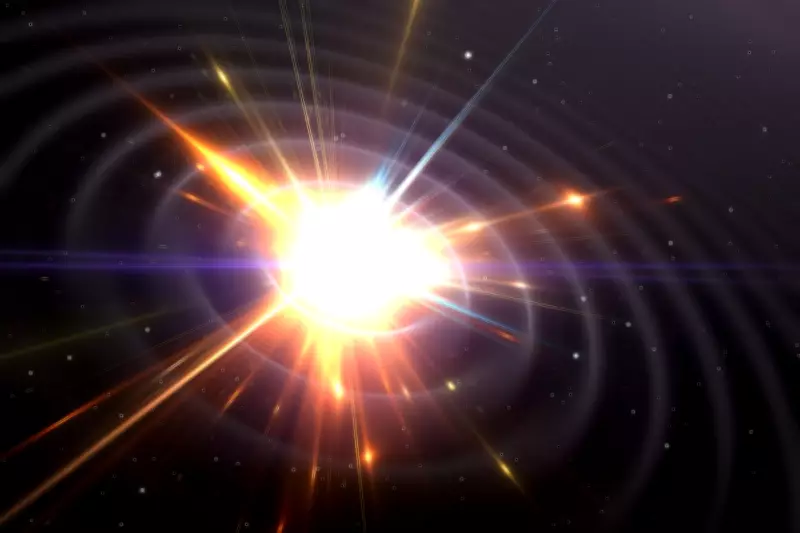
In a landmark astronomical breakthrough, researchers have for the first time directly measured the staggering power of jets erupting from a black hole, with an instantaneous energy output matching that of 10,000 suns. This unprecedented observation also captured the jets' phenomenal velocity, clocking in at around 355 million miles per hour, which is precisely half the speed of light.
Focus on Cygnus X-1: A Historic Black Hole System
The study concentrated on Cygnus X-1, a binary system situated 7,200 light-years from Earth. This system holds historical significance as it was the first black hole ever identified more than five decades ago. In this cosmic pairing, a black hole continuously pulls gases from its companion, a massive blue supergiant star, creating a dynamic and energetic environment.
Decades of Data Yield New Insights
An international research team, spearheaded by Steve Prabu from the University of Oxford, leveraged 18 years of high-resolution radio imaging collected from a global network of telescopes. Their meticulous analysis, detailed in the journal Nature Astronomy, enabled the measurement of the rapid power of these "dancing jets" as they were propelled in opposite directions by the stellar wind.

This achievement marks a significant advancement, as prior methods could only estimate jet power by averaging over millennia, making real-time measurements impossible until now.
Key Findings and Cosmic Implications
A pivotal revelation from the research indicates that approximately 10% of all energy released when matter falls into the black hole is subsequently transported away by these formidable jets. The blue supergiant star serves as an essential fuel source, supplying the black hole with material that is then ejected as these high-energy outflows.
These precise measurements provide crucial insights into how black holes shape the evolution of galaxies and other cosmic structures through large-scale shocks and turbulence. By understanding the mechanics of these jets, scientists can better comprehend the broader impact of black holes on the universe.
Future Research Directions
Steve Prabu and his team plan to apply these innovative measurement techniques to additional black hole systems. This approach promises to unveil further exciting discoveries about these enigmatic cosmic phenomena, potentially transforming our understanding of astrophysics and the forces that govern the cosmos.