Ancient Cosmic Giant Defies All Known Growth Limits
Astronomers have made a startling discovery that challenges fundamental theories about how black holes form and evolve in the early universe. Using advanced telescopic technology to peer back approximately 12 billion years into cosmic history, researchers have identified a supermassive black hole growing at an astonishing rate that defies all established physical models.
Breaking the Cosmic Speed Barrier
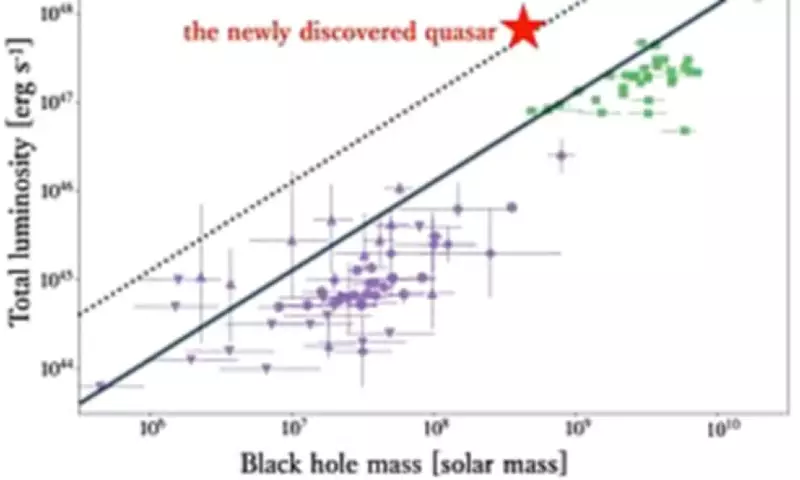
The black hole, designated ID830, has been observed growing at thirteen times what scientists previously considered the maximum possible rate for such celestial objects. This extraordinary finding upends conventional astrophysical understanding, as theoretical models have long suggested that black holes should face natural limitations on their growth speed due to opposing forces generated during matter absorption.
"This discovery may bring us closer to understanding how supermassive black holes formed so quickly in the early universe," explained lead researcher Sakiko Obuchi from the international team that made the breakthrough observation. The black hole already possesses a staggering mass equivalent to 440 million suns, despite existing during what astronomers consider the cosmic dawn period shortly after the universe's formation.

Unprecedented Multiwavelength Behavior
What makes ID830 particularly remarkable is its unexpected emission pattern across different wavelengths. While most theoretical models predict that rapidly growing black holes should exhibit reduced X-ray emissions and less prominent radiation jets, this cosmic anomaly shines brightly in both X-ray and radio wavelengths simultaneously.
The research team, comprising scientists from Waseda University and Tohoku University in Japan, utilized the powerful Subaru Telescope to conduct their observations. Their findings, published in the prestigious Astrophysical Journal, reveal that ID830 displays what researchers describe as "a surprising mix of traits" that existing theories suggest should not coexist.
The quasar is pulling in matter at an exceptionally high rate while also emitting intense X-rays and launching a strong radio jet, the researchers noted in their official statement. Many existing theories suggest these features should not appear together, making this object a rare and revealing find.
Possible Explanations for Extraordinary Growth
Scientists propose several potential mechanisms that might explain this unprecedented growth spurt:
- The black hole may have experienced a dramatic collision with a massive star or dense gas cloud
- Researchers might be observing the object during a brief transitional period following sudden gas influx
- The discovery could indicate previously unknown growth mechanisms operating in the early universe
- Current theoretical models may require significant revision to account for such extreme cases
Dr. Obuchi elaborated on the significance of their findings: "Going forward, we hope to explore the mechanisms of X-ray and radio wave emission from this quasar and determine whether there are any similar objects yet to be discovered." The team suggests that both the X-ray-emitting corona and the radio jet may have become highly energized simultaneously before the system gradually settles into a more typical growth pattern.
Implications for Understanding Cosmic Evolution
This discovery provides crucial new insights into one of astronomy's most persistent mysteries: how supermassive black holes managed to achieve such enormous sizes so rapidly during the universe's infancy. The observations challenge current understanding of black hole formation and growth mechanisms, suggesting that scientists may need to reconsider fundamental aspects of cosmic evolution.
The research team emphasizes that ID830 likely represents the fastest-growing supermassive black hole of comparable mass ever documented. Its existence forces astrophysicists to reconsider how matter accretion processes operate under extreme conditions and what factors might enable such extraordinary growth rates during the universe's formative years.

As astronomers continue to study this remarkable object and search for similar anomalies, they hope to unravel the complex processes that governed black hole formation in the early cosmos, potentially rewriting significant portions of our understanding about how the universe's most massive structures came into existence.