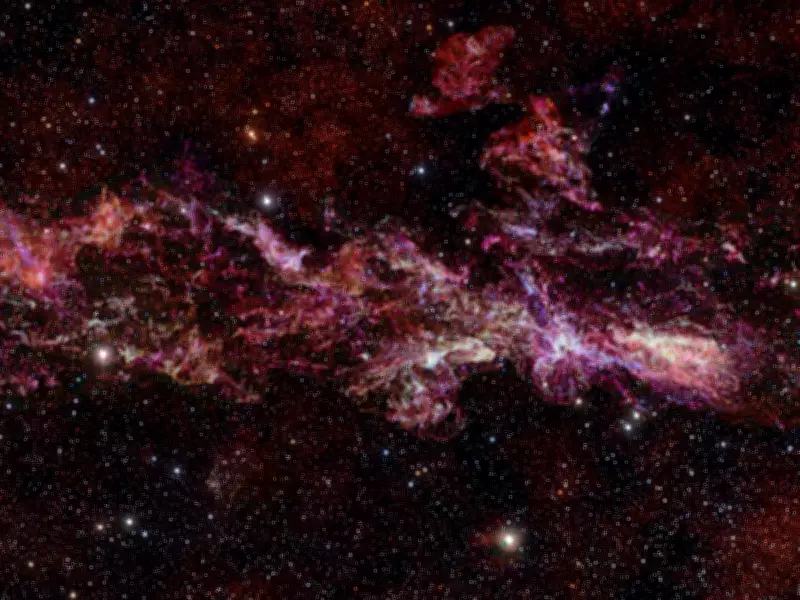
In a groundbreaking scientific achievement, researchers have unveiled a stunningly detailed image of the Milky Way galaxy, offering unprecedented insights into its central region. The image, obtained using the Atacama Large Millimeter/submillimeter Array (Alma) radio telescope in Chile, represents the largest ever captured by this specialist instrument, marking both an aesthetic and scientific breakthrough.
Unveiling the Galactic Core
The new image focuses on the Central Molecular Zone (CMZ) of the Milky Way, showcasing the complex distribution of molecular gas with remarkable clarity. This region, at the heart of our galaxy, is of immense interest to astrophysicists due to its extreme conditions, which mirror those found in early universe galaxies. According to Steven Longmore, the principal investigator and a professor of astrophysics at Liverpool John Moores University, the project involved collaboration with over 160 scientists over several years under the Alma CMZ Exploration Survey.
From Snapshots to a Comprehensive Map
Prior to this latest capture, scientists could only observe small, isolated patches of the Milky Way's center, limiting their understanding of the broader galactic structure. Longmore likened this to having a few snapshots of individual streets without a map of the entire city. The new image, however, reveals long, thin filaments of matter flowing to form stars and planets, a discovery that was unexpected and provides crucial connections between gas clouds and star-forming processes.

Longmore emphasized the dual significance of the image, stating, "The conditions at the center of our galaxy are very similar to those in galaxies in the early universe, when most of the stars that exist today were being formed. While we cannot observe individual stars and planets forming in those distant galaxies, we can in the center of our galaxy, and that's what our survey has been able to do."
Aesthetic and Scientific Harmony
Beyond its scientific value, Longmore appreciates the image on an aesthetic level, noting that the beauty captured by the eye also imprints the underlying physics of interest. He remarked, "I think that's cool to me as a scientist and someone who also likes pretty pictures." This blend of visual appeal and empirical data underscores the image's importance in engaging the public imagination about outer space while advancing our understanding of planetary origins.
Future Explorations and Challenges
The research team now aims to build on this discovery by combining observations from different wavelengths using instruments like the James Webb Space Telescope or the Extremely Large Telescope, currently under construction in Chile. By creating color images where each hue represents different physical information, scientists hope to pinpoint cause-and-effect relationships, such as how collisions between gas clouds trigger star formation.
However, securing observation time on the Webb telescope poses a significant challenge, as Longmore noted it is "so oversubscribed that your chances are pretty small." Despite this, the team remains optimistic about future breakthroughs in mapping the galaxy's secrets.
This image not only serves as a testament to technological advancement but also opens new avenues for exploring the fundamental processes that shape our universe, from star formation to the dynamics of galactic cores.