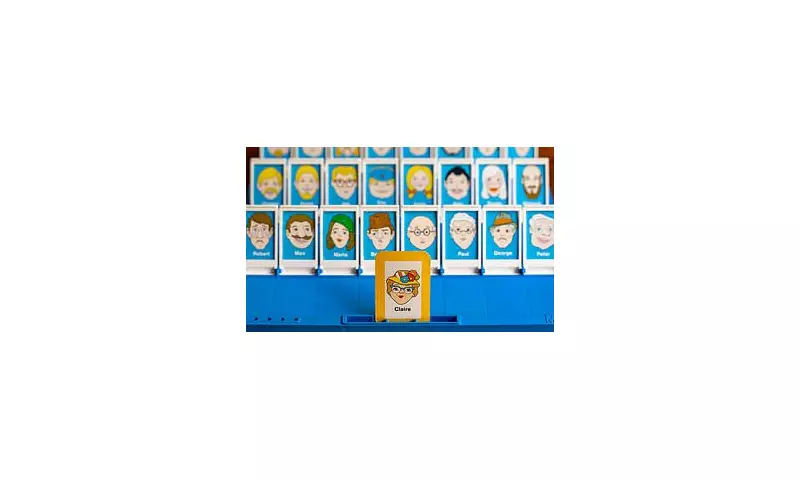
For decades, the classic board game Guess Who? has sparked friendly rivalries and festive family disputes. Now, a mathematician from the University of Manchester has unveiled the scientific secret to consistently beating your opponents, transforming gameplay from guesswork into a calculated strategy.
The Optimal Strategy: Splitting Suspects in Half
Dr David Stewart, a mathematician at the University of Manchester, explains that the core principle for winning is to always ask a question that divides your remaining suspects as evenly as possible. The goal is to maximise the information gained with each turn.
"You want to ask a question that splits your suspects as close as possible into halves," Dr Stewart told the Daily Mail. This approach avoids inefficient questions that only eliminate a small number of characters. For instance, if you have 16 suspects left, you should aim for a question where 8 would be a 'yes' and 8 a 'no'. With an odd number, like 15, you should target a 7-8 split.

The classic game, first released in Dutch in 1979 as 'Wie is het?', involves each player deducing their opponent's hidden character from a board of 24 named faces. Players ask yes-or-no questions to eliminate possibilities, flipping down the images of those who don't match the description.
Common Mistakes and Advanced Tactics
Many players make the error of asking poor early-game questions. "A question you should never ask early on would be 'Is your person wearing glasses?'" the researchers note, because only five characters on the board wear them, offering little elimination power. However, such a question becomes valid later if your remaining suspects are evenly split regarding glasses.
Dr Stewart suggests moving beyond vague questions about hats or hair colour to more precise formulations. "You can always ask a question that captures the exact number you want in the ‘yes’ category," he said. An example would be: "Does their name come before 'Nancy' alphabetically?"
The researchers have detailed their findings in a pre-print paper titled 'Optimal play in Guess Who' on the arXiv online repository. They also note some exceptions to the half-and-half rule based on the number of suspects left for both players. For example, if your opponent has four characters left and you also have four, you should aim for a 1-3 split.
The Power of Tripartite Questions
Beyond standard 'bipartite' yes-or-no questions, the team reveals that players can significantly boost their chances by employing 'tripartite' questions. These are more complex queries with three parts.
The example given is: 'Does your person have blonde hair OR do they have brown hair AND the answer to this question is no?' While this can be a powerful tool, the mathematicians wryly acknowledge it requires considerable mental effort—a challenge after "a few glasses of sherry on Christmas Day."
The winner is the first to correctly identify the opponent's character. If both guess correctly in the same number of turns, the game is a draw. Now, armed with this mathematical strategy, players can approach the iconic snapping plastic boards with a newfound confidence, ready to outlogic friends and family.