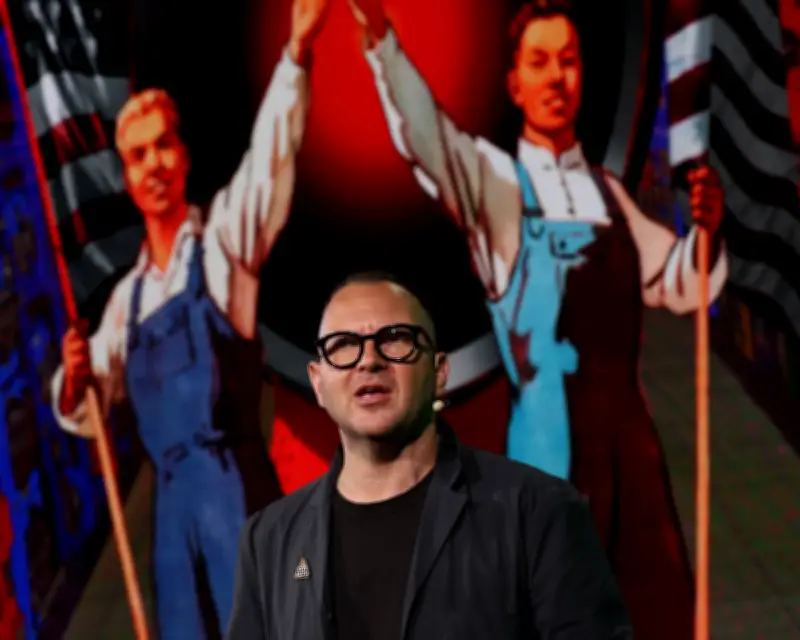
Cory Doctorow's latest polemic, The Reverse Centaur's Guide to Life After AI, delivers a vivid and entertaining takedown of the economics behind the AI revolution. The book argues that public hostility toward AI stems not from the technology itself but from the rapacious business models of tech giants.
Popular backlash against AI grows
Doctorow points to recent incidents, such as former Google CEO Eric Schmidt being booed by students at the University of Arizona during a commencement address, as evidence of a growing anti-AI sentiment. According to a New York Times column, “AI populism is here. And no one is ready.” Polls show that most US voters oppose new datacentres and believe AI will negatively impact jobs, creativity, and relationships.
Since OpenAI released ChatGPT in November 2022, AI's public image has shifted from existential threat to immediate nuisance: job crusher, fact mangler, slop maker, privacy invader, and climate trasher. Doctorow explains why this technology has been rammed down the public's throat with such speed and disregard for opinion.
The reverse centaur metaphor
Doctorow introduces the concept of a “reverse centaur”: someone whose freedom is diminished by a machine, as opposed to a centaur who is assisted by one. In radiology, for example, a human radiologist working with AI could produce more accurate results, but that costs money. In the reverse centaur model, the AI demotes humans to drones who check results, increasing error rates. “The most important thing about the gadget isn't what it does, it's who it does it for and who it does it to,” Doctorow writes, citing a science fiction trope.
Capitalism, not technology, is the problem
Doctorow argues that the AI backlash is fundamentally anti-capitalist, not anti-tech. He uses a 19th-century socialist framework: bosses will avoid paying workers more unless workers unionise. The AI industry's colossal valuation—Morgan Stanley predicts it will add almost a trillion dollars a year to the S&P 500—derives largely from the salaries of the human workers it aims to replace. Tech bosses, whose net worth is tied to stock value, have a personal incentive to keep investors excited, even if AI is a money pit today.
Doctorow despises “inevitabilism,” the doctrine that there is no alternative to adopting new technology. He cites Eric Schmidt's advice: “[If] someone offers you a seat on the rocket ship, you do not ask which seat, you just get on.” Doctorow counters that technology is shaped by choices, not inevitability, and booing is the least response such ultimatums deserve.
AI as a hype machine
Doctorow suggests the industry deliberately juices outrage over AI-generated art as hype: if people are scared, the promise of replacing human labour seems real. He targets the revenue model and the bubble it has created: “To be an effective AI critic, you need to strike at the source of AI's power, which is the investment capital it attracts.” Two studies found that 90% of people are less likely to use a product advertised as AI-enabled, and 95% of generative AI pilot schemes fail. Many companies have rehired employees replaced by chatbots. For Gen Z, AI has a favourability rating of minus 44, according to an NBC poll.
Doctorow notes, “The tech platforms are desperate to convince Wall Street that you love AI, which is very different from convincing you that you love AI.” However, seven big tech companies account for one-third of the US stock market's value, so a bubble burst could cause an economic shock comparable to 2008 or 2020.
The Reverse Centaur's Guide to Life After AI: How to Think About Artificial Intelligence Before It's Too Late is published by Verso (£16.99).