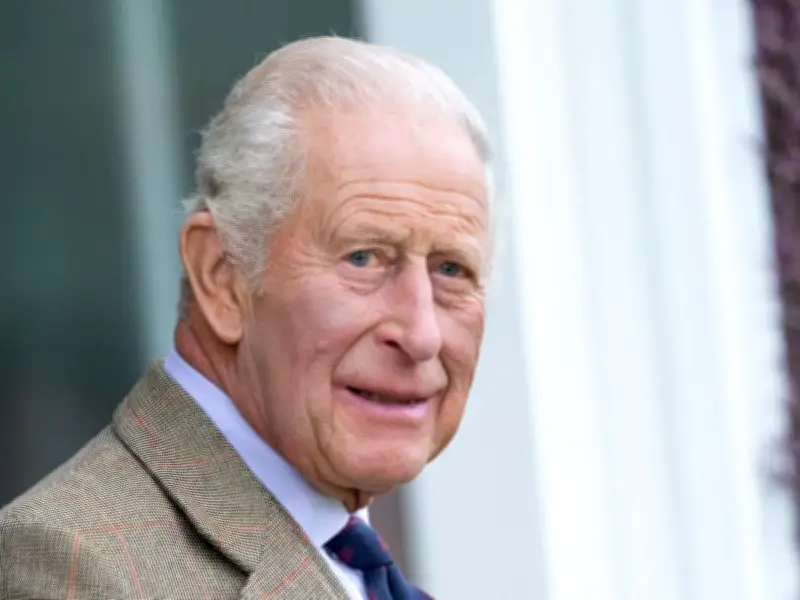
King Charles will this week ask leaders of the world’s most powerful AI firms to use the technology “for the good of humanity”.
Charles is due to host a summit with leaders from Anthropic, Nvidia, Google DeepMind and OpenAI at Dumfries House, Scotland, where he will encourage them to reach a consensus on a “shared set of principles”.
The importance of his plea was underlined when the boss of AI giant Anthropic called for development of the technology to be slowed.

Anthropic chief warns of rapid AI advances
In an open letter, Dario Amodei said AI had been “advancing drastically faster” since the summer and could be capable of taking over the “entire internet” and “potentially causing hundreds of billions of dollars in damage” in the next six to 12 months.
Amodei, who co-founded Anthropic with his sister Daniela in 2021, said: “Left unchecked, it could outrun our ability to understand and control these systems, and so must be pursued very carefully, if at all.”
Charles, 77, who has never owned a mobile phone, is understood to have taken a keen interest in AI’s development and the risks it posed.
Summit aims for shared principles
A source said he hopes the summit would encourage tech leaders to consider “the responsibilities of developing this technology, as well as the opportunities”.
It is understood delegates will include Jensen Huang, Nvidia's founder and chief executive; Sir Demis Hassabis, the founder and chairman of Google DeepMind; Niccolo de Masi, the chair and chief executive of IonQ; and Paolo Benanti, an adviser to the Vatican on AI.
A royal source told the Sunday Times: “The King is there to convene, listen and encourage those discussions and to pose the question of: ‘How do we develop AI for the good of humanity?’
“As we've seen him do on issues like the environment and water scarcity, he is hoping to provide a neutral space to aid conversations that are part of a national and global issue on something that is going to impact all of us.
“He hopes the discussions bring about a wider understanding of the responsibilities of developing this technology, as well as the opportunities, ensuring any technological development remains centred around human benefit for communities.
“He wants to ask the question: ‘Would it be helpful to have a set of principles?’ His feeling is it is not an easy thing to do, but that doesn't mean we shouldn't try.”
Charles's opening remarks are expected to “encourage collaborative, open discussion from all, and pose the question of whether guiding principles could help positive progress in this pace, on a topic that will in some way impact us all”.
Government and charity involvement
The King's aides have consulted the government on the summit, which will be attended by Kanishka Narayan, the AI minister.
The event at Dumfries House, which is headquarters of The King's Foundation, will be overseen by the Ditchley Foundation, which has drawn up the draft charter for AI leaders.
The charter is understood to include a “shared set of principles” that, if agreed, would “help guide the future application of AI, not merely as a driver of capability and efficiency, but as a tool that upholds human dignity and contributes to the flourishing of both people and the planet”.
Charles has also asked for “side discussions” to take place between AI leaders and representatives from his charities including The King's Trust, formerly The Prince's Trust, the Sustainable Markets Initiative and The King's Foundation, to explore the impact AI will have on young people, business, the environment and the developing world.
Last year, Charles awarded the Queen Elizabeth Prize for Engineering to Huang, the founder of Nvidia – the world's most valuable company with a market cap of $5.29 trillion (£3.9 trillion) – alongside six other AI pioneers.
Experts raise concerns about AI risks
Last week, AI experts aired their fears that the technology was advancing so rapidly, it could “kill all humans” within the next decade.
Evan Hubinger, a senior safety researcher at Anthropic, said on X: “We really do earnestly believe AI could kill all humans! I personally think it is >10% within the next decade.”

On Thursday, Anthropic, one of the world's largest AI companies valued at nearly £1 trillion, revealed that it had caught external researchers trying to use its technology to model harmful viruses that could be used as potential biological weapons.
Hubinger's remarks were in response to another post on X from Jacob Coxon, an AI researcher who resigned from Anthropic on Tuesday, and had worked at OpenAI.
He posted: “Neither company is acting responsibly. They are racing straight to self-improving superintelligence and gambling with our lives.
“Do not underestimate the power of this technology. These will soon be superhuman systems that can hack anything, revolutionize any field overnight, and acquire real power and resources.”
Coxon told the BBC: “I believe that if we don't slow down at the current rate of progress, there is a strong chance that we could all die in the immediate future.”
Shadow Foreign Secretary Tom Tugendhat said government “does not have the speed to keep up with” AI advances and “we need to maintain that ability to protect ourselves”.
He told Sky News: “It does sometimes feel like you're watching somebody loading a machine gun and then warning you that the machine gun's dangerous.
“The reality is there are real dangers with AI and controls on things like bio-weapons or on the development of new forms of nuclear threat are things that the AI services are aware of.
“But we saw recently with the Hugging Face attack the various different ways in which breakout capabilities have been enabled.”
Mr Tugendhat added: “The speed of change is also extraordinary, and this is where actually government can enable a conversation, but we simply do not have the speed to keep up with the advances that are happening.
“And the reality is, we can't pass laws against mathematics. These are mathematical equations that are being developed in greater and greater speed, and we need to maintain that ability to protect ourselves.”