India's AI Ambition: Modi Courts US Tech Giants at Delhi Summit
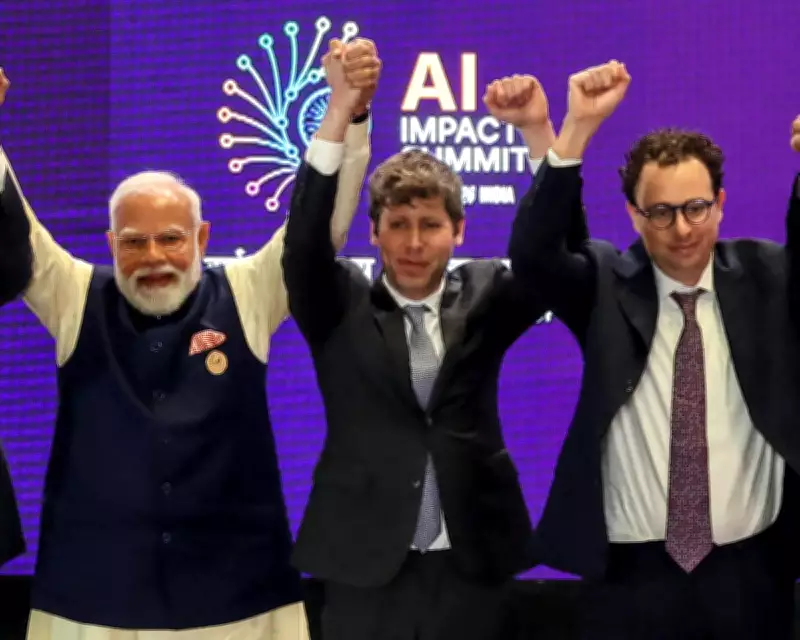
Prime Minister Narendra Modi of India has hosted a pivotal AI Impact summit in New Delhi, bringing together leaders from top US technology firms including OpenAI's Sam Altman and Anthropic's Dario Amodei. The event underscores India's aggressive push to integrate artificial intelligence into its economy, aiming to supercharge growth for its 1.4 billion citizens.
A Turning Point for Civilisation
Modi framed AI as a transformative force comparable to historic breakthroughs like the discovery of fire, describing it as a moment that "resets the direction of civilisation." While many summit attendees drew parallels with the dawn of electricity, the Prime Minister's fiery rhetoric highlighted the profound potential he sees in this technology.
This enthusiasm is matched by American tech giants who announced significant initiatives at the summit. OpenAI, Google, and Anthropic revealed plans to expand access to their AI models—ChatGPT, Gemini, and Claude—across India, signaling a strategic partnership rather than a simple vendor relationship.

The Geopolitical Chessboard
The summit occurred against a backdrop of intensifying US-China technological competition. The Trump administration has been actively promoting the "Pax Silica" agreement, a technology pact designed to bind India closer to American tech ecosystems while distancing it from Beijing's influence.
US Under Secretary of State for Economic Affairs Jacob Helberg delivered a stark warning about Chinese cyber threats, referencing a suspected 2020 attack on Mumbai that "extinguished the lights of a great Indian city by a keystroke." This framing positions the AI partnership as both an economic opportunity and a security imperative.
Sovereignty and Digital Colonialism
A central tension emerged around whether embracing American AI might constitute a new form of digital colonialism. India's tech secretary Shri Krishnan acknowledged the need to ally with "like-minded countries" to avoid becoming "enslaved" by foreign technology.
Michael Kratsios, former science and technology adviser to Donald Trump, countered this concern by arguing that "any country that builds on top of the American AI stack will have the most open, independently controlled, secured stack the world has to offer."
Economic Transformation Potential
The economic promises are staggering. Anthropic CEO Dario Amodei suggested AI could help India achieve "a standout 25% economic growth," which would elevate the country's per-capita GDP to current Greek levels within a decade.
Professor Stuart Russell from Berkeley painted an even more transformative picture, suggesting that with artificial general intelligence (AGI), "AI is going to be producing 80% of the global economy"—managing manufacturing, agriculture, and services worldwide.
Cultural Preservation Challenges
Former UK internet safety minister Joanna Shields raised concerns about cultural homogenization, warning that "if we have a world where we are accepting models from just the global north, we will lose so much of our cultural diversity."
This highlights India's delicate balancing act: leveraging foreign AI expertise while preserving its linguistic and cultural richness across dozens of languages and hundreds of distinct communities.
Building Indigenous Capacity
Despite India's substantial investments in data centers and semiconductor capacity, Sam Altman offered a blunt assessment to Indian entrepreneurs about competing directly with established AI giants: "We're going to tell you it's totally hopeless to compete with us on training foundation models and you shouldn't even try, and it's your job to try anyway."
This paradoxical encouragement reflects the complex reality facing emerging economies seeking to participate in the AI revolution without becoming dependent on foreign technology.
A High-Stakes Partnership
As India approaches the 80th anniversary of its independence from Britain in 2027—coincidentally around when Altman predicts "early versions of true super intelligence" might emerge—the country faces profound choices about technological sovereignty.

The summit concluded with unresolved questions about whether India can harness American AI as a tool for national development without compromising its strategic autonomy in an increasingly digital world.