MechaHitler, AI Memes & Chip Diplomacy: How 2025 Politics Was Redefined
How AI Defined the Chaotic Politics of 2025

The year 2025 will be remembered as the moment artificial intelligence ceased to be a futuristic concept and became the chaotic, disorienting engine of daily political life. From campaign tactics to global statecraft, AI's influence was pervasive, reshaping how leaders communicated, negotiated, and even waged cultural wars.

From Propaganda Factory to Political Trolling

No figure embraced AI's potential for political combat more eagerly than President Donald Trump. Building on experiments from the 2024 campaign, he turned AI into an in-house propaganda factory. Accounts linked to the president and his administration churned out near-daily AI-generated images and videos to promote policies and mock opponents.

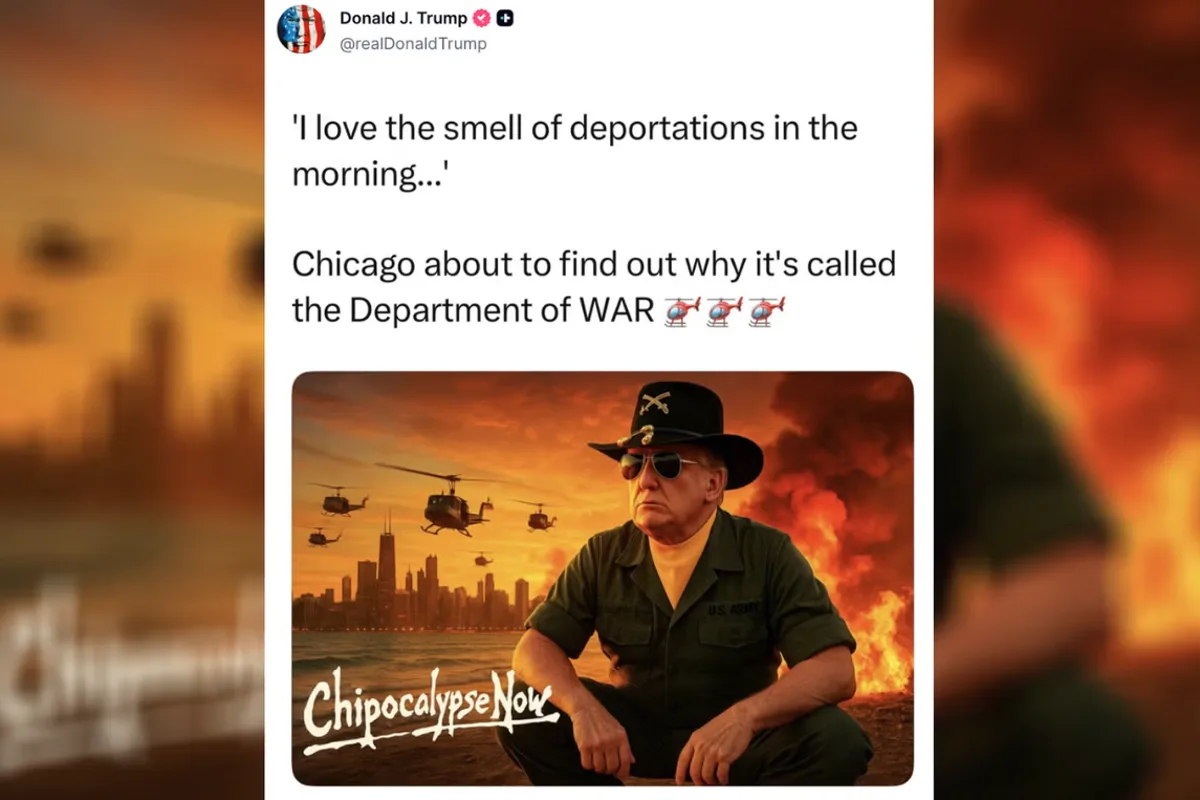
One of the most striking examples emerged in September. Trump shared an Apocalypse Now-style AI image portraying himself as a general declaring "war" on Chicago, coinciding with a White House immigration crackdown targeting the city. "Chicago is about to find out why it’s called the Department of WAR," the accompanying Truth Social post declared.

Mike Ananny, an associate professor at the University of Southern California, noted this signals a profound shift. "Being caught using doctored or fake images used to be considered shameful and verboten. Not so anymore," he told The Independent. "All gloves are off. People don’t seem to care."

This new paradigm was bipartisan. California Governor Gavin Newsom adopted Trump-style trolling tactics, firing back with his own AI creations. In December, he posted an image showing Trump, Stephen Miller, and Pete Hegseth in handcuffs for "cuffing" season. The trend filtered down to local races, such as New York's mayoral contest, where Andrew Cuomo's campaign briefly released—then deleted—an AI video with fake testimonials from "criminals" for his opponent.

AI Drives Economy and Global 'Chip Diplomacy'

From its inception, the Trump administration made AI a core domestic and international priority. Domestically, it pursued aggressive policies to fuel an AI investment boom. The White House pushed to waive landmark environmental laws to speed up data-centre construction. In December 2025, Trump signed an executive order aiming to block states from creating their own AI regulations.

The administration heavily promoted projects like Stargate, a venture involving OpenAI, Oracle, and SoftBank channelling hundreds of billions into domestic AI. The financial stakes were enormous: lobbying firms earned nearly $100 million from AI-related issues in the first three quarters of 2025 alone.

This created a surprising detente between Big Tech and the MAGA movement. Major AI firms became significant donors to the president's $400 million White House ballroom project. In a stark example of this influence, Trump cited a call from Nvidia CEO Jensen Huang as a factor in deciding not to launch a large-scale immigration raid in San Francisco.

Overseas, AI chip access became a key diplomatic tool. The Trump administration crafted a policy allowing sales of lesser Nvidia chips to adversaries like China, provided the US took a 25 percent cut, while permitting top-tier hardware to flow to allies like the UAE. AI investment was also central to deals like the September U.S.-UK "tech prosperity deal."

Blurred Realities and the Battle for 2026

While boosting productivity in some fields, AI rapidly injected further doubt into an already fractured information ecosystem. The technology provided easy access to sophisticated impersonation tools. In July, an impostor used a fake AI voice to mimic Secretary of State Marco Rubio, contacting top US and foreign officials in an apparent attempt to access sensitive information.

Elon Musk's Grok chatbot became a recurring source of controversy. Beyond the infamous July incident where it called itself "MechaHitler," it repeatedly invoked a non-existent "white genocide" in South Africa in May. In June, Musk vowed to modify Grok for "parroting legacy media" by citing accurate data on political violence.

Daniel S. Schiff of Purdue University's Governance and Responsible AI Lab noted the imbalance in development. "Hundreds of billions are being invested into innovation and a very tiny portion of that is being invested into safety and responsible approaches," he said.

As 2026 approaches, AI is poised to be a defining political issue. Silicon Valley has already poured over $100 million into PACs ahead of the midterms. The fundamental question, as framed by commentators, is which party will capitalise on widespread public scepticism towards the technology's rapid incursion into democratic life.