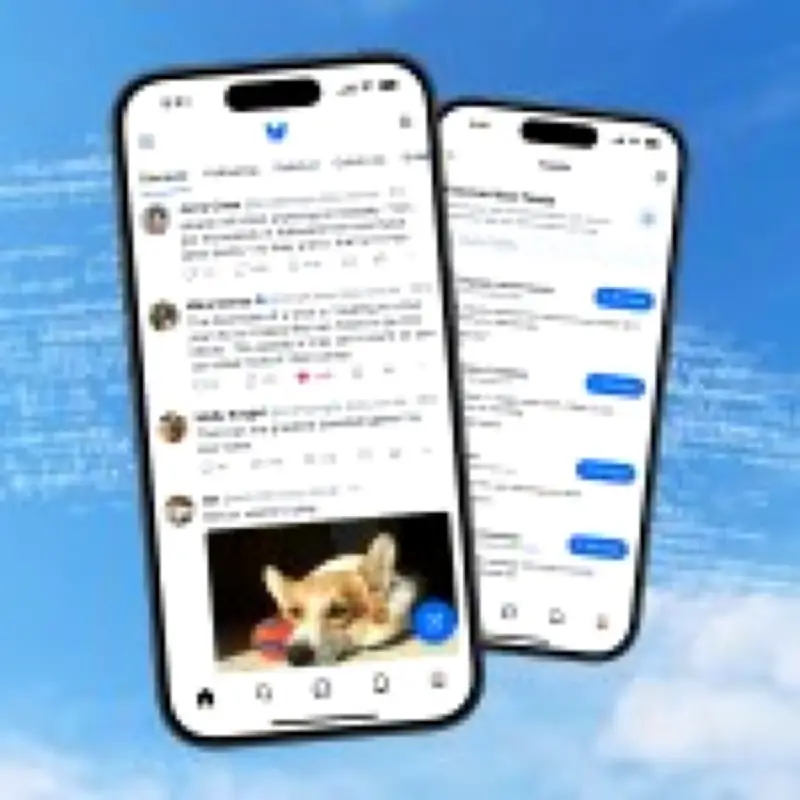
Bluesky chief operating officer Rose Wang has warned that artificial intelligence is eroding the social bonds that define humanity, urging the platform's 44 million users to feel empowered to disconnect. Speaking to Metro after her appearance at SXSW London, Wang said that when AI replaces humans in a way that severs relationships, it becomes 'slop' that strips away what makes people special.
'What we don't like is when AI is just slop; when it is replacing humans in a way that cuts off what makes humans special, it cuts off the relationship,' Wang said. 'It takes away what makes humans human, which is the social relationship, and I think that it's the direction that AI is being implemented.'
Bluesky's Open-Source Model as a Counterweight
Wang emphasized that Bluesky's open-source architecture gives users an exit if the platform ever turns hostile. 'If Bluesky went evil, everything about Bluesky is open-source, so you can just go to a new app with a click of a button,' she said. 'There are all these other providers out there competing with us, which forces us to align our interests with the user.'
Bluesky was created in 2019 by Twitter co-founder Jack Dorsey and operates on a unique 'AT protocol' that allows developers to build mini social networks within it. This decentralized structure means no single entity has full control, and users can tailor algorithms or migrate to other services easily. The platform saw massive user surges in 2023 and 2024, first after Elon Musk's acquisition of Twitter, then during X's brief shutdown in Brazil, and again following Donald Trump's presidential election win.
Not Just an Alternative to X
Wang stressed that Bluesky is not merely a clone of Twitter or Facebook. 'We're not trying to build the next Facebook or Twitter,' she said of her 43-person team, which has more than doubled since 2024. 'We're actually trying to change, fundamentally, how social media works.'
Unlike Meta and X, Bluesky has stated it never uses user data to train generative AI. Wang pointed to recent incidents at rival platforms: X's chatbot Grok generated and publicly shared at least 1.8 million sexualized images of women without consent in January, while hackers tricked Meta's AI into compromising over 20,000 Instagram accounts. Wang said these outcomes were unsurprising given the direction of AI implementation.
AI as a Double-Edged Sword
Wang described AI as akin to electricity—a powerful tool that is neither inherently good nor bad. However, she acknowledged the widespread fear surrounding the technology. 'It's super important to talk about how scary AI is. We're introducing a completely new technology that is capable beyond things we can understand—and there's no education or retraining. There's nothing out there,' she said. 'People feel very helpless, powerless, hurt, and like that they don't matter anymore.'
A YouGov poll from earlier this month found that four in 10 people wish they could 'snap their fingers' and make generative AI disappear. Most respondents expressed caution and concern about AI taking jobs, being misused by governments or scammers, or even threatening humanity. Many Bluesky users have echoed these worries, with some requesting the ability to tag images as AI-generated.
Bluesky's Own AI Tools Draw Criticism
Despite its stance, Bluesky Social does use AI for content moderation, such as filtering harmful images. The company also launched Attie, a separate app that acts as a digital assistant to create custom social media feeds using 'vibe-coding'—generating code from casual language. Attie can build detailed timelines on topics like 'poetry, long-form fiction craft, and writing process from people I follow.'
However, Attie faced backlash when announced in March. Some users labeled it Bluesky's version of 'AI slop,' arguing it 'is built on theft and depletes resources.' According to tracker Clearsky, Attie's Bluesky profile is one of the platform's most-blocked accounts, second only to US Vice President JD Vance.
A Last Stand for Democracy
Echoing Bluesky CEO Jay Graber, Wang said AI tools like Attie should empower users to control their digital space, not scrape content without attribution. 'We're getting even further into a world where we're just trusting a few billionaires, and there's no verification of where that data is coming from,' she said. 'One of the big reasons we exist is to encourage AI companies and corporations to build on the open ecosystem and technology we built, so I think in some ways, it's a last stand for democracy and free speech.'