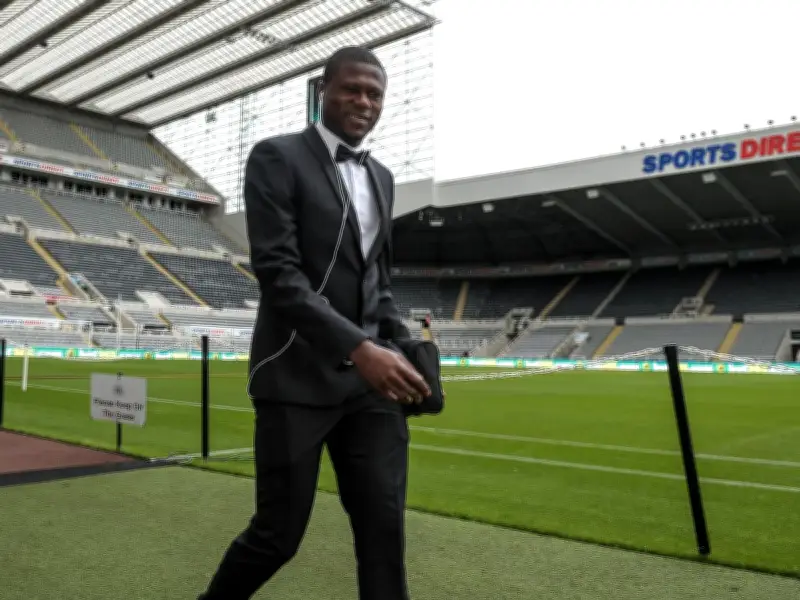
When Premier League fans see the name Chancel Mbemba, their first memory might be something to do with the tuxedo he wore when arriving for his first Newcastle United appearance at St James' Park. More than a decade on, though, the centre-back has developed into one of the most important players in the Democratic Republic of Congo national team as the African nation reached a first World Cup in more than half a century.
“I have seen that picture, pretending I'm James Bond, but that wasn't the reason why I did it,” Mbemba, who joined Newcastle a fortnight before his 21st birthday, told Mirror Football in 2015. “I did it because the manager said, 'Look sharp on match days' — so I did!”
Even at that tender age, Mbemba showed maturity, sending 10 per cent of his earnings back home to help those in need of medical treatment. He was still a rising star back then but is now one of the elder statesmen of his national team and their most-capped player with more than a century of appearances.
The Democratic Republic of Congo was known as Zaire the last time the country qualified for a World Cup, losing all three group games in 1974. Since then, the national team has turned to diaspora talents - Newcastle striker Yoane Wissa and Sunderland midfielder Noah Sadiki were born in France and Belgium respectively - but having a Congolese-born player wearing the armband has been its own help.
“Chancel is the symbol, let's say, of the Congo national team,” former Congolese international and Mbemba's brother-in-law Paul-Jose M'Poku said. “He's coming from Congo and he was born there, [then] he went to Europe and succeeded in Europe and has now succeeded with his national team.
“He's a symbol for all the Congolese who were born in Congo and he can show hope to them that if Chancel made it, why can't we? And I think he's so aware of it also, so that's what's good about him.”
M'Poku, who spent time on Tottenham's books as a youngster and joined Baller League in 2026 after a nomadic professional career, was on the bench when DRC lost a play-off against Morocco to miss out on qualification for the 2022 World Cup. Given the success of their opponents at the tournament proper - Morocco reached the semi-finals in Qatar - there's certainly no shame in that loss, but there was still a fair amount of pain after also narrowly missing out in 2018.
A number of members of that 2022 squad will travel to North America this summer, where DRC have been drawn in a group with Portugal, Uzbekistan and Colombia. They got there the hard way, finishing two points behind Senegal in their qualifying group before getting past Cameroon, Nigeria and finally Jamaica in a series of gruelling play-off matches.
Burnley defender Axel Tuanzebe scored the extra-time winner against Jamaica. He is one of a handful of players to declare for the country of his birth after playing youth football for another nation, in his case England, and M'Poku believes Mbemba's captaincy style has helped others settle into the team while making the skipper himself a respected figure.
“Obviously he's a captain but there is that different type of captain or leader and he's a leader who loves to show himself on the pitch,” M'Poku added. “He always has done it everywhere he's been and yeah, everyone is proud of him as a Congolese.”
Tom Williams, author of Va-Va-Voom: The Modern History of French Football, agrees that Mbemba's distinctive style has helped him earn the respect of the younger squad members. On a more personal level, though, he suggests this also helped the defender through a tough spell at Marseille when he went a full year without making a first team appearance.
The defender helped Newcastle bounce back to the Premier League after relegation in 2016 but was never a regular starter under Rafa Benitez and left for Porto in 2018. He fared much better under Sergio Conceicao, though, earning a move to Marseille where he made the Ligue 1 team of the year in his very first season as L'OM finished third under Igor Tudor.
Changes in the dugout didn't help, though, with three different managers at Stade Velodrome in the 2023/24 season. Roberto De Zerbi arrived in the following close-season and essentially froze Mbemba out, but he continued to put in the hard yards in training and with the reserve team before ultimately getting another shot at Ligue 1 football with current club Lille.
“He's described as being someone who doesn't talk a great deal, is a kind of a leader by example,” Williams said. “Tudor called him the silent leader of the changing room, so he's not someone who makes a huge amount of noise, even when things aren't going well.
“He's also a very devout Christian and every time he's kind of asked about what might happen to him and what the future might have in store and particularly during this season, whether he might be able to leave in January, his response would invariably be, 'God decides. God has a plan for me, and when the time is right, God will let me know.'”
There was reported interest from Saudi Arabia during that 2024/25 season but Mbemba stayed in the south of France and kept himself in top shape to help his national team. He would go on to play every minute of World Cup qualifying, scoring a crucial winner in Cameroon and converting the decisive penalty in a shoot-out win over Nigeria.
“On the pitch he's a real warrior but day to day he's quite placid,” Williams added. “I think because he's so sort of pious, he's so devout, he just thinks, 'Well, look, I'm in a situation that I didn't ask for but I'm not going to complain about it. I'm just going to carry on working and then we'll see what happens.'
“A lot of the feedback from people who worked with him last season was very positive. Jean-Pierre Papin, the former OM striker, coached OM's reserves last season so worked with Mbemba a lot. He said the guy was an absolute joy to work with. He was always on time, super professional, a great example for younger players and didn't cause any problems.”
Mbemba has been in and out of the Lille side this season but has been trusted for some of the bigger games, including Europa League knockout ties against Red Star Belgrade and Aston Villa. He also has the chance to go into the World Cup on a high, with Bruno Genesio's team still in with a chance of Champions League qualification.
The road to North America has been a long one, with M'Poku speaking of the work that has been done to professionalise the national team. Those efforts have been rewarded, and this will be more clear than ever when they kick off their opening group game against Portugal on June 17.
Mbemba will lead his countrymen out onto the pitch in Houston and he will do so as the only Congolese player with 100 senior international caps to his name. “I think he's seen as the big brother by an awful lot of the younger players in that DR Congo squad, and the fact that he is DR Congo born, I think perhaps gives him extra authority in their eyes,” Williams said.
“There are an awful lot of France-born players who play for DR Congo and I think having a player like Mbemba as a reference point has been very helpful for them and helpful for the team as well, in being a kind of beacon for younger players to look up to and to aspire to emulate.
“It's something I tend to be quite conscious of, following Ligue 1 and then looking at these players who play for African countries at international level. I think people probably underestimate what a complete living legend, someone like Mbemba is in DRC, and so you can completely see how younger players would look up to him.
“The issue of dual nationality is something that causes an awful lot of handwringing in French football but I think when you have an example like Mbemba, who's played for big European clubs, who's achieved great things with this national team, it probably makes making the decision to play for DRC or another African country, perhaps slightly easier to come to because there is that greater visibility.”
When Zaire (as they were then known) took part in the 1974 World Cup, every single member of the squad played their club football in their home country. When they took on Jamaica in their inter-continental play-off, 12 different leagues were represented in the squad - but the Congolese top flight wasn't one of them.
That's partly a sign of how football as a whole has become more international, with all 48 World Cup teams expected to have representatives from a variety of leagues. Certainly, it's far from the first thing on the minds of a Congolese public celebrating a landmark achievement which is the first of its kind for more than a generation.
“Obviously it took time but now it's a proud moment, not only for the national team, but for all the country,” M'Poku added. “To be able to play at the World Cup is a dream for every person so yeah, we are so proud as the Congolese.
“Everyone's been speaking about [the last time they qualified]. Even some of our parents, those people who were there. We always spoke about how they were there, and now we will speak about how in 2026 we were there, we made it also, after 52 years - it was crazy.”