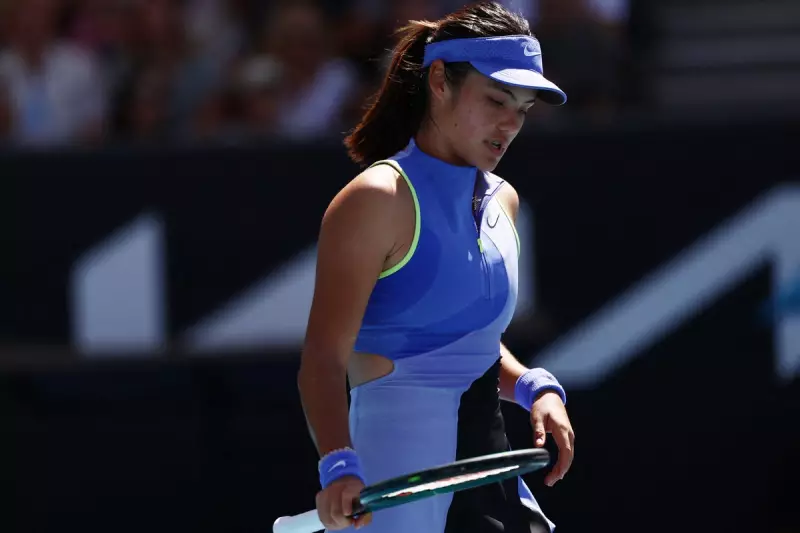
Emma Raducanu's premature exit from the Australian Open has prompted a stark admission from the British number one, who now acknowledges she must fundamentally 're-evaluate' her approach to the game. The 23-year-old's second-round defeat to world number 55 Anastasia Potapova in Melbourne has laid bare a deeper crisis of confidence and identity on the court, stemming from years of instability in her coaching setup.
A Stark Admission After Early Exit
Raducanu's straight-sets loss to Potapova, 7-6 (7-3) 6-2, was compounded by her frank post-match assessment. "I need to just work on playing in a way more similar to how I was playing when I was younger," she confessed, highlighting a significant departure from the aggressive, early-strike tennis that catapulted her to US Open glory as an 18-year-old qualifier in 2021. This victory, while historic, established what Raducanu herself recognises as an extremely unfair level of expectation for a player still in the formative stages of her professional career.
The Coaching Carousel Conundrum
The past four-and-a-half years have been characterised by a revolving door of coaches following her shock grand slam breakthrough. "I think there are just many iterations that are going on and have gone on," Raducanu noted, alluding to the constant changes that have prevented the development of a consistent game plan. Her most recent partnership with Francisco Roig, a seasoned coach from Rafael Nadal's camp, appeared to offer stability. However, her flat and subdued performance against Potapova, with minimal communication from her coaching box, suggested this alignment remains fragile.

Raducanu identified a critical 'misalignment' between her current style of play and her desired approach. "I think I want to be playing a different way, and I think the misalignment with how I'm playing right now and how I want to be playing is something that I just want to work on," she stated, hinting that further coaching changes could be imminent as she seeks to rediscover her authentic tennis identity.
Technical Troubles and Physical Setbacks
The match statistics revealed troubling technical deficiencies, particularly with Raducanu's once-devastating forehand. This shot, her primary weapon during her US Open triumph, contributed 16 of her 28 unforced errors against Potapova. Raducanu has expressed dissatisfaction with recent modifications to her forehand swing, describing a bigger, higher motion that takes more time as "not something that I really wanted to happen." Restoring confidence in this key stroke has now become a higher priority than addressing the foot injury that hampered her pre-season preparation.
That foot problem limited Raducanu to static drills before travelling to Australia, disrupting her off-season at a crucial developmental phase. "Making it to the start line in Melbourne, let alone playing five matches so far this season, was pretty surprising," she admitted. Entering a major tournament underprepared and carrying an injury that was not at 100 per cent, combined with tricky swirling wind conditions in Melbourne, created a perfect storm of adversity.
Searching for Consistency in Flashes of Brilliance
Despite the disappointment, Raducanu found glimmers of hope in sporadic moments where her preferred style emerged. "I think there are definitely pockets of me playing how I want to play, and it comes out in flashes, which is a positive," she reflected. The challenge now is transforming those fleeting instances into the consistent, dominant identity she craves every time she steps onto the court.
This early Australian Open exit represents a significant setback following a positive 2025 season where Raducanu returned to the world's top 30 and secured a seeding at a major for the first time in three years. Last season's grand slam defeats came against elite opponents like Aryna Sabalenka, Iga Swiatek, and Elena Rybakina. In Melbourne, she faced the prospect of a third-round clash with top seed Sabalenka, but failed to progress even that far.

Raducanu's journey now appears to be circling back to its origins. "I always just changed direction, took the ball early, and went for it," she recalled of her younger self. In many ways, the solution she seeks involves winding back the clock, stripping away the accumulated technical variations, and returning to the fearless, instinctive tennis that once made her the most unexpected grand slam champion in history. The path forward requires not just physical rehabilitation, but a profound psychological and technical reset to reclaim the identity that has somehow been lost along the way.