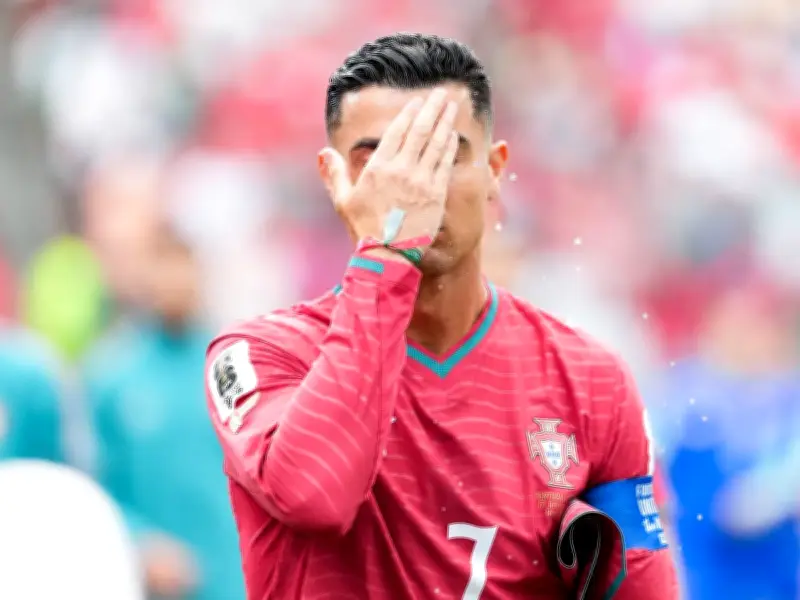
Portugal's World Cup performance in their opening game against DR Congo only confirmed what many Selecao fans feared. It was a display lacking identity, reaction and the leadership required at a tournament of this magnitude.
And the uncomfortable truth is this - the biggest issue Portugal face right now is Cristiano Ronaldo.
In truth, escaping with a 1-1 draw - Congo's first ever World Cup point - may have been the better outcome, as it could easily have been worse. Even so, a national team of Portugal's stature cannot afford to take these games for granted.
They cannot simply assume the opposition are beaten before a ball is kicked, and this match exposed their inability to read what was unfolding on the pitch and their lack of in-game awareness. For many, the questions began the moment Roberto Martinez named his squad: an unusually high number of goalkeepers, an obvious imbalance between full-backs and centre-backs, and the absence of players with specific profiles needed to decide key moments.
Rodrigo Mora, Mateus Fernandes, Pedro Goncalves, Joao Palhinha and Ricardo Horta are just some of the players who could have helped push this team forward with goals. Despite strong seasons with their clubs, they ultimately missed out - and the lingering question now is how much that decision will also weigh on Portugal's World Cup campaign.
Of course, we should not forget that Portugal built much of their success over the years thanks to Ronaldo, and it is only natural that a player as driven as he is wants to be there, help his nation and play a meaningful role in what is set to be his final World Cup. That is understood.
But the reality is he is no longer capable of offering what this team needs at this level. Portugal's squad has an average age of 28, packed with players at the peak of their careers - and that is why the team cannot keep bending its entire structure just to accommodate Ronaldo at 41.
Yes, it is clear to see the players idolise Ronaldo - the 'King' of the sport, the face of a generation - and that is visible on the pitch. When they are chasing a goal, he is still the one they instinctively look for, the one singled out for the final pass.
And that, ultimately, is costing them. When the Selecao searched for a winner against Congo, Bruno Fernandes' reaction said it all when Ronaldo snatched a cross he should have left - with the Manchester United captain perfectly placed behind him.
With Champions League winners such as Joao Neves, Vitinha, Goncalo Ramos and Nuno Mendes, plus a generation thriving across Europe, Portugal simply no longer needs to lean on the one player who defined their past. He is, without question, the greatest footballer Portugal has ever produced and one of the most influential figures the sport has ever seen.
He delivered titles, broke records and gave the country moments that will live forever. But at 41, he is no longer the force he was five or ten years ago - and yes, it hurts to watch an era slowly fade. Portugal knows this. The entire country does.
We are grateful for everything he has given - immeasurable contributions - but gratitude cannot dictate selection. It is time to let others step forward, to allow the next generation to shape the team's future rather than remain stuck in the past.
That sentiment is increasingly shared among the Portuguese public and the press.
"The issue we have is that he will only leave when he wants to. He is the one that decides this and knowing his personality... that is where the problem lies," one Portuguese user wrote on social media.
"We have a manager who is not brave enough to put CR7 on the bench and that limits our game. Everyone knows this even those who understand little about football. Ronaldo can still help this team but he will not make a difference than other players who can offer more," another added.
A third demanded: "To build a team, it is not just one old player and ten others conditioned by him. Please, Martinez. Wake up," while another pointed out: "Ronaldo is preventing Goncalo Ramos from being a starter, even though he is a much faster player, and when combined with Vitinha and others, the style of play will simply be different. We have more speed and more depth."
Portuguese channel SIC's commentator Ricardo Lemos delivered a stark breakdown of why 'CR7' is now at the centre of Portugal's problems.
"It is very difficult for a player who has been competing at the highest level for 23 or 24 years to have the self-awareness to admit when the moment has arrived to step aside," he said. "Who has the courage to take Ronaldo out of the national team? It is important to understand a player's physical level, their mental state, and for the player himself to recognise whether he is still capable of helping the team in the way he has for so many years. At 41, it is impossible to maintain the same strength and the same capabilities. In the player's mind, he believes he still can - but then his body does not respond, and it no longer follows the same guidelines."
At the centre of it all is Martinez, who has become the face of the criticism for the decisions he continues to stand by. Justifying his decision to keep Ronaldo on the pitch and replace Vitinha with Ramos, the Spaniard said: "It does not make sense to take off a striker when you need goals. For us, in moments like this, Cristiano's experience in the box is important. The way he draws defenders in is important, the way we can use space is important. And every player has a specific responsibility or quality on the pitch. And clearly, when you are looking for goals, you need to count on Cristiano."
Meanwhile, the captain himself believes that 'nothing' was missing from the match against Congo. The Al Nassr forward said: "What was missing? Nothing - this is football. Portugal could have won but could also have lost. It could have gone either way."
Those explanations only reinforce the wider issue: Portugal are still shaping their game around a version of Ronaldo that simply does not exist anymore. Experience in the box sounds good in theory, but not when it sidelines players who offer far more mobility, intensity and end product.
All eyes will now turn to Portugal's second match against Uzbekistan on Tuesday, June 23 - a fixture that will show whether the warnings have been heeded or whether the same mistakes are about to be repeated. It is a must-win game, especially with Colombia - their final group opponent - already off the mark with a victory. Another draw would plunge Portugal into real trouble and intensify the scrutiny on every decision being made. At that point, the pressure would shift from concern to crisis, and the questions would no longer be polite ones.