Hunter Hess' Olympic Protest Marred by Embarrassing Gesture and Poor Performance
Team USA freestyle skier Hunter Hess found himself at the centre of controversy and mockery during the Winter Olympics in Milan-Cortina, after an anti-Trump protest gesture backfired in spectacular fashion. The athlete, who had previously criticised the Trump administration, attempted to make a statement during his halfpipe event by holding an 'L' sign to his forehead - only for spectators to notice he was holding it backwards.
The Backwards 'L' That Divided Opinion
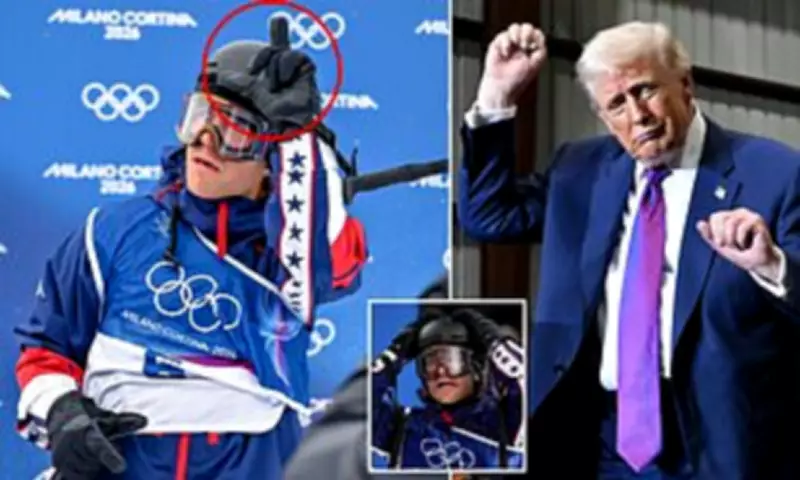
As photographers captured Hess during his freestyle halfpipe qualification, the skier made the deliberate gesture of forming an 'L' with his thumb and index finger and placing it against his forehead. This symbolic act was intended as a response to former President Donald Trump labelling him a 'real loser' two weeks earlier, after Hess expressed 'mixed emotions' about representing the United States.
However, eagle-eyed viewers quickly spotted that Hess' 'L' was facing the wrong direction. The revelation sparked immediate debate among fans and commentators, with many questioning whether this was a simple mistake or a deliberate artistic choice.

"Apparently the genius doesn't know that the letter 'L' faces the other direction," remarked one Daily Mail reader in the comments section. Another added sarcastically: "He can't even get his L the right way round!"
Some observers offered a more charitable interpretation, suggesting the backwards 'L' might have been intentional - symbolising that Hess was calling himself the loser rather than directing the insult outward. Regardless of intent, the gesture became a focal point of discussion that overshadowed his athletic performance.
Disappointing Performance Compounds Controversy
The symbolic mishap was followed by competitive disappointment for Hess in the halfpipe final. The American skier struggled throughout his three runs, eventually finishing 10th out of 11 competitors - a result that many critics saw as poetic justice given the preceding controversy.
His first run earned a low score of just 27.25 after poor execution led to a bobbled landing and fall in the snow. The second attempt brought no improvement, with Hess falling again and completely losing his right ski during the descent. His final run scored 58.75 points, securing his second-to-last position in the event.
"I worked so hard to be here. I sacrificed my entire life to make this moment happen," Hess told reporters afterwards. "I'm not going to let controversy like that get in my way. I love the United States of America. I cannot say that enough."
Political Backstory and Social Media Reaction
The controversy began two weeks prior when Hess admitted to having 'mixed emotions' about representing his country, stating that "just because I'm wearing the flag doesn't mean I represent everything that's going on in the US." This prompted an immediate response from Donald Trump on his TruthSocial platform.
"U.S. Olympic Skier, Hunter Hess, a real Loser, says he doesn't represent his Country in the current Winter Olympics," Trump wrote. "If that's the case, he shouldn't have tried out for the Team, and it's too bad he's on it. Very hard to root for someone like this. MAKE AMERICA GREAT AGAIN!"
Hess later described the period as "probably the hardest two weeks of my life," acknowledging the intense scrutiny and criticism he faced. Despite this, he insisted he didn't regret his original comments and was grateful for family support during the challenging time.
Social media reactions to his Olympic performance were largely unsympathetic. "Ooooh my, Hunter Hess couldn't even get a score over 60. HAHAHA KARMA BABY .. Now find another country if the USA isn't for you. Go Woke Go Broke," wrote one user on X.
Another commenter noted: "If you're gonna get political as an athlete, you need to bring the goods. Hunter Hess did not, placing 10th in his only event." A third simply stated: "Hunter Hess dead last bruh. Another trash liberal."

Broader Context and Aftermath
While Hess struggled, another American skier achieved success in the same event. Alex Ferreira claimed the gold medal, standing on the top step of the podium that had eluded his teammate. The contrast between their performances and receptions highlighted how political statements by athletes can dramatically affect public perception and legacy.
Hess reflected on the experience, telling reporters: "It was pretty distracting. I had a week that was pretty challenging. Luckily my family was there to support me and help me get through it. There was a lot of noise and I've never been subject to that type of criticism."
He added: "But with my family's help, I was able to get through it. And skiing has saved my life, time and time again, and it seems to have done so again." Despite the disappointing competitive result and public mockery, Hess maintained his commitment to both his sport and his right to express personal views.
The incident serves as a case study in how political expression intersects with elite sports, particularly in the highly visible arena of the Olympic Games. Hess' backwards 'L' gesture - whether accidental or intentional - became an enduring symbol of an Olympic campaign defined by controversy as much as athletic achievement.