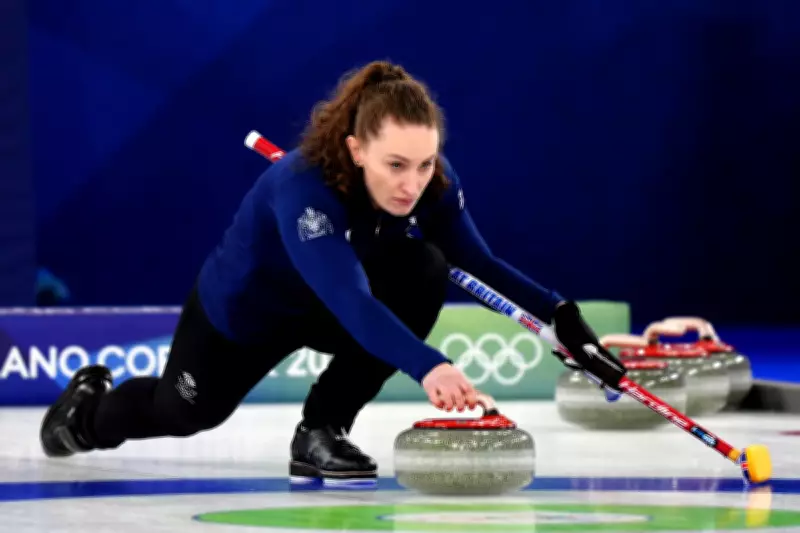
Curling enthusiasts will have daily viewing opportunities throughout the Milano-Cortina Winter Olympics, with the mixed doubles competition commencing two days prior to the Opening Ceremony and concluding alongside the traditional men's and women's medal matches. This format provides a continuous stream of strategic ice action for fans.
Mixed Doubles: A Distinct Olympic Discipline
The mixed doubles event differs significantly from the classic four-person team format. In the traditional game, each team delivers eight stones per end. In contrast, mixed doubles involves only five stones per end, with a unique rotational throwing order. One athlete bookends each end by delivering both the first and the final stone, adding a layer of individual pressure and tactical nuance.
Strategic Starting Positions and Scoring Potential
Every end in mixed doubles begins with a pre-placed stone for each team already positioned on the sheet. This setup creates immediate strategic complexity and dramatically increases the potential for high scores. In fact, it is theoretically possible to score a maximum of six points in a single end, making aggressive play a viable and often rewarding option.

The Power Play: A Game-Changing Tactic
This is where the power play becomes a pivotal tool. During a standard end, the pre-placed stones are arranged centrally. The team with the last-stone advantage (the hammer) typically starts with a stone positioned at the back of the four-foot circle. Their opponents begin with a centre guard stone.
However, when a team calls its power play, the pre-placed stones are moved to a side configuration. One stone is placed as a corner guard near the side of the sheet, with a second stone positioned directly behind it, its back edge touching the tee line.
Executing the Power Play
This strategic repositioning fundamentally alters the geometry of the end. By moving stones to the wing, it clears the central portion of the playing sheet. This opens up significant space for aggressive draws, takeouts, and complex scoring setups that are harder to achieve from the conventional centre-line start.
Crucially, each team is permitted to use the power play only once per game. This limitation forces captains to choose their moment wisely, often saving it for a critical end where maximizing score potential is paramount. The decision of when to deploy this option adds a profound layer of strategic depth and gamesmanship to every match.
British Medal Hopes in Milano-Cortina
Great Britain enters the Games with strong medal aspirations in curling. The Scottish duo of Bruce Mouat and Jennifer Dodds, who triumphed at the 2021 World Championships on home ice, are among the favourites. They will be eager to improve upon a frustrating fourth-place finish at the Beijing 2022 Winter Olympics and return to the podium in Italy.
The mixed doubles competition promises fast-paced, tactical battles where the judicious use of the power play could be the difference between victory and defeat. As the event unfolds from the very start of the Olympic programme, all eyes will be on the ice to see which teams can master this unique and game-changing rule.