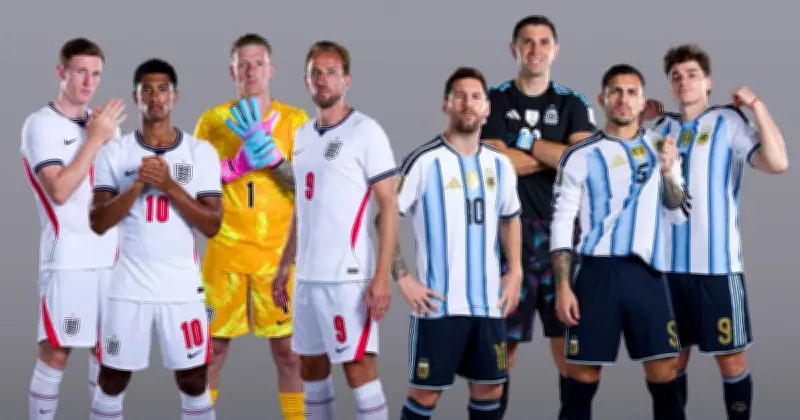
Argentina and England will face off in the 2026 World Cup semi-final on Wednesday, with the winner advancing to the final in Los Angeles. Few international football fixtures carry the same emotional weight as this clash. While both nations have produced some of the sport's greatest players and matches, their rivalry extends beyond football, shaped by decades of political tension, conflict and unforgettable World Cup clashes.
That backdrop will add extra intensity when Argentina and England meet in Wednesday's World Cup semi-final in Atlanta, with a place in the 2026 final hanging in the balance. While focus will naturally be on events on the pitch, there are also worries amongst US law enforcement about possible supporter clashes at the fixture. Reports surfaced this week that the FBI has classified the match as 'highest risk' owing to security concerns.
1966 Red Card Chaos
The roots of the rivalry stretch back to the 1966 World Cup quarter-final at Wembley. England prevailed 1-0 courtesy of Geoff Hurst's strike, but the fixture became infamous after Argentina captain Antonio Rattín was dismissed for dissent by German referee Rudolf Kreitlein. Rattín refused to depart the pitch for several minutes, maintaining he had committed no offence.
Following the fixture, England manager Alf Ramsey labelled the Argentines 'animals' and ordered his players not to exchange shirts with their opponents, remarks that sparked fury in Argentina and helped establish a rivalry that has persisted for six decades.
Falklands War
Tensions in the political landscape grew considerably more fraught in 1982 with the onset of the Falklands War, a bitter dispute between the United Kingdom and Argentina over the Falkland Islands, known in Argentina as the Islas Malvinas. The conflict lasted 74 days before Argentina finally surrendered, having launched an invasion of the British Overseas Territories. The total death toll stood at 907 people, made up of 649 Argentine military personnel and 255 British lives lost.
Hand of God
Four years on came what many regard as the most iconic World Cup clash in the history of the game. Argentina defeated England 2-1 in the quarterfinals of the 1986 World Cup in Mexico, thanks to two extraordinary Diego Maradona goals scored within a four-minute spell. The first goal, immortalised as the 'Hand of God,' saw Maradona unlawfully punch the ball past England goalkeeper Peter Shilton before officials controversially allowed the score to stand. He later described it as 'a little with the head of Maradona and a little with the hand of God.'
Maradona then picked up the ball deep inside his own half, ghosted past five England defenders and rounded Shilton before finishing what FIFA would ultimately crown the 'Goal of the Century.' Argentina went on to lift the World Cup, while the quarterfinal cemented its place as one of football's most defining matches.
David Beckham Sees Red
The rivalry has continued to produce memorable moments in later tournaments. At the 1998 World Cup, England midfielder David Beckham was sent off following retaliation against Diego Simeone. Argentina went on to prevail in a penalty shootout, with Beckham vilified as a national scapegoat upon his return to England. Four years on, England gained a measure of revenge when Beckham converted the winning penalty in a 1-0 group-stage victory at the 2002 World Cup.
2026 World Cup
Now, a fresh chapter looks set to be written. Lionel Messi's Argentina have progressed to the semifinal after victories over Cape Verde, Egypt and Switzerland, while Jude Bellingham has driven England past DR Congo, Mexico and Norway. The tournament has already been overshadowed by controversy, with Argentina players and fans heard chanting against their English rivals, while violent confrontations broke out between supporters at the competition.