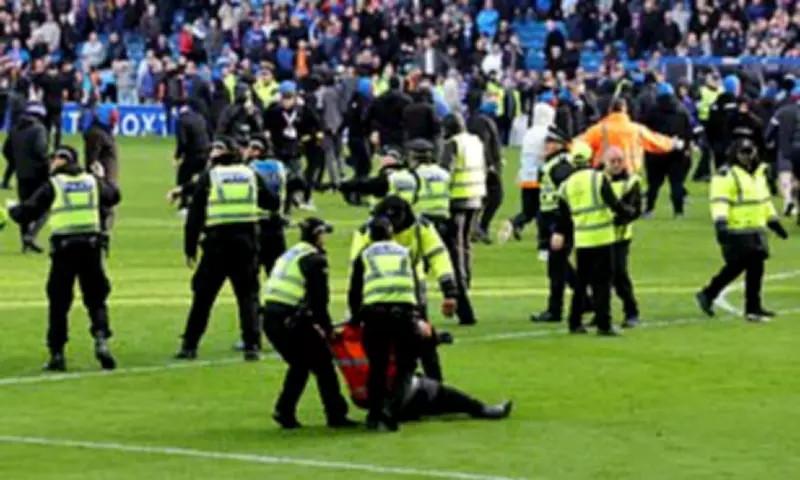
Police Chiefs Demand Crackdown After Old Firm Pitch Invasion Chaos
Scotland's police chiefs have held urgent talks with Rangers bosses to demand a crackdown on football hooliganism following the shocking disorder that marred the recent Old Firm clash. Chief Constable Jo Farrell and Assistant Chief Constable Alan Waddell met with Rangers chief executive Jim Gillespie in the aftermath of the violent scenes on March 8.
Ugly Scenes at Ibrox Stadium
The Scottish Cup quarter-final, which saw Celtic triumph on penalties, was overshadowed by disgraceful incidents that began when dozens of visiting Celtic fans spilled onto the pitch at Ibrox Stadium. Scores of Rangers supporters reacted by also invading the field, advancing over the halfway line towards a police cordon.
At least one fan was injured as missiles and flares were thrown in what Police Scotland described as 'despicable' scenes. The Scottish Football Association has since announced it will oversee a full review of the game's shameful finale.

Police Authority Meeting Reveals Concerns
At a public board meeting of the Scottish Police Authority in Glasgow, Chief Constable Farrell emphasized that while police have a strong track record of supporting sporting events, ultimate responsibility for safety within grounds lies with clubs and football authorities.
'We have had productive discussions across all the partners involved in football,' Farrell stated. 'There will be a debrief in relation to events on March 8 and we are keen to progress that. We have made an offer to meet with representatives of both clubs and myself and Alan met with Rangers on Tuesday, with the chief executive. That was a productive meeting and we hope to follow that with an equivalent meeting at Celtic.'
Farrell made it clear that her priority is ensuring necessary changes are implemented to prevent a repeat of the March 8 violence, noting that most football fans are decent people who want to enjoy the game peacefully.
Policing Burden and Resource Challenges
Assistant Chief Constable Waddell revealed that policing football matches represents a significant burden on resources, with almost 20,000 rest days cancelled annually to cover such events. This directly impacts the force's ability to address other threats and risks across Scotland.
'This is not an issue that will be resolved by significantly increasing the resources at football,' Waddell explained. 'This is about the environment that football clubs and the football authorities create to make sure fans and supporters know what's acceptable within football grounds.'
Waddell acknowledged that the level of policing at the last Old Firm game was the highest this season but indicated the force is looking to reduce officer deployments at events where risk is perceived to be lower.
Officer Numbers and Operational Impact
David Kennedy, general secretary of the Scottish Police Federation, highlighted how reduced policing levels across Scotland have created operational challenges. The force had 17,170 full-time officers nationwide in 2018 but this has dropped to 16,416 in 2026.
'At football games in the past, there used to be a lot of police officers present,' Kennedy told The Herald. 'Over the last ten to 15 years, they've been trying to reduce the number of officers and that is one of the main issues. There probably weren't enough cops in the ground on March 8.'
Kennedy explained that historically, nearly double the required officers were deployed at matches, creating a reserve capacity that no longer exists. This has led to a shift in policing tactics, with officers increasingly instructed to avoid arrests and let clubs handle minor incidents internally.
Both Rangers and Celtic were contacted for comment regarding the ongoing discussions about improving stadium safety and fan behavior.