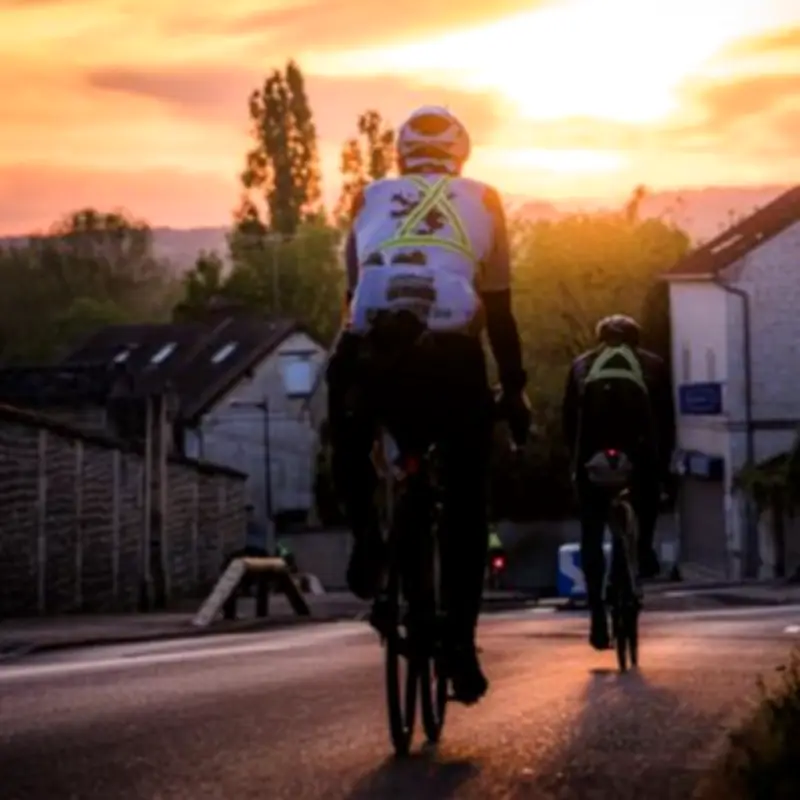
Just over one week before the Tour de France rolls out of Barcelona, ready to tackle its annual loop of the country, another race across France will conclude. But instead of elite riders backed by teams of coaches, mechanics and nutritionists, it will be ordinary cyclists rolling into Mandelieu on the shimmering Cote d'Azur after completing the challenge of a lifetime.
A platform for self-discovery
“It’s much more than a cycling competition,” Arnaud Manzanini, founder of the Race Across Series, told Daily Star Sport. “It's a platform that allows people to discover new landscapes, new countries and their own limits.”
The Race Across Series hosts events across the globe and is designed to make ultra-distance cycling accessible to as many people as possible, offering courses ranging from 200km to 2,500km, some of which span countries.
“At the beginning, my goal wasn't simply to organise races,” Arnaud continued. “I didn't come from a sports marketing or events background. I just had an idea and wanted to see where it could go.”
Before launching the Race Across Series, Arnaud had raced in ultra-events himself, an experience he says taught him “resilience, humility and self-discovery.” That journey ultimately inspired him to create something for others. An ultra-distance race isn’t about times or positions: it’s simply getting to the finish. “You prove to yourself that you can overcome difficulties and push beyond what you thought were your limits,” Arnaud said.
The French challenge
The French series will see amateurs roll out of Hendaye in the Basque Country on June 18 as they take in the sights and heights of Orleans, Albertville, and the legendary Mont Ventoux en route to the Cote d'Azur. Riders face a staggering 2,500km route and 28,600 metres of climbing before reaching the finish line.
France is just one of eight events in the Race Across calendar. Seven are held across Europe, while another takes place in Quebec, that take place throughout the year.
Riders will pedal over mountains, through the night and pass checkpoints as they wind through France. “Sleeping outdoors and managing your equipment is all part of ultra-distance cycling,” Arnaud said.
Support and safety
To help riders cope with the demands of the challenge, organisers provide life bases every 400km-600km where competitors can stop and recover. “Riders are never required to stop, but they must pass through the life bases.” At these checkpoints, exhausted cyclists have access to showers, food, toilets and camping facilities. But often, Arnaud says, the human connection is just as important. “Sometimes all they need is someone to ask, 'How are you? Are you okay? Do you need anything?' Volunteers become part of the rider's story.”
Once competitors return to the road, organisers continue to keep a close eye on their progress. “The goal is to allow riders to focus on riding while we focus on monitoring the event,” he explained.
“We have a dedicated control centre that monitors every rider throughout the event. At least two people are constantly watching GPS tracking, schedules and safety information.” If a rider strays from the route, organisers can intervene quickly. And if a GPS tracker suddenly stops transmitting, they immediately investigate.
“We assess the location. If a rider is near a hotel, restaurant or known stopping point, it's usually not a concern. However, if the tracker stops in a remote location for an extended period, we immediately try to contact the rider. If we can't reach them, we can dispatch a dedicated support vehicle. We may also contact nearby riders and ask them to check on the situation.
“Our priority is always making sure the rider is safe. We don't want to wait for a serious accident before taking action. We want to prevent accidents before they happen.”
As part of that commitment to safety, Arnaud has also introduced mandatory sleep rules, with every rider required to clock up at least four hours of sleep every 36 hours. The Frenchman knows the dangers of fatigue firsthand. During the Race Across America, he became so exhausted that he would pull up at traffic lights and immediately fall asleep.
“If the rider doesn't comply with the sleep requirement, it's immediate disqualification,” he said. “There is no negotiation when it comes to safety.”
It’s not just at these stations where riders sleep; some may catch a quick kip on park benches. Arnaud encourages this, joking it’s better to make a decision after some sleep. “If you are struggling and thinking about quitting, stop, sleep for two hours and then reassess the situation. Very often, things look completely different after some rest.”
He continued, when asked about riders finishing: “The excitement of the start, the atmosphere and the adrenaline can make that difficult. But patience is the key. Every rider on the start line is capable of finishing.”