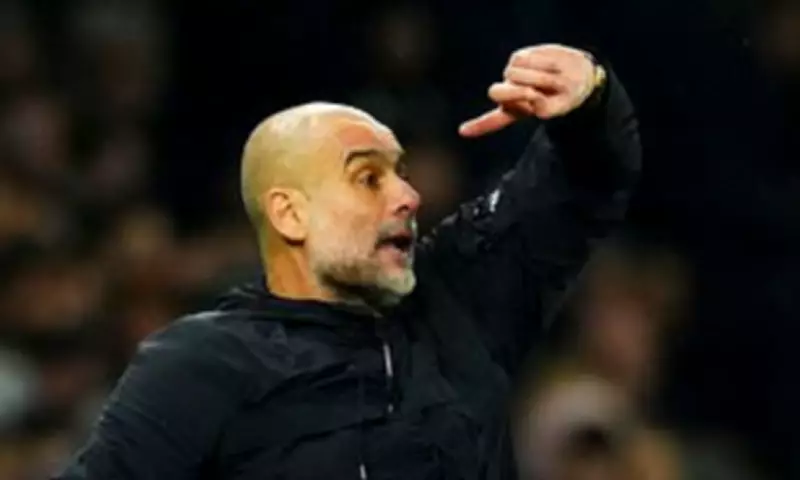
In a remarkable and emotionally charged press conference, Manchester City manager Pep Guardiola launched into an extensive monologue on pressing global humanitarian crises, just hours before his team's crucial Carabao Cup semi-final clash. The 55-year-old Catalan coach, known for his tactical genius, shifted focus from football to geopolitics, delivering pointed criticisms of international conflicts and US immigration enforcement.
Guardiola Condemns Global Conflicts and US Immigration Policies
Guardiola did not hold back in his assessment of world affairs, explicitly referencing the wars in Ukraine, Gaza, and Sudan. He expressed profound distress over what he described as a genocide in Palestine and widespread violence, stating, Never, ever in the history of humanity have we had the information in front of our eyes more clearly than now. The manager questioned the moral justification for such conflicts, asking, We kill each other, for what? For what? It is about a human being. Protecting human life is the only thing we have.
Particularly striking was his criticism of the Trump administration following the killings of Renee Good and Alex Pretti by ICE agents in Minneapolis. Guardiola drew a parallel to the UK, questioning, Imagine the NHS, five six people around him, go on the grass and 10 shots. Tell me how you can defend that? He emphasised the urgency of humanitarian rescue, regardless of political stance, saying, Don't ask if he is right or wrong, rescue him.

Controversial Symbolism and Club Connections
Guardiola's political activism has not been without controversy. Recently, he wore a keffiyeh scarf—a traditional headdress symbolising Palestinian resistance—during an emotional speech at a charity concert in Barcelona. This followed accusations from the Jewish Representative Council that his remarks on Gaza had put the lives of British Jews in danger, prompting a letter to City chairman Khaldoon Al Mubarak questioning why Guardiola had not condemned a terrorist attack on a local synagogue.
The connections run deeper within the club's hierarchy. Chairman Khaldoon Al Mubarak served as the United Arab Emirates' representative on Trump's newly formed Board of Peace at Davos last month, an organisation designed to resolve conflicts with significant US decision-making power. Al Mubarak was part of a delegation that visited the White House after Trump's inauguration. Meanwhile, protest groups have called on City's owner, UAE vice president Sheikh Mansour, to be held accountable for the conflict in Sudan, with demonstrations outside the Etihad Stadium. The Sudanese government has accused the UAE of being complicit in genocide, a claim the UAE strongly denies, though it has pledged $20 million in humanitarian aid to the region.
On-Pitch Struggles and Referee Controversies
Against this backdrop of global commentary, Guardiola's recent challenges in the Premier League seem almost trivial. Manchester City are six points behind leaders Arsenal after only one win in six matches. Guardiola made a sarcastic remark about the club's net spend, noting, I'm a little bit sad because in net spend the last five years we are seventh in the Premier League — I want to be the first, I don't understand why the club don't spend more money. He acknowledged that the perception of money driving City's success is unlikely to change, stating, No, never ever. Always we live with that. The numbers are the numbers and that is not going to change.
The team's on-field issues were compounded by a controversial 2-2 draw at Tottenham, where midfielder Rodri suggested officials were biased against City. Guardiola defended Rodri, attributing his comments to the heat of the moment, but refused to entertain conspiracy theories. I'm not suspicious, he said. Of course there aren't meetings between the referees about how they can punish Man City. I've never said that. However, he did express frustration over recent contentious decisions, including a goal by Dominic Solanke that City insist involved a foul on Marc Guehi—the fourth such incident in weeks.

A Call for Focus and Accountability
Despite the distractions, Guardiola urged his team to maintain focus. He reflected on past successes, attributing them to avoiding excuses, and emphasised personal accountability. Here we don't blame — it's on our shoulders. Here we have to do better, we have to find a way, he asserted. As Manchester City prepare for their Carabao Cup semi-final, Guardiola's words resonate beyond the pitch, highlighting a manager unafraid to confront the world's most pressing issues while navigating the pressures of elite football.