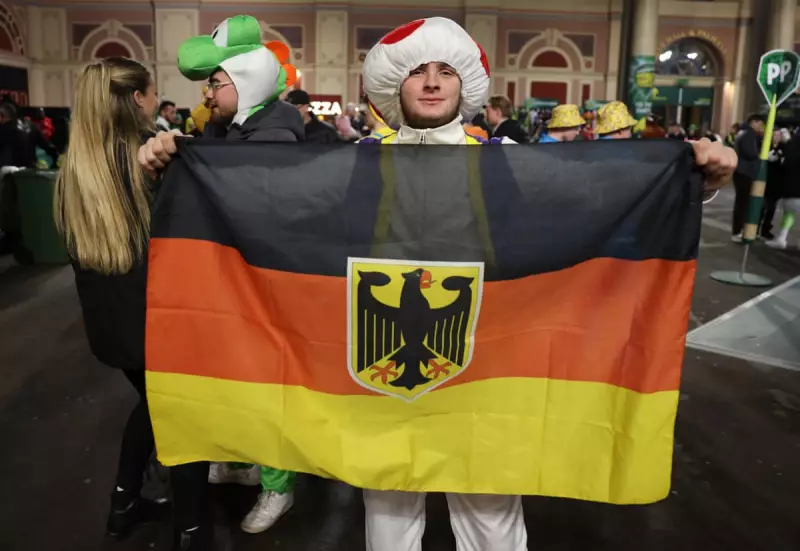
They have become an unmistakable presence at the iconic Alexandra Palace. They walk, sit, and sing among the British crowd, speaking perfect English and consuming pints of Amstel with the same gusto. Yet, to the seasoned observer, there is a distinct difference in their comportment and vibe, evident even in their choice of fancy dress: less ironic British pop culture references and more flag suits or woodland creatures. The Germans have arrived at the PDC World Darts Championship, and they are here in force.
The Scale of the German Invasion
What began as small, scattered groups has escalated into a full-scale incursion. A fleet of tour buses regularly deposits the latest wave of fans up the steps of 'Ally Pally'. Package excursions from Germany sell out months in advance. Around a quarter of all tickets for this year's world championship were sold in Germany, a figure that rises to a third for some sessions. This raises a compelling question: how did a nation without a world-class darts champion become so thoroughly hooked on the sport?
"I think the German public is quite similar to the British public, in terms of what entertains them," explains Philip Brzezinski, a commentator and MC for the PDC's European Tour. "They like good sport. They like a good night out." His colleague at Sport1, Katharina Kleinfeldt, points to a seasonal gap: "There's kind of a niche between Christmas and New Year's. In the UK you have Boxing Day football, but in Germany there's not that much going on. The Bundesliga isn't on."
The viewing figures are staggering. Three million viewers in Germany watched the 2025 world final between Michael van Gerwen and Luke Littler, matching the audience on Sky Sports in the UK. According to the German Olympic Sports Confederation, darts is officially the country's fastest-growing sport.
A Strategic Revolution Decades in the Making
This German darts revolution is no accident; it is a triumph of long-term vision and incremental investment. Before the 1970s, the sport barely registered beyond expat circles linked to the British military presence. Germany's first world championship entrant did not appear until 2005.
However, the foundations were being laid. The launch of the PDC European Tour in 2012 acknowledged both the need for expansion and the sport's grassroots growth in German pubs and social clubs. That same year, the World Cup of Darts moved to Hamburg, and later Frankfurt. Berlin was added to the Premier League roster in 2018. Today, the Euro Tour features 14 events, with Germany hosting seven of them.
This fervent fanbase has developed despite Germany's lack of a consistent top-tier champion. Gabriel Clemens's run to the 2023 semi-finals now appears an outlier. While players like Ricardo Pietreczko, Niko Springer, and Martin Schindler have won on the Euro Tour, they have struggled to replicate that success on the sport's biggest stages.
A (Mostly) Friendly Rivalry Boils Over
A significant hurdle for any rising German talent is the reaction from the English crowd. Debutant Arno Merk was greeted by jeers in his first match this year. Martin Schindler notes, "For a couple of years now, every time there's a walk-on I get booed." The rivalry took a darker turn in 2023 when Scott Williams, after beating Schindler, remarked that "we've won two world wars and one World Cup," a comment for which he later apologised.
Yet this dynamic is reciprocal. English stars now face equally partisan crowds in Germany. At this year's World Cup in Frankfurt, Luke Littler and Luke Humphries were mercilessly booed by the local crowd during their defeat to Schindler and Pietreczko. Littler was so frustrated by the barracking in Munich that he temporarily boycotted German events.
"Germany's good when you're not playing a German," says world No. 40 Callan Rydz. "I've played there a few times against Germans and it can be so hostile." The effect is tangible: despite his phenomenal success worldwide, Luke Littler has never won a PDC title in Germany.
Philip Brzezinski downplays the idea of a bitter feud, noting that players like Stephen Bunting and Phil Taylor have been warmly received. Perhaps the booing contains a performative, pantomime element—a raw expression of a symbiotic relationship between two remarkably similar darting cultures. What sounds like hostility on the surface may, in the raucous world of darts, be a peculiar form of flattery and engagement. The Germans have not just arrived; they have become an essential, vibrant part of the spectacle.