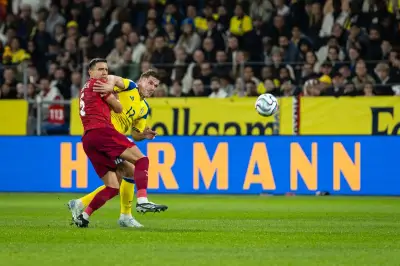
Celtic's European Decline Exposed in Stuttgart Defeat as Club Crisis Deepens
Celtic's European Decline Exposed in Stuttgart Defeat

Celtic's European Decline Exposed in Stuttgart Defeat as Club Crisis Deepens

As VfB Stuttgart's players celebrated with their jubilant supporters in the corner of Celtic Park moments after the final whistle, a familiar face was pressing the flesh in the heated seats. Andreas Hinkel, who played for Stuttgart in their 2003 UEFA Cup defeat to Martin O'Neill's Celtic and later signed for the Glasgow giants, watched with mixed emotions as his former club suffered a comprehensive 4-1 defeat.

Hinkel's obvious delight at seeing Stuttgart all but confirm their place in the Europa League last sixteen was tempered with genuine concern for Celtic, a club for which he still holds great affection. "What's happened to them?" he asked old friends in attendance. The question hung in the air as Celtic's current predicament became painfully clear.

A Stark Contrast to Recent European Campaigns

While the epic 2003 clash provided a natural reference point for this tie, it wasn't necessary to look back a generation to gauge Celtic's marked decline on the European stage. Last season, under Brendan Rodgers, the team dismantled RB Leipzig in the Champions League and progressed to the play-off round. While Bayern Munich ultimately proved too strong, Celtic performed valiantly across both legs, setting what appeared to be a new standard.

Wide Pickt banner — collaborative shopping lists app for Telegram, phone mockup with grocery list

Stuttgart are undoubtedly an accomplished side, but they are not as formidable as Leipzig or Bayern from last season. The reason Celtic fell to such a comprehensive defeat had more to do with their own regression than the quality of their opponents.

From Promise to Free-Fall

Since coming within seconds of taking their game against Bayern Munich to extra-time at the Allianz Arena, Celtic have gone into free-fall. Martin O'Neill has done commendable work in twice getting the side back into the Premiership title race and securing European progression, but the underlying issues cannot be ignored.

A struggling side has required stoppage-time goals in three successive domestic matches to achieve results. While the spirit O'Neill has instilled deserves praise, this current Celtic team are not a great side habitually pulling off heroic acts. They are an ordinary team riding their luck, albeit with a brilliant manager at the helm.

Thursday's Mauling Underscores the Problems

Thursday's defeat to a superior Stuttgart team underscored the point emphatically. Celtic created next to nothing throughout the match, were second best all over the park, and were fortunate not to suffer an even more humiliating scoreline of six or seven goals against them.

The only cause for celebration among home fans came when Benjamin Nygren capitalised on an error to score a consolation goal. The atmosphere from the outset was flat, with the early disruption of tennis balls thrown onto the pitch as part of a protest failing to help the home side establish momentum.

Boardroom Failures and Financial Implications

From a position of strength and promise during that night in Munich, Celtic's hierarchy have overseen a staggering nosedive. The board's failure to adequately support the football department in successive transfer windows led directly to elimination by Kairat Almaty in the Champions League qualifiers.

The financial implications of this ineptitude were manifest in recent interim financial results showing revenue dropping by 28.9 percent. Celtic's shortcomings extend beyond merely failing to source adequate replacements for departed players like Kyogo Furuhashi and Nicolas Kuhn.

Squad Management and Player Morale Issues

Squad management also encompasses knowing when players should be moved on, either due to contractual situations or advancing age. The club's hierarchy have seemed blinded to issues that everyone else can see clearly in the rear-view mirror.

This week, O'Neill insisted that Reo Hatate's poor recent performances should be attributed to a loss in form rather than a bad attitude. However, the midfielder hasn't been the same force since Celtic rejected Udinese's advances last summer. The same pattern has emerged with Daizen Maeda since he was denied a move to Wolfsburg.

Both players have been at Celtic for four years and would reasonably have expected to move to clubs in bigger leagues by now. Their declining performance levels should come as no surprise given these circumstances.

Pickt after-article banner — collaborative shopping lists app with family illustration

The Kasper Schmeichel Conundrum

The case of Kasper Schmeichel presents similar concerns. Ahead of turning forty, the Dane's next move will likely be retirement this summer. While he was a brilliant goalkeeper in his day and filled the void left by Joe Hart extremely well for a season, this campaign has evidently been one too many.

Schmeichel was culpable for two goals against Stuttgart, adding to a multitude of errors in other significant matches. Celtic characteristically hoped they would get away with keeping him in goal when all evidence pointed to the need to address the problem proactively.

While O'Neill's anger at fans booing the keeper was understandable, the unedifying spectacle was hardly incongruous with everything that had preceded it. Schmeichel has become emblematic of the penny-pinching, make-do-and-mend approach that permeates the entire club.

A Club Divided and Directionless

With the Green Brigade still banned, the famous Celtic Park atmosphere that served as such an advantage for O'Neill's great sides of the past has temporarily disappeared. Unless interim chairman Brian Wilson can broker a peace deal with various disaffected groups, the remainder of this season will be played out amid ongoing acrimony.

After a string of last-gasp heroics in domestic competition, the sobering defeat to Stuttgart served as a stark reminder of the bigger picture. Celtic, a club divided and directionless, finds itself in a dark place. The hierarchy bears sole responsibility for taking them there, having failed to fix the roof while the sun was shining, with the consequences now cascading through every aspect of the club.