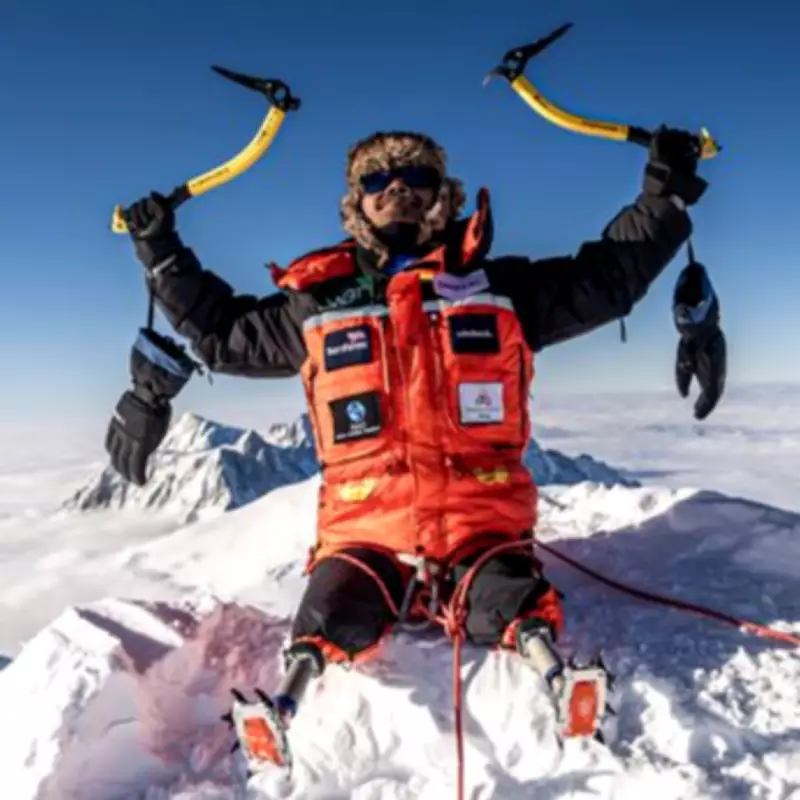
Fearless explorer Hari Budha Magar has revealed the heart-stopping moment his life was saved on Mount Everest when his guide selflessly gave him his own oxygen supply. The 46-year-old made history earlier this month by becoming the only double below-the-knee amputee to complete the legendary Seven Summits challenge.
The Ultimate Mountaineering Achievement
The Seven Summits challenge represents the world's most coveted mountaineering accomplishment, requiring climbers to summit the highest peak on each continent. Hari has conquered Mount Everest in Nepal (29,032ft), Mount Kilimanjaro in Tanzania (19,341ft), Denali in Alaska (20,310ft), Aconcagua in Argentina (22,831ft), Vinson Massif in Antarctica (16,050ft), Carstensz Pyramid in New Guinea (16,023ft), and Mont Blanc in France (15,771ft) as a substitute for Russia's Elbrus, which remains inaccessible to Western climbers.
A Treacherous Journey
Speaking from his home in Canterbury, Kent, Hari described numerous life-threatening moments throughout his seven-year quest. "One slip and you'd fall for kilometres down the mountain," he recalled of his final climb up Mount Vinson in Antarctica, where he planted The Mirror's flag on January 7.

The former Gurkha and British Army veteran, who lost both legs to an IED explosion in Afghanistan in 2010, faced particular challenges on his prosthetic limbs. "I was worried about losing limbs because of the cold," he admitted. "I was crawling up the mountain on all fours at some points."
The Everest Crisis
While all the summits presented dangers, Everest proved the most formidable challenge. After successfully reaching the peak in 2023, disaster struck during the descent when Hari's oxygen supply ran dangerously low.
"We ran out of oxygen on Everest - my guide gave me his and saved my life," Hari revealed. "He made it back down without it, and we were very lucky to come back safe. I'll never forget his generosity."
The climb had already been exceptionally grueling. While the fastest climbers typically complete the journey from camp four to the summit and back in about eight hours, it took Hari 25 hours, consuming three times the normal energy expenditure.
Other Close Calls
Hari's Seven Summits journey included multiple near-death experiences. On Mont Blanc in 2019, his guide slipped on a steep, serpentine route, pulling Hari with him. "Luckily, I had an ice axe in my hands," he recounted. "Somehow, miraculously, it went in the ice and saved us from falling to our deaths."
On Everest, he faced the treacherous Khumbo Icefall, where enormous ice formations "bigger than a house" threatened to collapse at any moment. "If you became trapped, nobody could dig you out - it's just too dangerous," he explained.
Family Support and Celebration
Upon returning home, Hari was greeted at the airport by his wife Urmila and their three children - Samjhana, 29, Brian, 17, and Ublan, 12. "My wife and children met me at the airport, with music and banners, and flung their arms around me," he shared.
Urmila, a stay-at-home mother, expressed her relief mixed with concern. "Urmila scolded and said, 'Don't you dare go and do it again - I was worried about you'," Hari revealed. The family celebrated his achievement with chicken biryani, cake, and Champagne.
Background and Advocacy
Born in a Himalayan village overlooking the Nepalese mountains Dhaulagiri and Sisne, Hari was selected as one of 230 people from 12,000 applicants to join the Gurkhas. Awarded an MBE in 2024 for his services to disability awareness and a Pride of Britain award in 2004, he continues to advocate for veterans and disabled individuals.
Hari has expressed support for Prime Minister Keir Starmer's criticism of Donald Trump's comments about NATO troops in Afghanistan. "The Prime Minister was right to speak out against Trump," he stated. "Our veterans should be respected, celebrated and remembered for what they've done for both our country and the world."
Charitable Mission
The mountaineer is currently raising £884,900 - a figure representing Mount Everest's height in metres with two zeros added - for five charities: Gurkha Welfare Trust, BLESMA, Pilgrim Bandits, On Course Foundation, and Team Forces.

"So many people have donated and supported me and I'm incredibly grateful for every single pound," he said. "I went through hell and back to make history - but I wasn't alone. I had the Gurkhas with me, the veterans, all those with a disability, my family and those soldiers who risked their lives to save mine in Afghanistan."
Message of Hope
Despite his injuries and the immense challenges he has faced, Hari maintains an inspirational outlook. "My legs are never going to grow back," he acknowledged. "But I can climb mountains with them still. Anything is possible - you just have to dare to dream."
He offers encouragement to others facing difficulties: "Whatever happens it happens for a reason. When it's a hard time, don't give up, keep going, there will be a day after night."
While not considering a political career himself, Hari expressed hope for greater representation: "It might be nice to see a disabled Prime Minister one day." His extraordinary journey stands as testament to human resilience and the power of determination against seemingly insurmountable odds.