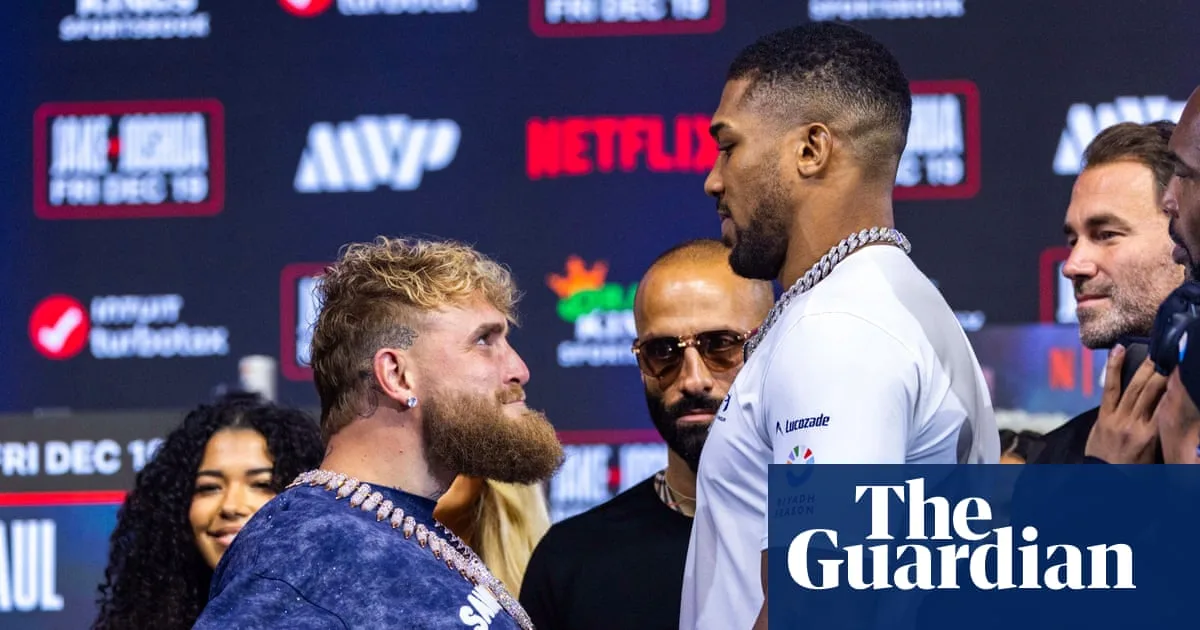
Millions will tune in on Friday night to watch Jake Paul, the brash YouTuber turned boxer, face Anthony Joshua at the Kaseya Center in Miami. The bout, scheduled for eight rounds, has been widely criticised as a mismatch, with Paul an 8-1 underdog against the two-time unified heavyweight champion. Concerns over safety have been raised due to the disparity in size and experience: Paul weighs around 200lb, while Joshua, five inches taller, has fought above 250lb. Despite warnings from regulators and fighters, the fight has been sanctioned and backed by a nine-figure investment from Netflix, with each fighter reportedly guaranteed a minimum of $50m (£37.3m).
The build-up has drawn inevitable comparisons to the 1964 bout between Cassius Clay and Sonny Liston in Miami, where the underdog shocked the world. But the similarities end there. Paul, 28, rose to fame as a YouTuber before turning professional in 2020, winning 12 of 13 fights against faded MMA fighters, fellow YouTubers, a retired basketball star and a 58-year-old Mike Tyson. Joshua, 36, is an Olympic gold medallist and former champion with an 89% knockout rate in victories, but he enters the fight after a fifth-round knockout loss to Daniel Dubois in September 2024.
Fistic purists may lament the state of the sport, but boxing has always been the original attention economy. Long before algorithms and engagement metrics, a fight's value was dictated by visibility. John L Sullivan, Jack Johnson and Jack Dempsey became global celebrities not just for their skill but for their drawing power. Promoters like Tex Rickard engineered spectacle through controversy and narrative. Joshua acknowledged the logic: 'People don't like the fact that I'm fighting Jake. But they want me to put an end to Jake Paul's show. I have to carry boxing on my back with this fight.'