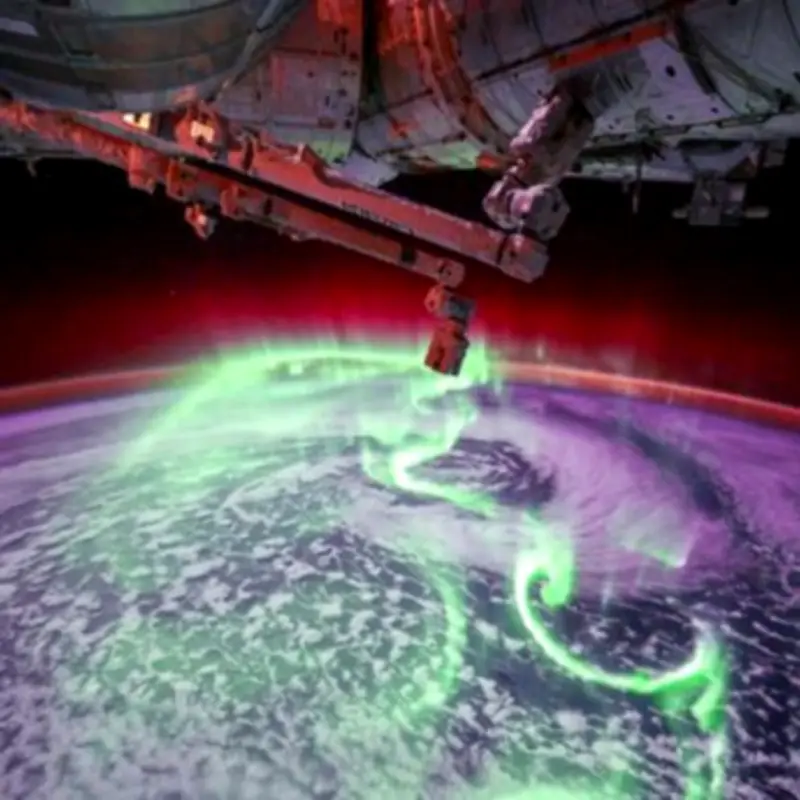
European Space Agency astronaut Sophie Adenot captured stunning images of a glowing aurora from the International Space Station (ISS) on Saturday, June 20, while floating 250 miles above Earth. The 43-year-old French astronaut shared the incredible snaps, which show vibrant green lights rippling and dancing beneath the orbital platform.
Aurora Described as 'Absolutely Spectacular'
Adenot said: 'This aurora was absolutely spectacular. It rippled and danced beneath our feet, as far as the eye could see, and its light was so intense that it bathed the entire Station in green reflections.' She added that the crew has observed several auroras since the mission began, but this one was exceptionally bright, leaving them 'all in awe.'
'Moments like this never lose their magic, even up here, and the whole crew finds itself scrambling for the best spot by a window,' Adenot said.
What Causes Auroras?
Auroras are natural light displays caused by charged solar particles interacting with Earth's magnetic field and atmosphere. The phenomenon is most commonly seen near polar regions, but from the ISS, astronauts have a unique vantage point 250 miles above the planet's surface.
NASA UFO Files Released
The stunning aurora images come just weeks after NASA briefings referencing an 'alien star base' on the Moon surfaced in the latest batch of UFO documents disclosed by the US Government. Audio from a formerly classified NASA discussion following the Apollo 16 mission in the 1970s was made public as part of the third release of UFO files.
Apollo 16 orbited the Moon from April 16 to April 27, 1972. Astronauts John Young and Charles Duke explored the Moon's highland territory, while Thomas 'Ken' Mattingly stayed in orbit. During a 55-minute recording, teams discussed gravity, laser readings, and irregularities discovered during exploration.
Embedded in the audio is a conversation about a 'great big hole' near the Van de Graaff crater, known for peculiar characteristics. One voice stated: 'In the backside of the moon around Fendi graph, that's where we get our big hole.' Moments later, an extraordinary proposition emerged: 'It could be an alien star base or something. Anyway, the next slide shows the front side of the moon.'