
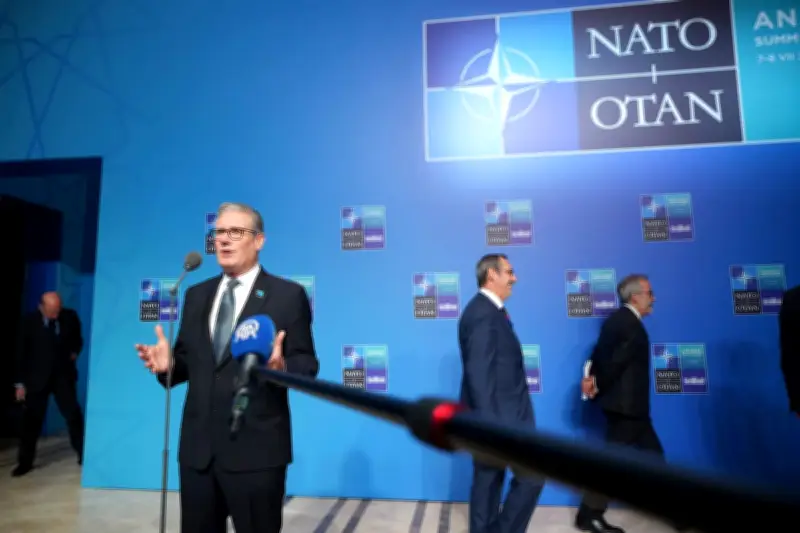
Sir Keir Starmer urged leaders to show 'the unity and the strength' of the Nato alliance at the start of a summit in Ankara, Turkey, that was again overshadowed by US President Donald Trump. Speaking to reporters on arrival at the presidential palace, the Prime Minister said the gathering would prove to be 'very important' against the background of the Ukraine war and the US conflict with Iran.
'It's very important that, as leaders, we show the unity and the strength of Nato at a time like this, and that's what we'll do at this summit here this morning,' Starmer said.
Trump's Criticism Overshadows Summit
In a re-run of last year's summit in The Hague, the meeting in Ankara has been focused on Trump and his ongoing criticism of the alliance. Ahead of the summit, Trump reopened questions about his commitment to Nato, insisting again that Greenland – which belongs to Nato ally Denmark – should be part of the US. He said the dispute over Greenland earlier this year had 'hurt my relationship with Nato' and suggested the US could pull all its troops out of Europe.
On Wednesday, Nato Secretary-General Mark Rutte insisted that the US remained committed to Nato 'no doubt', but had an 'expectation' that allies would 'equalise' their defence spending with America. However, at a meeting with Rutte, Trump renewed his attacks on Nato, saying he would 'relate my problems' at Wednesday's session of the North Atlantic Council. He complained again about Greenland and defence spending, saying he was 'very upset with Nato', and criticised the UK for refusing permission for the US to use British bases to launch strikes against Iran at the beginning of the war.
Defence Spending a Key Issue
Defence spending is likely to be a key issue at the summit, with Rutte calling on allies to present 'credible' plans for reaching the target of spending 5% of GDP on defence by 2035, agreed at The Hague last year. At home, Starmer has been accused of arriving at the summit 'empty-handed' after last week's Defence Investment Plan did not set out a clear path to reaching the Nato target. Ministers insist that the next spending review will set out that path, but that will be a decision for Andy Burnham, who is set to enter No10 in less than two weeks.
European Missile Partnership Announced
At Wednesday's summit, Starmer unveiled a partnership of around 12 European nations that had agreed to spend a total of 50 billion dollars (£37 billion) developing long-range missiles. So-called 'deep precision strike' missiles, including the British-made Storm Shadow, have proved crucial in the Ukraine war, allowing Ukrainian forces to hit targets far beyond the front line. The European commitment brings together several projects, including a joint UK-German effort to develop hypersonic long-range missiles and work with Italy and France on the Stratus missile. The announcement does not involve all the nations involved working on a single weapon, but officials said the move would prevent duplication among allies, with nations working on different types of missiles.
Bilateral Meetings and Deals
Starmer is also expected to hold what is likely to be his final meeting with Ukrainian President Volodymyr Zelensky on the margins of the summit, before signing a defence cooperation deal with Turkish President Recep Tayyip Erdogan. The Prime Minister is not expected to hold a formal meeting with Trump, but will be sat next to him at Wednesday's meeting of the North Atlantic Council.
During the summit, Starmer and Canadian Prime Minister Mark Carney said their countries would 'co-operate closely' on defence funding mechanisms. But they stopped short of committing to a merger of the UK's Multilateral Defence Mechanism (MDM) and Canada's Defence, Security and Resilience Bank (DSRB). On Tuesday, Chancellor Rachel Reeves had expressed support for a merger, but in a joint statement on Wednesday, the two leaders said only that their countries would 'continue to engage closely to ensure our respective initiatives develop in a coherent and mutually supportive way'.




