
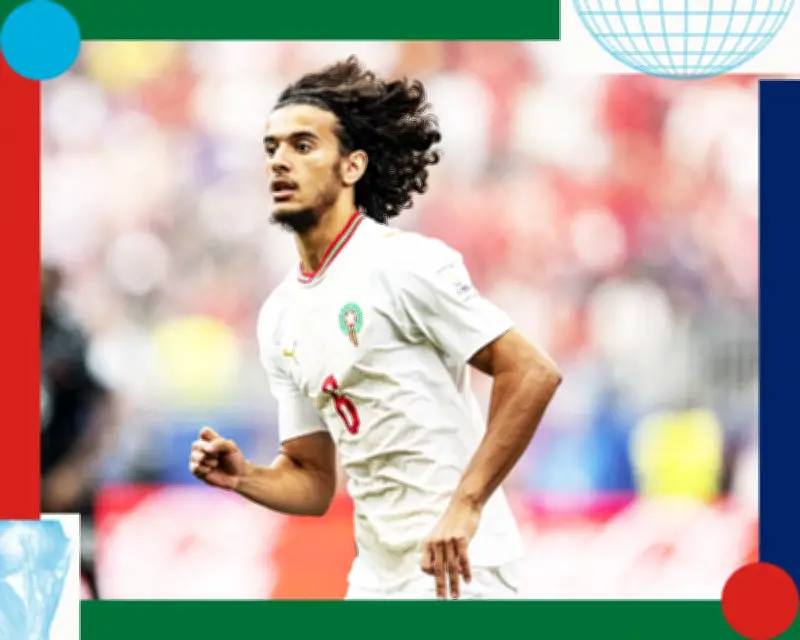
Ayyoub Bouaddi will step onto the pitch in Boston for the World Cup quarter-final wearing a Morocco shirt, just 101 days after captaining France's under-21 side to a 2-1 win over Iceland in a European Championship qualifier. The Lille midfielder, coveted by Morocco, took time to consider his international future before joining the Moroccan squad six weeks later. “A big loss,” said Hubert Fournier, technical director of the French national team. “A lost treasure,” declared L’Équipe. Guy Stéphan, France’s assistant manager, remarked: “He made a choice. We won’t criticise him for that, quite the opposite. He chose a different sporting nationality. He isn’t the first and he won’t be the last.”
France’s Role as a Global Talent Producer
Bouaddi is not an isolated case. There are 99 players at the World Cup this summer who were born in France – 32 more than the next most represented nation, the Netherlands. Just seven of the Morocco squad were born in the country; three were born in the Netherlands, whom they beat on penalties in the last 32, and six were born in France, their next opponents. After Morocco’s victory over the Oranje, midfielder Azzedine Ounahi quipped that the “providers” had won. France, and specifically the Île-de-France region, are the biggest “providers” at this World Cup. Of the 99 players born in France, 52 come from this region; just 12 play for the France national team.
There were eight players from Île-de-France at the 2018 World Cup in Russia and 12 in Qatar four years ago, showing a clear upward trend. São Paulo was once the world centre of player development, but no longer. Scouts have long since taken note, and this hotbed is being exploited. Paris Saint-Germain, having largely ignored the rich talent pool on their doorstep, have shifted strategy in recent seasons to provide a pathway for academy players like Warren Zaïre-Emery and Senny Mayulu.
Intense Competition Drives Standards
The intense level of competition is a driver of increasing standards. With football seen as a means to social mobility, there is an unrelenting intensity even at amateur level. At club level, this creates a surplus of talent. “There are too many talents for clubs to use and make the most of,” one scout told Get French Football News. Consequently, foreign clubs are increasingly dialled into the Parisian scene and France more generally. This surplus is France’s gift to the world, and Morocco is a clear beneficiary.
There is no ill feeling towards Bouaddi, despite attempts by the French football federation – and reportedly Zinédine Zidane – to convince him to play in bleu. Bouaddi is not the only player who could line up against the country of his birth in the quarter-final. Neil El Aynaoui, born in Nancy, will probably partner him in midfield. Samir El Mourabet, born in Strasbourg, and Issa Diop, who represented France up to U21 level, are other contenders. Gessime Yassine, born near Marseille, and Redouane Halhal, born in Montpellier, are also part of Mohamed Ouahbi’s squad.
Morocco’s Multicultural Squad
They are part of a distinctly multicultural Morocco squad, featuring 19 players born abroad – from France, the Netherlands, Spain, Canada and Belgium. Morocco are an extreme example, but 23% of players at the tournament are not representing the country of their birth. Morocco have strong arguments to attract talent, beyond matters of the heart. Having reached the semi-finals of the World Cup in 2022 and constructed the Mohammed VI Academy – a national training centre that rivals the installations of the most elite European nations – there is ambition and a vision.
France’s colonial history in north Africa means there is a significant Maghrebin diaspora in the country. More than a tenth of France’s population was born elsewhere; nearly half of them were born in Africa. This diversity was France’s strength when they won the World Cup in 1998, encapsulated in the “Black, Blanc, Beur” slogan. Diversity continues to be France’s strength, despite attacks on it. In 2024, Enzo Fernández apologised after he and other Argentina players were filmed singing a chant that included the phrase “They play for France, but all come from Angola.”
Political Storms and Sport
After France beat Paraguay in the last-32 stage, Paraguayan senator Celeste Amarilla described Kylian Mbappé as a “colonised Cameroonian, desperately trying to pass himself off as French.” The FFF denounced the “utterly abhorrent and unacceptable” comments, as did the UN Human Rights office; the Paraguayan government distanced itself, and French prosecutors launched an investigation. Politics and sport have been intertwined throughout the tournament: from the treatment of the Iran delegation, the decision to bar Somali referee Omar Artan from entering the US, and Donald Trump’s intervention in Folarin Balogun’s suspension.
Mbappé has been at the centre of a political storm after his criticism and concern about the rise of the far right in France drew criticism from Michel Platini before the tournament. “The France national team is representative of the French population,” said Didier Deschamps in May. After Amarilla’s attack on Mbappé, FFF president Philippe Diallo reiterated: “France’s national team players represent France.” Diversity is France’s strength, and other countries, including Morocco, are now benefiting from it too.




