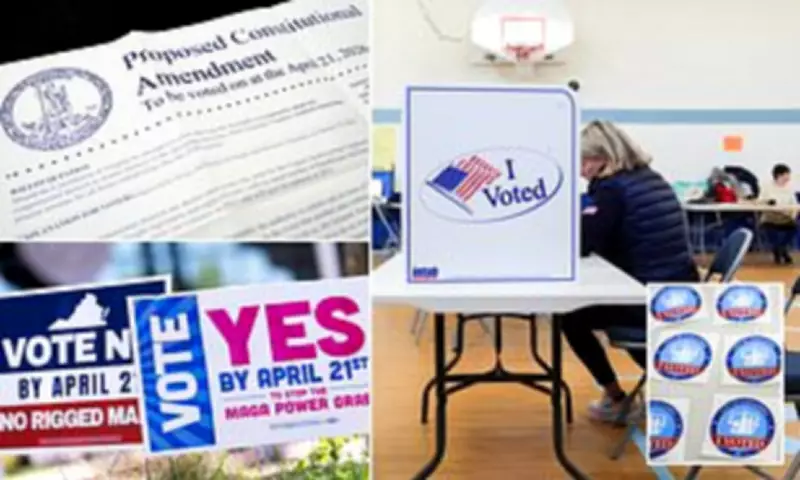
In a significant political rebuke, Virginia voters on Tuesday approved a constitutional amendment that could dramatically reshape the state's congressional delegation, potentially handing Democrats a commanding 10-to-1 advantage in the US House of Representatives. The move is widely seen as a direct response to former President Donald Trump's encouragement of Republican gerrymandering efforts in Texas and other states.
A Decisive Shift in a Former Swing State
The Associated Press called the race shortly before 9 pm, confirming that voters had chosen to bypass the state's established bipartisan redistricting commission. This decision empowers Democrats to redraw Virginia's congressional map, which currently features six Democratic-held seats out of eleven. The new configuration is designed to branch several additional districts from the liberal-leaning suburbs of Washington, DC, effectively diluting the influence of the state's rural, Republican vote.
National Context and Republican Reactions
This Virginia initiative, backed by prominent national Democrats including former President Barack Obama, emerges amidst an unusual mid-decade redistricting frenzy triggered by Trump's actions. While fresh maps in Missouri, North Carolina, and Ohio are expected to benefit Republicans, Virginia's vote aims to counterbalance those gains. Democrats believe that, combined with a court-ordered redistricting in Utah and changes in California—where Governor Gavin Newsom spearheaded Proposition 50—they could secure enough seats to reclaim the House majority.

Virginia Republicans have expressed outrage at the effort, particularly targeting Democratic Governor Abigail Spanberger. They accuse her of campaigning as a moderate during her 2025 gubernatorial race but now supporting the constitutional amendment. Spanberger had previously endorsed the 2020 bipartisan commission approach and generally opposed gerrymandering, making her current stance a point of contention.
Trump's Limited Engagement and Strategic Implications
Notably, Trump—who can reach Virginia from the White House in about ten minutes by motorcade—did not actively rally support against the amendment. Instead, he and House Speaker Mike Johnson participated in a closed-door "tele-rally" on Monday, away from press scrutiny. Trump also refrained from endorsing GOP Lieutenant Governor Winsome Earle-Sears in the lead-up to November's off-year gubernatorial election.
Former Trump White House press secretary Sean Spicer, a Northern Virginia resident, criticized this lack of engagement. "A few million of early money to get the grassroots engaged would have saved 4 seats—which very well could be the difference between keeping and losing the House majority," Spicer lamented on Monday.
Broader Political Ramifications
With midterm elections historically unfavorable to the President's party and Republicans holding a razor-thin House majority, this redistricting could prove pivotal. If Democrats regain control, investigations and impeachment proceedings become more likely. The Virginia vote underscores how state-level redistricting battles are increasingly influencing national political power dynamics, setting the stage for intense partisan clashes ahead of the next election cycle.