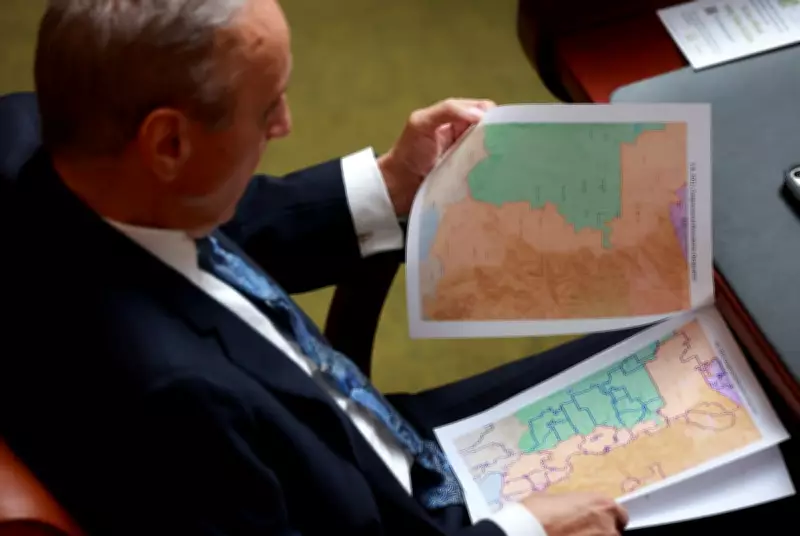
Utah Republicans Intensify Battle Over Redistricting Maps
Utah's Republican-dominated legislature is ramping up its confrontation with the state's anti-gerrymandering legislation following a series of judicial decisions that jeopardised the congressional map long favouring the GOP. In a recent development, lawmakers enacted a new regulation over the weekend that prevents numerous voters from retracting their signatures from a petition seeking to repeal Proposition 4 before a Monday deadline, thereby sabotaging grassroots initiatives to uphold the reform.
Court Rulings and Public Backlash
On 25 August 2025, Third District Judge Dianna Gibson determined that Utah legislators had unconstitutionally overridden Proposition 4, the 2018 voter-approved measure that established an independent redistricting commission, implemented neutral mapping standards, and mandated increased transparency. Judge Gibson supported the League of Women Voters of Utah and Mormon Women for Ethical Government, invalidating the state's 2021 congressional maps and reinstating Proposition 4 as enforceable law, permitting independent entities to redesign the districts.
This judicial alignment resonated with public sentiment, as indicated by the conservative Sutherland Policy Institute, which discovered that 85% of registered Utah voters endorse involving an independent commission in redistricting. The consequences of gerrymandering have been particularly acute in Salt Lake County, Utah's youngest and most populous county, which strongly leans Democratic. The 2021 Republican-crafted maps fragmented the county across all four districts, weakening urban Democratic votes and solidifying GOP control.

Republican Countermeasures and National Attention
The optimism felt in Salt Lake City during August has gradually diminished as Republicans have enacted multiple layers of legislation intended to dilute or revoke Proposition 4. Following the district court ruling last year, Utah's Republican leadership promptly dismissed the decision, with some lawmakers even menacing to impeach Judge Gibson. As it became evident that Proposition 4 might grant an additional seat to Democrats, the conflict attracted national scrutiny.
Former President Donald Trump and JD Vance both intervened, portraying the dispute as part of a wider struggle over election regulations, with Trump swiftly taking to social media to label the proposition "unconstitutional" and the judges as part of the "Radical Left". In late January, Utah Republicans passed legislation augmenting the state's supreme court by two seats. Governor Spencer Cox rapidly signed the bill into law, enlarging the court from five to seven justices. Critics contend this manoeuvre constitutes court expansion designed to mitigate the impact of rulings associated with Proposition 4.
Legal Challenges and Signature Controversy
In early February, with the re-election filing deadline merely a month away, two Utah Republican members of Congress, Representatives Celeste Maloy and Burgess Owens, initiated a federal lawsuit contesting the state court's directive to reinstate the district court-approved map. They contended that the ruling breached the US constitution and petitioned the US district court for Utah to restore the map enacted by the Republican-controlled legislature in 2021.
Later that month, a three-judge federal panel rebuffed the GOP-led attempt to obstruct the new House map. The judges declined Republicans' request for a preliminary injunction, permitting the revised map to be utilised in this year's election and offering Democratic candidates a potential chance to secure a US House seat. In a final endeavour to overturn Proposition 4, Utah Republicans declared last Monday that they had submitted sufficient verified signatures to qualify a repeal measure for the November ballot, with a verification deadline on 9 March.
Grassroots Outcry and Legislative Tactics
Elizabeth Rasmussen, executive director of Better Boundaries, an advocacy group that had been conducting an awareness campaign encouraging petition signers to withdraw their signatures before the Republicans' latest legislation, expressed frustration. "What's really frustrating is seeing that instead of listening to the people, and to the courts who are trying to keep them in line, they're just trying to change the rules," Rasmussen stated.

She criticised the bill for being rushed through with minimal public examination. "This bill was obviously planned to pass as the clock ran out with very little public input," Rasmussen remarked. "It was introduced at 11pm on a Friday, the last night of the legislative session, and was signed into law only 12 hours later." She added that this action illustrates a broader issue: "This type of legislative behavior is what happens when there aren't any checks on power."
Katharine Biele, president of the League of Women Voters of Utah, vehemently denounced Republican lawmakers, labelling the move an abuse of authority. "Every time they lose, or get a ruling they don't agree with, they change the rules so it works for them," she asserted. The redistricting conflicts are intensifying across the United States ahead of the midterm elections, with courts in several states adjudicating lawsuits over congressional maps, and Donald Trump urging Republican governors to redesign districts in manners that could reinforce GOP control of House seats.