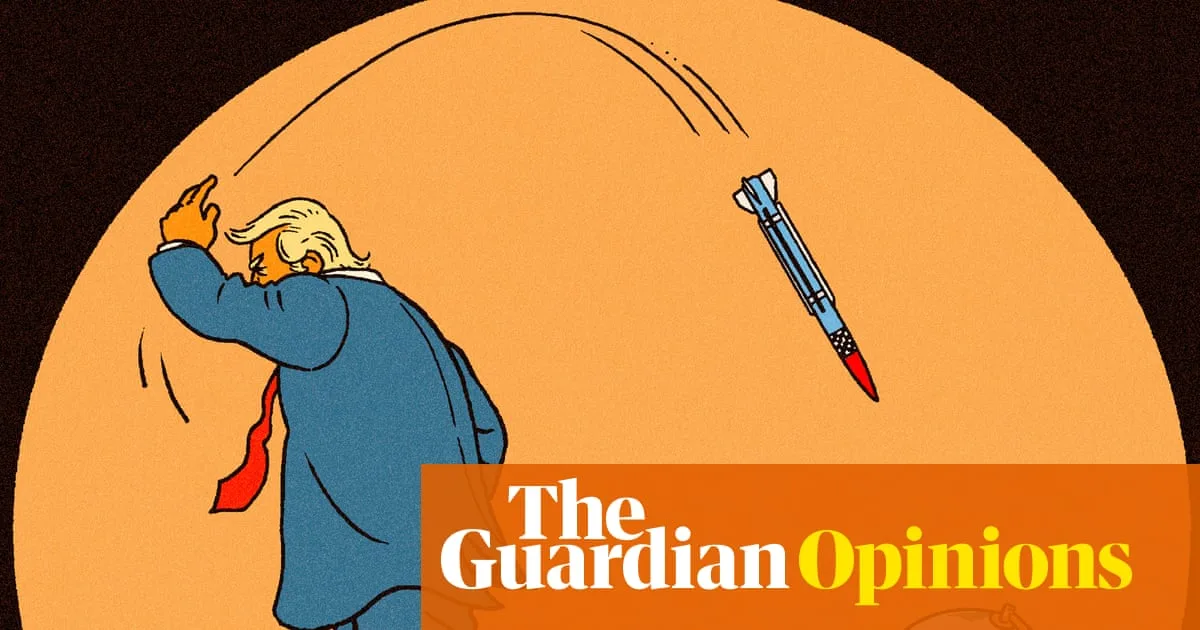
Commentators have argued that Donald Trump’s clownishness and lack of ideology make him less dangerous, but they are wrong. Over recent weeks, a random kaleidoscope of images has flashed through my mind—characters from movies, snippets from literature, iconic art—all joined by an exaggerated, almost kitschy evil. These images stand in for the real carnage: bodies pulled from rubble in Gaza, a school blown apart in Iran, over a million people expelled from southern Lebanon.
What is bewildering is the casualness of the cruelty. Trump hovers above the circus of death and chaos, defying attempts to make his actions cohere with any strategy. His wars and killing of innocents reshape the world without a master plan, animated by momentary impulses and resentments. His seeming lack of vision is misread as making him less dangerous than past authoritarians.
Take the debate over whether Trump can be called a fascist. The Wall Street Journal’s Barton Swaim argued that “you can’t be a fascist without in any way meaning to be one.” Trump is inept, inconsistent, “puzzling and exasperating,” but not a fascist, he claims. Trump does not hold rallies, wear uniforms, or make fiery speeches; he is an addled comic figure, baring his soul in angry social media outbursts.
But isn’t this what evil is? A projection of smallness and fear, where violence is secondary to validation. Trump’s self-aggrandisement, grudges, and fury at being challenged all erase a terror of humiliation. In 1931, after Hitler’s Nazi party surged, reporter Dorothy Thompson noted “the startling insignificance of this man who has set the world agog.” Similarly, journalist Barbara Grizzuti Harrison wrote of Mussolini: “just because something is silly doesn’t mean it isn’t dangerous.”
We tend to imbue history with a seriousness we struggle to apply in the present. It is hard to recognise evil in ludicrous form. That is how it creeps up on you. The answer to how past crimes were allowed is that evil rarely arrives with the hallmarks of a villain; it arrives in broken people, whose power lies in their absurdity.