Trump's Far-Fetched Iran School Bombing Excuse Lays Bare Hollow War Leadership
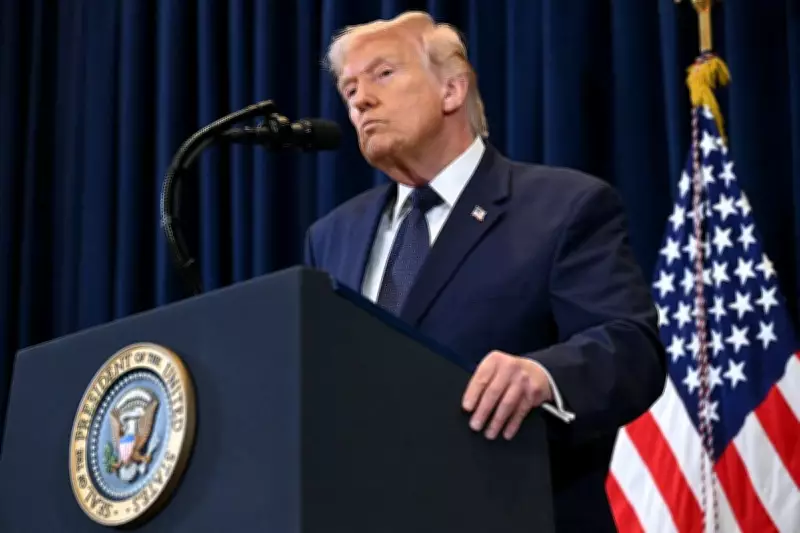
President Donald Trump's attempt to tightly manage public perception of his conflict with Iran has spectacularly backfired, exposing a leadership style that eagerly claims glory while evading responsibility for the grim realities of war. During a press conference on Monday, Trump's contradictory statements painted a picture of a commander-in-chief unwilling to face the consequences of military action.
Claiming Victory While Dodging Blame
Trump enthusiastically took credit for what he described as major military successes against Iran, telling reporters: "We're achieving major strides toward completing our military objective. And some people could say they're pretty well complete." He added, "Together with our Israeli partners, we're crushing the enemy in an overwhelming display of technical skill and military force."
Yet this triumphant rhetoric stood in stark contrast to his refusal to acknowledge any negative outcomes from the bombing campaign. When questioned about a Tomahawk missile strike that hit a girls' school in Iran, killing 175 people mostly children, Trump offered a bizarre explanation that contradicted established facts.
Bizarre Theories About School Attack
The president suggested Iran might have fired the missile on its own facility, despite the Tomahawk being a ship-based weapon system exclusively in American military inventory. "I will say that the Tomahawk, which is one of the most powerful weapons around, is used by, you know, it's sold and used by other countries," Trump claimed, falsely asserting that Iran possessed such missiles.
Video evidence obtained by The New York Times and other outlets clearly shows the American strike hitting both a Revolutionary Guard Corps naval base and the adjacent school building. Even under pointed questioning, Trump refused to admit any U.S. responsibility, stating: "I just don't know enough about it."
Democratic Outrage and Administration Divisions
Democratic leaders responded with scathing criticism. Senate Minority Leader Chuck Schumer declared: "Trump is lying through his teeth. The claim is beyond asinine. Again, he says whatever pops into his head no matter what the truth is."
Senator Chris Van Hollen added: "He & Sec. Hegseth are responsible for the killing of these 175 people, most of them children. They must be held accountable."
The president's statements created clear divisions within his administration, with White House press secretary Karoline Leavitt attempting to reframe Trump's assertions about an imminent Iranian attack as "a feeling, again, based on fact." This admission that military action stemmed from presidential intuition rather than concrete evidence raises serious questions about decision-making processes.
Economic Consequences and Public Opinion
The conflict carries significant economic and political costs. The war currently costs American taxpayers nearly a billion dollars daily, while gas prices have surged up to 50 cents per gallon in many states due to Iranian attempts to mine the Strait of Hormuz.
Despite this reality, Leavitt promised: "Rest assured to the American people, the recent increase in oil and gas prices is temporary and this operation will result in lower gas prices in the long-term."
Public opinion reflects growing concern, with a Quinnipiac poll showing more than half of registered voters oppose the war with Iran, compared to approximately 40 percent who support it. These numbers could deteriorate further if economic pressures intensify or civilian casualties mount.
Strategic Contradictions and Political Gambles
Trump's approach reveals fundamental contradictions in his war strategy. While claiming Iran posed an imminent threat requiring military action, the president offered no evidence to support this assertion. Iranian diplomats were actually meeting with U.S. officials in Geneva to discuss terms for a new agreement when the bombing campaign began.
The president's insistence that "They were going to take over the Middle East and they were going to try and destroy Israel" finds no support from his own advisers, creating a troubling disconnect between presidential rhetoric and administration policy.
Trump's handling of the Iran conflict represents a dangerous political gamble, asking Americans to disregard evidence about both economic impacts and military outcomes. Unlike his predecessor, however, Trump's political fate remains somewhat insulated from potential November consequences, creating a perilous dynamic where accountability appears secondary to perception management.