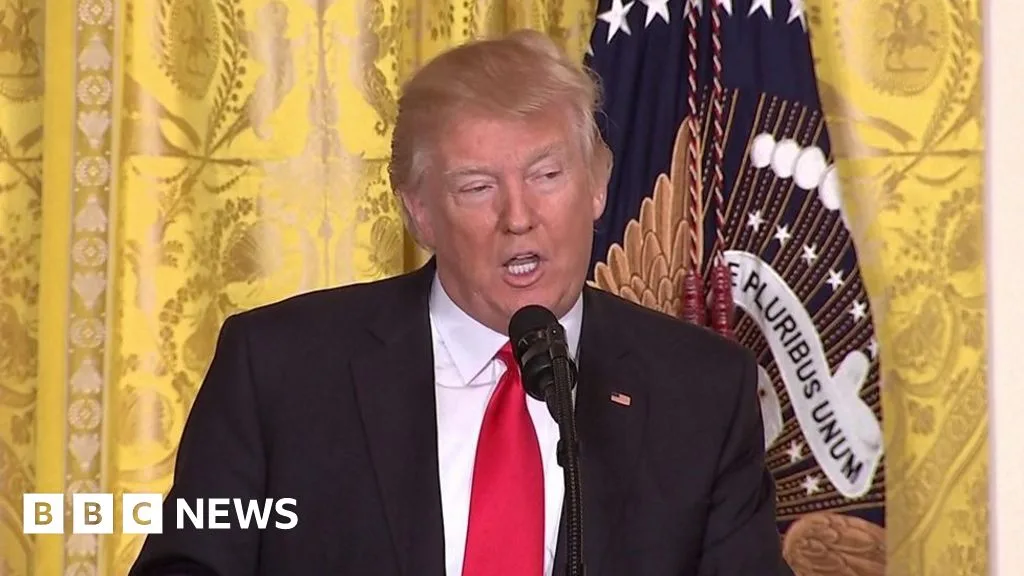
Former President Donald Trump has declared that the world would be "torn to pieces" if he were not in office, making this bold statement just days after facing widespread criticism for posting an artificial intelligence-generated image that portrayed him as Jesus Christ. The 79-year-old Republican made these remarks during an interview with ABC News' Jonathan Karl, as his administration engages in delicate negotiations with Iran amid a violent conflict that has escalated across the Middle East.
Trump's Assertion of Global Stability
In his interview, Trump emphasized his perceived role as a stabilising force on the international stage. "If I weren't president, the world would be torn to pieces," he stated, suggesting that his leadership is the primary barrier preventing global disintegration. This comment comes at a critical juncture, with the United States and Israel having launched a joint military operation against Iran in late February, resulting in significant casualties and displacement.
Iran Peace Deal Prospects
Despite the collapse of initial talks in Pakistan over the weekend, Trump hinted that a breakthrough in peace negotiations with Iran could be imminent. He told Karl, "I think you're going to be watching an amazing two days ahead. I really do." When questioned about whether the conflict would conclude with a formal agreement or merely maintain the current stalemate, Trump acknowledged, "it could go either way," but expressed a preference for a deal to facilitate reconstruction.
He further commented on the Iranian regime, stating, "They really do have a different regime now. No matter what, we took out the radicals. They're gone, no longer with us." The war has led to over 3,000 reported deaths in Iran, according to government figures, and millions displaced across the region, as confirmed by United Nations estimates. Additionally, thirteen U.S. service members have lost their lives, with hundreds wounded, according to Pentagon reports.
Economic and Political Fallout
The conflict has triggered fears of global economic disruption, particularly due to blockades enforced by Iran and the U.S. on the Strait of Hormuz, a crucial maritime passage responsible for 20% of the world's oil transit. This has caused oil prices to surge above $100 per barrel and U.S. gasoline prices to exceed $4 per gallon. Public opinion in America reflects growing discontent, with approximately 61% of respondents disapproving of Trump's handling of the war, as indicated by a recent Pew Research Center survey.
Controversial AI Image and Backlash
Trump's comments on the war and his self-proclaimed role in preventing global chaos follow a significant controversy stemming from an AI-generated self-portrait he shared on Truth Social. The image, posted on Sunday, depicted Trump in robes, healing a sick man with beams of light emanating from his hands, a clear resemblance to traditional portrayals of Jesus. The post sparked immediate outrage across the political spectrum.
Former Georgia GOP Representative Marjorie Taylor Greene condemned the image on social media, writing, "On Orthodox Easter, President Trump attacked the Pope because the Pope is rightly against Trump's war in Iran and then he posted this picture of himself as if he is replacing Jesus. I completely denounce this and I'm praying against it!!!" Senator Bernie Sanders, an Independent from Vermont, described Trump's behaviour as "deranged" and "egomaniacal."
Trump's Defence and Removal of the Post
By Monday morning, the controversial post had been deleted from Trump's Truth Social feed. Speaking to reporters outside the White House later that day, Trump defended his actions, claiming, "I viewed that as a picture of me being a doctor. You know, as a little fun playing the doctor and making people better. So that's what it was viewed as. That's what most people thought." He explained that he removed the image because he "didn't want to have anybody be confused," but blamed the "fake news" for stirring up the controversy.
In a separate interview with Fox News aired on Wednesday, Trump asserted that the war is "close to over," adding, "I don't know how much longer they can survive." This ongoing narrative underscores the complex interplay between Trump's personal image, geopolitical negotiations, and public perception as the conflict in Iran continues to unfold.