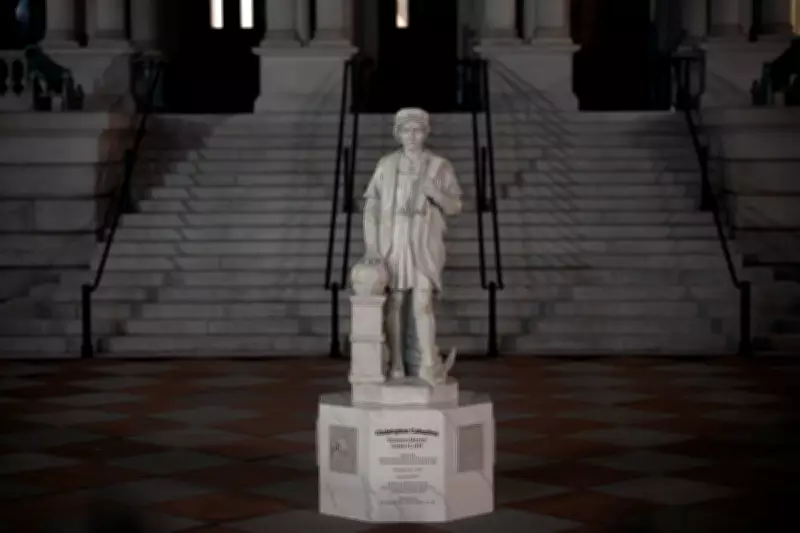
A statue of Christopher Columbus has been erected on the grounds of the White House, marking a significant move by former President Donald Trump to champion the explorer as a foundational American hero. The 13-foot monument, weighing one ton, was placed in front of the Eisenhower Executive Office Building adjacent to the White House on Pennsylvania Avenue.
Replica from Shattered Pieces
This new statue is a replica of an original monument that was torn down and thrown into Baltimore's inner harbor by protesters during the widespread anti-racism demonstrations in 2020. Constructed in 2022, it was built using shattered pieces retrieved from the harbor, symbolizing a resurrection of the controversial figure.
The pedestal bears an inscription that reads: "Destroyed July 4, 2020 … Resurrected 2022 ... Rededicated by President Donald J. Trump, October 13, 2025." This dedication underscores Trump's personal involvement in the statue's placement and his commitment to honoring Columbus.

Trump's Praise for Columbus
In a letter to Basil Russo, leader of the Conference of Presidents of Major Italian American Organizations, which owns the statue and loaned it to the federal government, Trump described Columbus as "the original American hero and one of the most gallant and visionary men to ever walk the face of the Earth." He expressed honor that the statue would now stand on White House grounds, ensuring Columbus is celebrated for generations.
The White House reinforced this sentiment in a post on X, labeling Columbus a "hero" and affirming Trump's dedication to preserving his legacy. This action aligns with Trump's broader efforts to position historical figures in a positive light, despite ongoing debates about their impacts.
Controversial Legacy
Christopher Columbus is traditionally hailed as the discoverer of America, though he never set foot on the continental United States, arriving instead in what is now the Bahamas. However, his legacy is deeply contentious due to his role as a slave trader and the subjugation and killing of Indigenous peoples in the Caribbean during his voyages between 1492 and 1504.
In recent years, honors for Columbus have faced increased scrutiny. Some jurisdictions in the US have replaced Columbus Day with Indigenous Peoples Day, reflecting a shift in public perception. In his 2021 Columbus Day proclamation, then-President Joe Biden acknowledged that Columbus "ushered in a wave of devastation: violence perpetrated against native communities, displacement and theft of tribal homelands, the introduction and spread of disease, and more."
Symbol of Pride and Division
Despite the controversy, Columbus's legacy remains influential, with the District of Columbia named after him. He is still revered by some Italian-American groups as a symbol of national pride, highlighting the ongoing cultural and political divisions surrounding his figure.
The installation of this statue on White House grounds not only revives debates about historical memory but also underscores the polarized views in US politics regarding how to commemorate complex figures from the past.