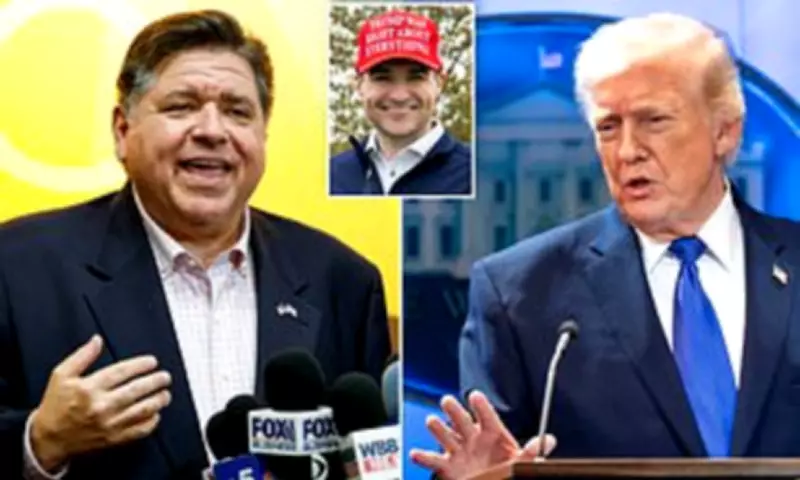
A senior advisor to former President Donald Trump has unleashed a scathing personal attack on Illinois Governor JB Pritzker, after the Democratic leader attempted to publicly shame Trump over a recent Supreme Court ruling on tariffs. The fiery exchange began when Governor Pritzker sent a formal letter to Trump demanding immediate refunds for Illinois residents, following the court's decision that declared certain Trump-era trade policies unconstitutional.
The $8.6 Billion Demand
Governor Pritzker, the billionaire heir to the Hyatt Hotels fortune, attached a detailed invoice totaling $8,679,261,600 to his letter, which he claimed represented compensation owed to the people of Illinois. The invoice calculated this staggering sum based on $1,700 refunds for each of the state's more than five million households. In his correspondence, Pritzker explicitly stated that Trump's tariff policies had "wreaked havoc on farmers, enraged our allies, and sent grocery prices through the roof."
The governor's communication took an unusually confrontational tone, with the invoice prominently marked "Past Due – Delinquent" and captioned with the directive "cut the check." Pritzker warned that failure to comply would result in "further action," though he did not specify what legal or political steps might follow.
The Trump Camp's Vicious Counterattack
The situation escalated dramatically when reporter Natasha Korecki shared details of the invoice on social media. Alex Bruesewitz, one of Trump's longest-serving advisors, responded with a deeply personal attack targeting the Pritzker family. In a public post, Bruesewitz demanded that reporters question Governor Pritzker about his cousin Thomas Pritzker, who had recently resigned from the Hyatt Hotels board of directors following revelations about his association with convicted sex offender Jeffrey Epstein and Ghislaine Maxwell.
This marked a significant escalation in the political feud, shifting the focus from policy disagreements to personal allegations and family connections. The Daily Mail reported reaching out to the White House for comment on the developing controversy.
Trump's Tariff Maneuver and Supreme Court Clash
The backdrop to this political confrontation involves complex legal and trade policy developments. Shortly after the Supreme Court's 6-3 ruling against his tariff policies, Trump announced he had invoked Section 122 of the Trade Act of 1974 to implement a new global 10% tariff. This obscure provision allows presidents to impose temporary tariffs for up to 150 days without congressional approval, marking the first time this particular law has been utilized.
In a remarkable statement from the Oval Office, Trump declared: "It is my Great Honor to have just signed, from the Oval Office, a Global 10% Tariff on all Countries, which will be effective almost immediately." The White House confirmed these temporary import duties would take effect on February 24 at 12:01 AM EST, though numerous exemptions would apply including energy products, pharmaceuticals, certain vehicles, and food items like beef and tomatoes.
Supreme Court Dynamics and Presidential Fury
The Supreme Court decision that triggered this political firestorm saw an unusual alignment of justices, with three conservative justices joining all three liberal justices to rule against Trump. Notably, two Trump appointees – Neil Gorsuch and Amy Coney Barrett – sided with Chief Justice John Roberts against the former president. Only Justice Brett Kavanaugh, another Trump appointee, joined the dissent alongside Justices Samuel Alito and Clarence Thomas.
Trump responded to the legal defeat with extraordinary public criticism of the judiciary, claiming in a press briefing: "The Supreme Court's ruling on tariffs is deeply disappointing and I'm ashamed of certain members of the Court. Absolutely ashamed for not having the courage to do what's right for our country." He went further, suggesting that "the court has been swayed by foreign interests" and lamented what he perceived as judicial inconsistency: "I'm allowed to destroy the country, but I can't charge them a little fee."
Despite the setback, Trump attempted to frame the decision as ultimately strengthening presidential authority over trade, stating: "While I am sure that they did not mean to do so, the Supreme Court's decision today made a President's ability to both regulate trade and impose tariffs more powerful and more crystal clear rather than less."
Broader Implications and Exemptions
The newly announced tariffs include significant exemptions reflecting complex trade relationships. Products from Canada and Mexico will be largely excluded due to the United States-Mexico-Canada Agreement, though steel, aluminum, and non-compliant goods will still face duties. Similarly, certain textiles and apparel will be exempt under the Dominican Republic-Central America Free Trade Agreement.
The White House defended the tariff approach despite the Supreme Court rebuke, stating: "The Supreme Court’s disappointing decision today will not deter the President’s effort to reshape the long-distorted global trading system that has undermined the economic and national security of our country, and contributed to fundamental international payment problems."
This escalating conflict between Trump and Governor Pritzker represents more than a simple policy disagreement – it has evolved into a deeply personal political feud with significant implications for trade policy, presidential authority, and the boundaries of political discourse in an increasingly polarized environment.