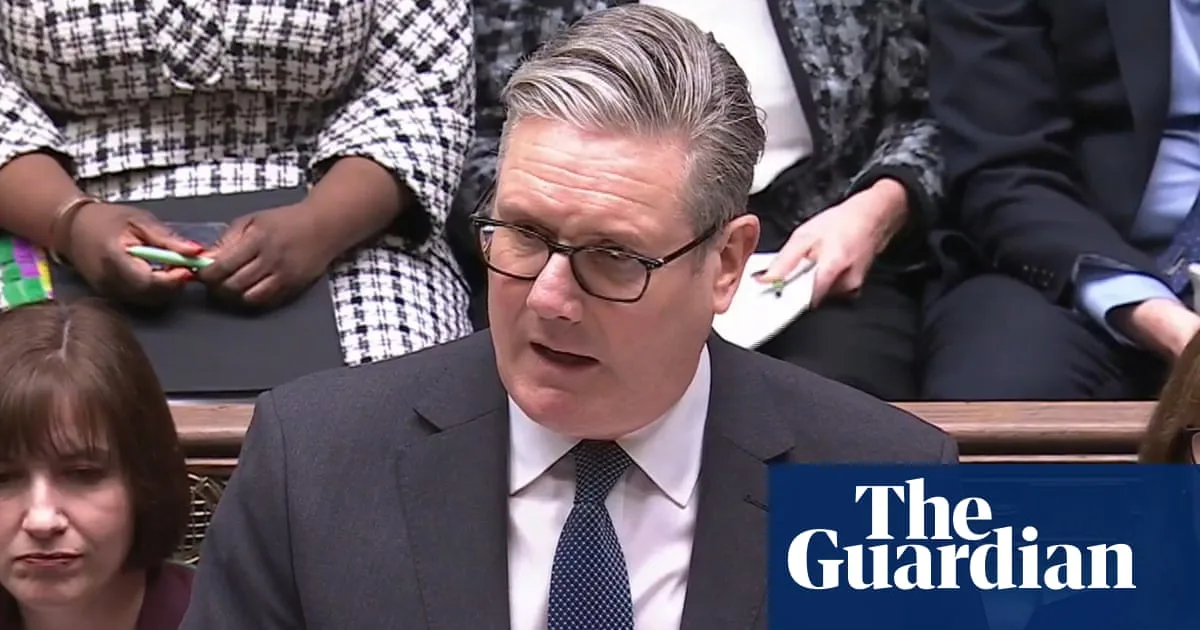
Starmer Accuses Political Rivals of Reckless War-Mongering Ahead of Local Elections
Prime Minister Sir Keir Starmer has launched a scathing attack on his political opponents, warning that Britain would have been plunged into a catastrophic conflict without proper strategy if either Nigel Farage or Kemi Badenoch held power. The Labour leader's comments come during a crucial television broadcast as he battles to secure votes ahead of what pollsters predict will be devastating local election results in May.
'War Without a Plan' Warning
In his first Party TV broadcast before the May elections, Sir Keir will directly accuse the Reform UK and Conservative leaders of offering what he describes as "anger or easy answers" to complex international crises. The prime minister has repeatedly emphasized that the United States' military action against Iran "is not our war," and he insists he "won't be dragged in" to American-led operations.
"You don't get a second chance at decisions like this," Sir Keir will tell voters. "There are huge consequences both abroad and at home, and of course for our brave Armed Forces. Nigel Farage and Kemi Badenoch would have jumped into this war with both feet without thinking through the consequences."
The prime minister added that while such reckless positioning might be inconsequential from opposition benches, "if they'd been in government, we would be in a war without a plan."
Political Pressure and Leadership Stakes
Despite Sir Keir's steadfast approach to the Middle East conflict proving popular with certain voter segments, Labour faces what analysts describe as a "very substantial threat" in the upcoming local elections. The party continues to hemorrhage support to both Reform UK on the right and the Greens on the left, creating a political squeeze that could potentially endanger Sir Keir's leadership position.
Mrs Badenoch has previously criticized the prime minister's foreign policy approach, accusing him of being "too scared to make foreign interventions for fear of upsetting a tiny section of the electorate." She claimed he spent excessive time "consulting lawyers, plucking up the courage to say whose side he was on."
However, when pressed to clarify her position, the Conservative leader told the BBC that while her party supported American and Israeli actions, "I never said we should join." Sir Keir later characterized this as "the mother of all u-turns" on what he called "the single most important decision a prime minister ever has to take."
Conflicting Opposition Positions
Reform UK's stance on the Iran conflict has appeared particularly inconsistent. In March, Mr Farage declared at a press conference that "the gloves need to come off" after RAF Akrotiri in Cyprus was struck by a drone, adding that "we need to accept that we're part of this with the Americans, with the Israelis."
Yet later that same month, the Reform leader contradicted himself by stating: "If we can't even defend Cyprus, let's not get ourselves involved in another foreign war." This apparent confusion has provided ammunition for Sir Keir's criticism of opposition foreign policy coherence.
Standing Firm Against International Pressure
Sir Keir has maintained his refusal to bow to American pressure regarding Britain's involvement in the Iran conflict, a position that has actually boosted his popularity ratings among certain voter demographics. According to a recent JL Partners survey conducted for The Independent, the prime minister's approval increased by 26 points when respondents were reminded of his diplomatic fallout with former US President Donald Trump.
"In these uncertain times, there are plenty of people offering anger or easy answers," Sir Keir will emphasize in his broadcast. "I'm not going to be pressurised to change my view. I'm the British prime minister and it's Britain's national interest, protecting you and your family, that determine every decision that I make. Whatever other people say, whatever the criticism, that's my focus."
Current UK Military Posture
The United Kingdom has authorized limited American use of British military bases exclusively for defensive operations targeting Iran's missile sites and facilities being utilized to attack shipping in the strategically vital Strait of Hormuz. This narrow permission reflects the government's cautious approach to the escalating conflict.
On Tuesday, Downing Street reiterated that Britain's primary objective remains "de-escalation" and a "negotiated settlement" for the region, even as President Trump intensified his rhetoric and the American-Israeli bombing campaign continued unabated. The former US president issued Tehran an ultimatum to end its blockade of the strait by 1am Wednesday UK time or face what he described on Truth Social as complete obliteration: "A whole civilisation will die tonight, never to be brought back again."
As the local elections approach, Sir Keir's foreign policy stance has become a central pillar of his political messaging, positioning himself as the steady hand against what he portrays as opposition recklessness in matters of war and peace.






