Angela Merkel's Controversial Plea to Migrant Voters Ignites Political Firestorm
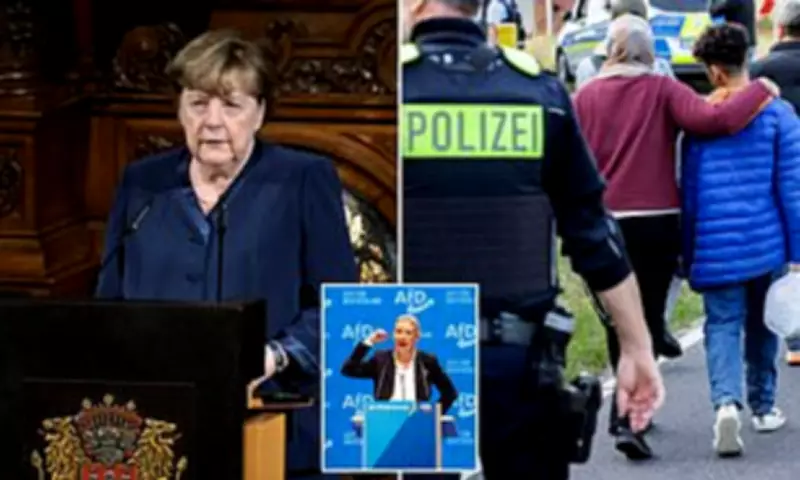
Angela Merkel, the former Chancellor of Germany, has provoked significant anger across the nation after explicitly calling for migrants to vote against the hard-right Alternative for Germany (AfD) party. In a recent interview with Hesse Broadcasting, Merkel appealed to individuals with a 'migration background' to join forces with other citizens who oppose the AfD, emphasising unity within the political centre.
Merkel's Call for Unity Against the AfD
Merkel stated, 'I wish everyone would stand together against this party. And we do not split ourselves as a political centre, I say, onto those who have a migration history and those who have none. Because then our country would become weaker against the AfD.' She further argued that the duration of German citizenship is irrelevant, asserting, 'Whether a German citizen has been a German citizen for two years or for four days or the entire family for three generations, it doesn't matter. We are the German people… We must also stick together when we have to take action against people who have completely different ideas about our future.'
AfD Leader Alice Weidel's Fierce Rebuttal
AfD leader Alice Weidel swiftly retaliated, accusing Merkel of having 'inflicted severe damage' on Germany through her policies. Weidel criticised Merkel's 2015 decision to open Germany's borders to Syrian refugees, which triggered the European Union's migrant crisis, and linked this to her recent comments. 'In addition to the ruin of our energy infrastructure and the open borders for everyone from all over the world, she is now calling on naturalised ‘people with a migration background’ not to vote for the AfD,' Weidel added.

Merkel's Legacy: Recognition and Controversy
Despite the backlash, Merkel was recently honoured in the EU's inaugural honours list for her efforts in transitioning Germany away from nuclear energy towards renewables. However, her 16-year tenure remains deeply contentious. Key points of criticism include:
- Her handling of the 2015 migrant crisis, where over one million refugees were admitted—a move later disavowed by her own Christian Democratic Union (CDU) party.
- Years of appeasing Vladimir Putin by relying on cheap Russian gas, which bolstered Russia's finances ahead of its invasion of Ukraine.
- The shift from nuclear energy and Russian gas led to increased coal usage, exacerbating pollution concerns.
Current Political Landscape and Migration Policies
In the 2025 elections, the AfD secured 20.8% of the vote, becoming the second-largest party in the Bundestag. Meanwhile, current Chancellor Friedrich Merz's CDU and its Bavarian sister party, the Christian Social Union, formed a coalition government with the Social Democratic Party of Germany.
Under Merz's leadership, Germany has implemented stringent border controls, resulting in a notable decline in illegal immigration. Key statistics include:
- From January to November 2025, 106,298 first-time asylum applications were recorded, the lowest annual total since 2013.
- In 2024, applications were over double at 229,751.
- Illegal entries dropped to 62,526 in 2025, half the 2023 figure.
- Nearly 75% of 33,000 attempted border crossings from May to December 2025 were rejected or resulted in physical escort back.
Chancellor Merz has declared migration a 'national emergency', enforcing measures such as turning back undocumented migrants at borders, suspending family reunification, and replacing cash benefits with prepaid debit cards for asylum seekers.
Regional Tensions and Economic Warnings
Merz has also warned that the Middle East conflict could spur uncontrolled migration in Europe, with 'far-reaching consequences' for security and energy. In a March 6 statement, he cautioned against scenarios like a collapse of Iranian statehood, which could mirror the Syrian refugee crisis. 'We do not want to see a Syrian scenario here,' Merz emphasised, advocating for a functional Iranian state to prevent proxy conflicts.

Following meetings with US leaders, Merz highlighted the economic impacts, noting rising oil and gas prices due to the war. 'This is, of course, damaging our economies... So that's the reason why we all hope that this war will come to an end as soon as possible,' he stated.