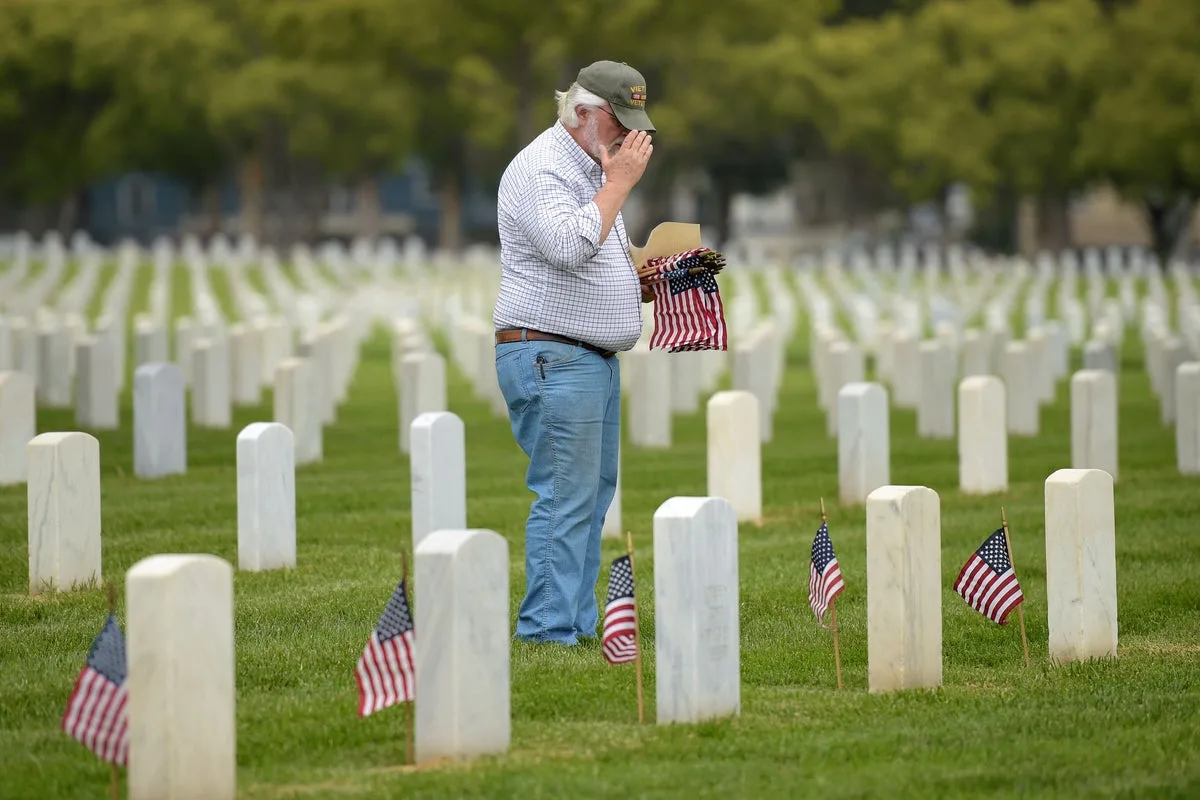
Memorial Day: From Civil War Origins to Modern Controversy
Memorial Day: Civil War Origins to Modern Controversy

Memorial Day, a US national holiday for mourning fallen service members, has increasingly become known as the unofficial start of summer, marked by long weekends, travel, and discounts on everything from mattresses to lawnmowers.

What is Memorial Day?

It falls on the last Monday of May. This year, it is on May 25. The day is meant for reflection and remembrance of those who died while serving in the US military, according to the Congressional Research Service. The National Moment of Remembrance encourages all Americans to pause at 3 p.m. for a moment of silence.

Origins of Memorial Day

The holiday's origins trace back to the American Civil War, which killed more than 600,000 service members between 1861 and 1865. The first national observance of what was then called Decoration Day occurred on May 30, 1868, after an organization of Union veterans called for decorating war graves with flowers. The practice was already widespread. Waterloo, New York, began a formal observance on May 5, 1866, and was later proclaimed the birthplace of the holiday. Boalsburg, Pennsylvania, traces its first observance to October 1864, according to the Library of Congress. Women in some Confederate states decorated graves before the war's end. Yale history professor David Blight points to May 1, 1865, when as many as 10,000 people, many of them Black, held a parade, heard speeches, and dedicated the graves of Union dead in Charleston, South Carolina. A total of 267 Union troops had died at a Confederate prison and were buried in a mass grave. After the war, members of Black churches buried them in individual graves.

Wide Pickt banner — collaborative shopping lists app for Telegram, phone mockup with grocery list

Why did Memorial Day become a source of contention?

As early as 1869, The New York Times wrote that the holiday could become “sacrilegious” and no longer “sacred” if it focused more on pomp, dinners, and oratory. In an 1871 Decoration Day speech at Arlington National Cemetery, abolitionist Frederick Douglass said he feared Americans were forgetting the Civil War’s impetus: enslavement. “We must never forget that the loyal soldiers who rest beneath this sod flung themselves between the nation and the nation’s destroyers,” Douglass said. His concerns were well-founded, said Ben Railton, a professor of English and American studies at Fitchburg State University in Massachusetts. Although roughly 180,000 Black men served in the Union Army, the holiday in many communities would essentially become “white Memorial Day,” especially after the rise of the Jim Crow South. In the 1880s, then-President Grover Cleveland was said to have spent the holiday fishing, and people were appalled. However, when the Indianapolis 500 held its inaugural race on May 30, 1911, a report from the Associated Press made no mention of the holiday or any controversy.

How has Memorial Day changed?

Matthew Dennis, an emeritus history professor at the University of Oregon, said Memorial Day’s potency diminished with the addition of Armistice Day, which marked World War I’s end on November 11, 1918. Armistice Day became a national holiday by 1938 and was renamed Veterans Day in 1954. In 1971, Congress changed Memorial Day from every May 30 to the last Monday in May. Dennis said the creation of the three-day weekend recognized that Memorial Day had long been transformed into a more generic remembrance of the dead, as well as a day of leisure. Just a year later, Time Magazine wrote that the holiday had become “a three-day nationwide hootenanny that seems to have lost much of its original purpose.”

Why is Memorial Day tied to sales and travel?

Even in the 19th century, grave ceremonies were followed by leisure activities such as picnicking and foot races. The holiday also evolved alongside baseball and the automobile, the five-day work week, and summer vacation, according to the 2002 book A History of Memorial Day: Unity, Discord and the Pursuit of Happiness. In the mid-20th century, a small number of businesses began to open defiantly on the holiday. Once the holiday moved to Monday, “the traditional barriers against doing business began to crumble,” authors Richard Harmond and Thomas Curran wrote. These days, Memorial Day sales and traveling are deeply woven into the nation’s muscle memory.

Pickt after-article banner — collaborative shopping lists app with family illustration

Iraq War veteran Edmundo Eugenio Martinez Jr., 48, an Army veteran from Katy, Texas, believes the day has lost so much meaning that many Americans conflate Memorial Day with Veterans Day, Armed Forces Day, and July Fourth. He noted how social media posts pay tribute to everyone who has served, when Memorial Day is specifically for those who died. For Martinez, the day is about honoring 17 US service members he knew who lost their lives. “I was either there when they died or they were soldiers of mine, buddies of mine,” he said. “Some of them lost the battle after the war.” He is posting photos and stories on social media about the service members he knows who died. “I’m not trying to be a Debbie Downer and tell you not to have your hotdogs and your burgers. But give them at least a couple minutes,” he said. “Give them some silence. Say a little prayer. Give them a nod. There’s a bunch of families out there that don’t have loved ones.”




