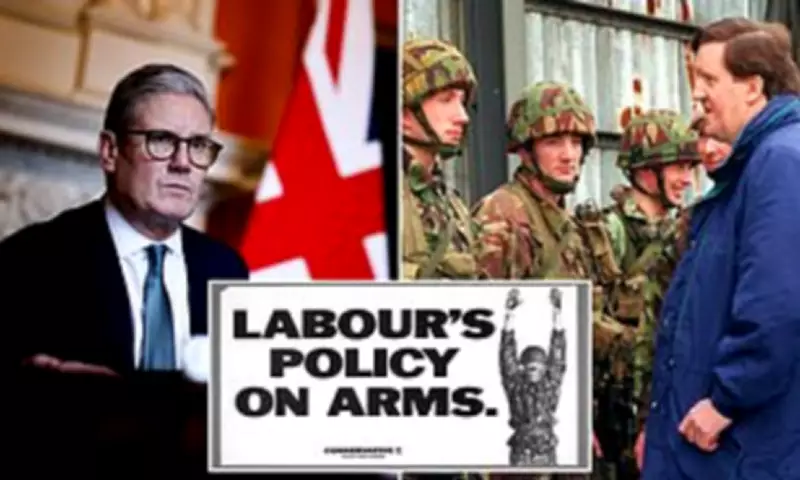
During the intense 1987 general election campaign, Neil Kinnock's revitalised Labour Party demonstrated unexpected resilience in opinion polls, prompting Conservative aides to convene an emergency strategy session. Their internal polling data revealed a critical vulnerability in Labour's platform: national defence. With insufficient time to develop polished attack advertisements, a director from the Tory branding agency hastily visited a nearby photo studio, donned a second-hand army surplus jacket and helmet, and posed with hands raised in mock surrender.
Historic Poster Transformed Political Fortunes
The resulting poster, emblazoned with the slogan 'Labour’s policy on arms', dramatically shifted Margaret Thatcher's electoral prospects. Perceived inadequacy on defence matters ultimately cost Kinnock and his party another opportunity to seize power. Now, nearly four decades later, Labour's perceived impotence on defence has resurfaced to plague the party once more. This time, however, the criticism originates not from political adversaries but from within Labour's own ranks.
Damning Assessment from Former Defence Secretary
George Robertson, who served as defence secretary under Tony Blair before becoming Secretary General of NATO, delivered a scathing indictment of Britain's current defence posture. Appointed by Keir Starmer last year to lead Britain's Strategic Defence Review, Robertson's comments yesterday proved devastatingly critical. He accused Starmer and his ministers of exhibiting 'corrosive complacency', leaving the nation dangerously unprepared for contemporary threats. Robertson particularly condemned Treasury policies as 'vandalism' against Britain's armed forces and challenged Starmer's national spending priorities, asserting, 'We cannot defend Britain with an ever-expanding welfare budget.'

Over recent weeks, as conflict escalated in the Middle East, Downing Street has endeavoured to portray Keir Starmer as a wartime leader—or at least a statesman who would ensure peace through strength. The government narrative suggested that under Starmer's steady leadership, which included last year's pledge to elevate defence spending to Cold War-era levels, citizens could rest assured of their security. This carefully crafted image has now been thoroughly dismantled, exposed as fundamentally deceptive.
Strategic Defence Review Co-Author Echoes Concerns
'We are not safe,' Lord Robertson declared unequivocally. His assessment found support from Fiona Hill, former White House advisor on Russia and co-author of Starmer's Strategic Defence Review. Despite the Prime Minister's bold rhetoric last year, Hill noted he had demonstrated 'a bizarre lack of urgency' regarding defence matters. In truth, Starmer's superficial posturing on defence reflects the consistent character of his premiership, extending back to his opposition leadership.
For Sir Keir, strength on defence represented primarily a political construct rather than a substantive policy commitment. Similar to his earlier insistence on being photographed before enormous Union flags, his interest centred on the optics of patriotism and strength. His pledge to rebuild Britain's hollowed-out armed forces served mainly to distance himself from predecessor Jeremy Corbyn. Once this positioning had exhausted its political utility, it was abandoned—much like the British military now faces abandonment.
Contrast Between Rhetoric and Reality
Recall Starmer's pronouncements from just twelve months ago: 'The defence review is a blueprint to make Britain safer and stronger, a battle-ready, armour-clad nation with the strongest alliances and the most advanced capabilities.' The present reality starkly contradicts this vision. Instead of increased expenditure, Britain's armed forces have been instructed to identify an additional £3 billion in savings. The nation's primary defensive alliance with the United States has disintegrated amid acrimony, NATO faces internal fractures, and Britain's supposedly 'armour-clad' nation could not deploy a single reliable destroyer to protect troops and bases in the Mediterranean when Iranian proxies launched attacks.

Downing Street now scrambles to manage the ensuing crisis. Treasury Minister James Murray toured broadcast studios repeating the implausible claim that balancing defence against other spending priorities does not constitute a 'zero-sum game'. Yet precisely this zero-sum dynamic defines the current predicament. We inhabit an age of austerity with the global economy teetering on the edge of a Trump-induced nervous breakdown. Taxpayers' funds must be allocated either to defence or to other sectors—they cannot magically accomplish both simultaneously.
Political Calculations Override National Security
The fundamental reality remains that Keir Starmer made a definitive political choice last year. Confronted with backbench rebellion over welfare reform, he prioritised personal political survival above all else. If this required reversing welfare savings and abandoning military enhancement plans, so be it. Compounding this dilemma, even if Starmer desired to reverse course, he lacks the capacity to do so. His Cabinet, parliamentary colleagues, and party would prevent such action.
Chancellor Rachel Reeves, whose own bold claims about Britain's economic preparedness were contradicted yesterday by IMF assessments, has explicitly stated she will not breach borrowing rules or locate additional funds for emergency rearmament. Other ministers have similarly refused to permit their departmental budgets to be raided for defence purposes. Even if Starmer could somehow persuade his Cabinet, Labour MPs would never sanction cuts to hospitals, schools, welfare, and policing to finance more tanks, bombs, guns, and drones.
Labour's Enduring Defence Dilemma
Certain priorities remain deeply embedded in Labour's DNA: NHS investment, public service promotion, workplace protections. Robust defence policy does not number among them. With Labour currently languishing fourth in opinion polls, MPs will not support reductions in social spending to facilitate military expansion. The necessary rearmament Britain desperately requires demands a Prime Minister possessing the strength, courage, and political acumen to drive military reconstruction. No credible observer within or outside government believes Sir Keir Starmer embodies these qualities.
Forty years ago, Labour's opponents exposed the party's defence Achilles heel, consigning it to another decade in political wilderness. This week, Labour's own senior figures have been compelled to highlight how the current Labour government jeopardises national defence. Beyond spin, optics, and outright falsehoods, this constitutes the undeniable reality: Britain is not safe under Keir Starmer's leadership.