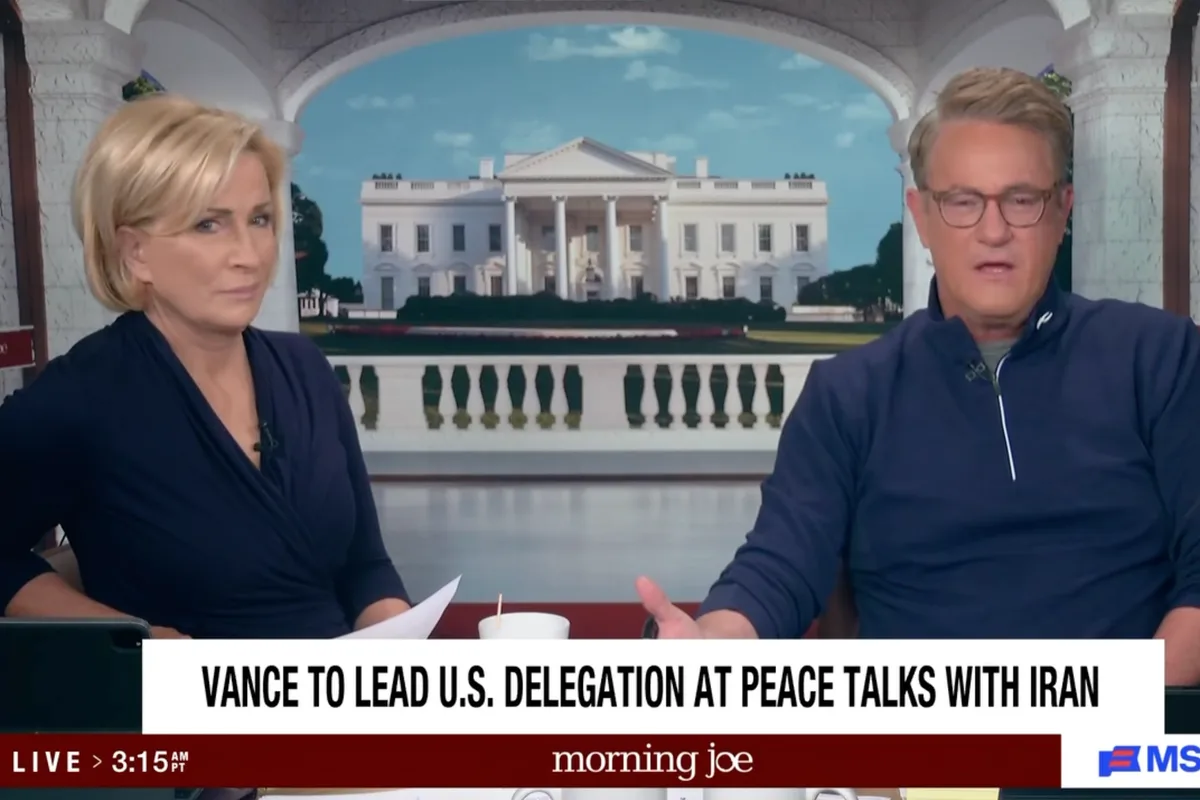
MS NOW's flagship breakfast programme Morning Joe descended into stunned silence and confusion on Thursday as its hosts grappled with Vice President JD Vance's extraordinary analogy comparing Iran's nuclear ambitions to his wife's theoretical right to skydive.
Airport Analogy Leaves Presenters Scrambling
The bizarre comparison emerged during Vance's visit to Budapest, where he was supporting Hungarian nationalist leader Viktor Orban ahead of Sunday's crucial elections. At Budapest airport, journalists questioned the vice president about recent comments from Iranian parliamentary speaker Mohammad Bagher Ghalibaf, who had emphatically restated his country's "right to enrichment" regarding nuclear materials.
Vance responded with what would become one of the most discussed political analogies of the week: "I thought to myself, you know what? My wife has the right to skydive, but she doesn't jump out of an airplane because she and I have an agreement that she's not going to do that because I don't want my wife jumping out of an airplane."
Presenters Struggle to Comprehend
When footage of Vance's comments reached the Morning Joe studio, presenter Mika Brzezinski visibly struggled to maintain her composure. "I'm just – I really don't want to hear about women's rights, and rights and women from JD Vance," she declared, her voice tinged with disbelief.
Her co-host and husband Joe Scarborough attempted to interject, but Brzezinski cut him off firmly: "Don't start the morning that way. So messed up." Scarborough later joked about the cognitive dissonance the analogy provoked, saying: "That was such a confusing analogy, my teeth hurt right now. I'm still trying to figure it out."
Fellow contributor Willie Geist added his own sardonic take: "I also didn't know you were allowed to give your wife rules of things she can't do. I need to write a few down now on how we operate!"
Broader Context of Nuclear Negotiations
The unusual analogy came at a diplomatically sensitive moment, following a late ceasefire deal between the United States and Iran that was brokered by Pakistan on Tuesday. This eleventh-hour agreement narrowly prevented another round of airstrikes, though the temporary truce already appears precarious due to disagreements about whether Israel's campaign against Hezbollah in Lebanon falls within the two-week suspension of hostilities.
Preventing Iran from obtaining nuclear weapons remains a cornerstone of Operation Epic Fury, the military strategy articulated by President Donald Trump. This persists despite Trump's previous claims to have "obliterated" Iranian enrichment facilities during bombing campaigns last summer.
The Civilian Nuclear Question
Shortly before launching into his skydiving comparison, Vance had been asked specifically whether Iran might be permitted to continue uranium enrichment for civilian purposes. Nuclear energy has legitimate peaceful applications including:
- Electricity generation for national grids
- Seawater desalination to produce drinkable water
- Medical treatments and diagnostic procedures
The vice president responded by reiterating administration policy: "What the president has said is that we don't want Iran to have the capacity to build a nuclear weapon. The president has also said that we don't want Iran enriching towards a nuclear weapon and we want Iran to give up the nuclear fuel. Those are going to be our demands during the negotiation."
Personal Context and Reactions
Second lady Usha Vance announced in January that she is expecting the couple's fourth child, which may have informed her husband's expressed opposition to hypothetical daredevil activities, though he made no explicit connection between the pregnancy and his comments.
Brzezinski expanded her criticism beyond the immediate analogy, connecting it to broader concerns: "Women across America have rules that I never grew up with that kill them, so that's where we are."
The incident highlights the continuing tension between diplomatic messaging and personal analogy in high-stakes international negotiations, while demonstrating how unconventional comparisons can dominate media cycles and provoke strong reactions across the political spectrum.






