

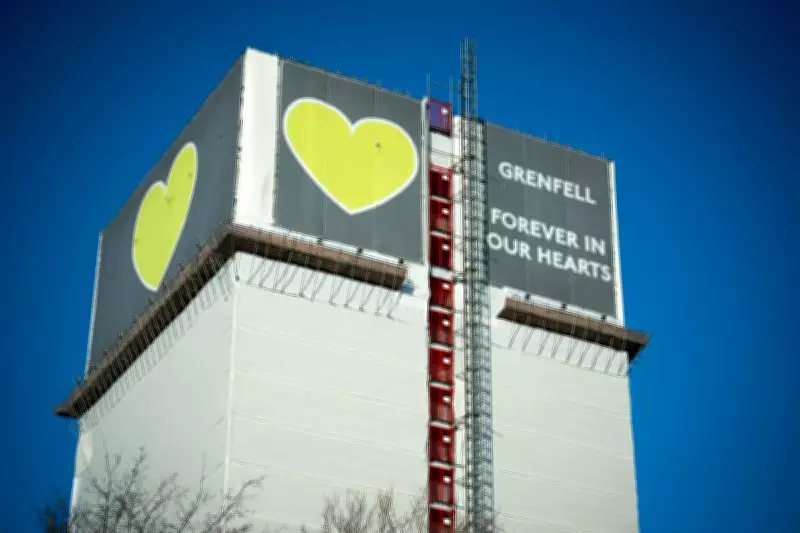
Grenfell Families Issue Urgent Plea to Preserve Tower's Handprint Walls
Families who lost loved ones in the catastrophic Grenfell Tower fire have issued a fresh and urgent plea to the UK government, demanding the preservation of sections of the building's stairwell walls that bear poignant handprints believed to belong to victims or survivors of the blaze.
The Tragic Fire and Ongoing Deconstruction
The devastating fire tore through the 24-storey social housing block in west London on 14 June 2017, claiming 72 lives. Deconstruction of the tower began in September last year and is expected to take approximately two years to complete, a process that has now sparked significant controversy and legal action.
A photograph shared with Reuters reveals a smoke- and fire-blackened wall in a hallway, clearly showing at least three distinct handprints. Additionally, an Arabic inscription reading "Allahu Akbar" (meaning "God is greatest") was discovered on a different floor, with further handprints identified in another stairwell area.

Families' Emotional Appeal and Legal Action
Karim Khalloufi, who lost his sister in the tragedy, stated emphatically: "These sections on the walls in the stairwell hold the voices of that night - and we will not let them be erased, silenced, or this tragedy be sanitised." His words underscore the deep emotional connection families have to these physical remnants.
The families have now initiated formal legal proceedings, filing a pre-action letter to the government in an attempt to secure a judicial review of the decision regarding the tower's deconstruction. They argue that Angela Rayner, then deputy prime minister, had promised in 2025 that parts of the tower could be preserved for a memorial if the community desired it, a commitment they feel is being disregarded.
Advocacy and Government Response
Grenfell Next of Kin, a group representing the immediate families of over half of those who died, is actively advocating for the preservation of these critical sections. They seek to allow adequate time for discussions with families and memorial designers to determine the most respectful and meaningful way to incorporate these artifacts into a permanent tribute.
However, lawyers for the families report that the government has indicated it will not preserve anything above the ninth floor due to the sensitivity and profound loss of life associated with higher levels, despite the handprints and inscription being found above this threshold. This stance has intensified the families' determination to fight for preservation.
A spokesperson for the Ministry of Housing, Communities and Local Government (MHCLG) affirmed the government's commitment to "ensuring what happened at the tower is remembered, with the community's voice at the heart of our work," adding that the deconstruction process is being handled with utmost care and consideration for those affected. Yet, this assurance has done little to alleviate the families' concerns about the potential loss of these irreplaceable historical markers.
The conflict highlights the ongoing struggle between practical deconstruction efforts and the imperative to honor the memory of the victims through tangible remnants of the tragedy, as the Grenfell community continues to seek justice and remembrance nearly a decade after the fire.






