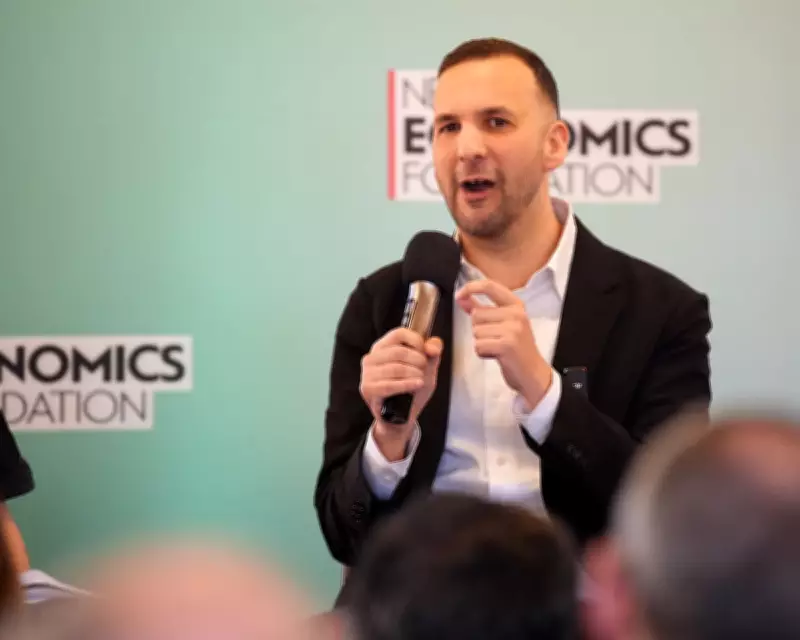
Green Party Leader Calls for Economic Paradigm Shift Away from GDP Growth
In his first major economic policy address since assuming leadership of the Green Party in England and Wales six months ago, Zack Polanski has articulated a bold vision that fundamentally challenges conventional economic thinking. Speaking at a community garden in north London, Polanski declared that a government led by the Greens would abandon traditional Gross Domestic Product (GDP) growth targets entirely, instead prioritising the enhancement of public services, mental health, and social cohesion as primary indicators of national success.
Condemning "Rip-Off Britain" and Austerity's Legacy
Polanski launched a scathing critique of what he termed "rip-off Britain," a system he argues disproportionately benefits a minority of asset owners while ordinary citizens struggle with unaffordable housing and escalating living costs. He attributed this economic injustice to decades of privatisation in social housing and utilities, compounded by austerity measures that have widened inequality.
"The picture for people living in the UK today is bleak," Polanski asserted. "Wages have all but stagnated since 2008. Unemployment is on the rise – and the number of young people out of work is at an 11-year high. Growth has literally ground to a halt in spite of this government pursuing a policy of growth at all costs."

GDP: A Flawed Measure of Progress
Central to Polanski's argument is the contention that GDP is an inadequate and often misleading metric for societal wellbeing. He illustrated this with a pointed example: "If a water company pumps sewage into the water and then pays for that to be cleaned up, then that technically improves your GDP, and that's economic growth. That would seem absurd to most people, and it's not a way to do it."
Instead of fixating on arbitrary growth figures, Polanski advocates for a mission-oriented approach to governance. Governments, he proposes, should construct policies around broader, cross-cutting objectives such as tackling the climate emergency or reducing gender inequality. Within this framework, economic growth could emerge as a beneficial byproduct, rather than being the primary, sometimes counterproductive, goal.
The Green Economic Framework: Three Guiding Questions
Polanski outlined that the Green Party's economic policy would be guided by three fundamental questions:
- How do we make life more affordable?
- How do we back the caring majority over the wealthy elite?
- How do we protect our planet for generations to come?
To translate these principles into action, he reiterated several specific policy proposals, including:
- The introduction of a comprehensive wealth tax.
- The implementation of rent controls to address housing affordability.
- The renationalisation of the water industry.
- A large-scale, government-backed programme for home insulation to combat energy inefficiency and high bills.
Funding the Vision: Rethinking Economic Rules
When pressed on how a Green government would finance such an ambitious agenda, Polanski called for a fundamental rethink of the UK's economic rules to escape what he described as the "bond market doom loop." He emphasised a pragmatic, non-ideological approach to fiscal policy.
"Ultimately, I'm a pragmatist. I'm not an ideologue, so I'm interested in anything that works," he stated. "There will be borrowing, but it's borrowing for investment. I think that's the key point there. As well as that, I think there is a conversation to be had about quantitative easing, and I think part of it is there's no one fixed approach. There's no one jigsaw piece that's going to solve everything."
Polanski also linked current economic pressures to geopolitical events, specifically describing the recent US-Israel actions against Iran as "a war of choice" not prompted by an imminent threat. He argued that such conflicts necessitate increased government support for households struggling with energy bills.
In conclusion, Polanski's speech marks a significant attempt to redefine economic success, shifting the focus from abstract growth metrics to tangible improvements in community welfare, environmental sustainability, and individual wellbeing.