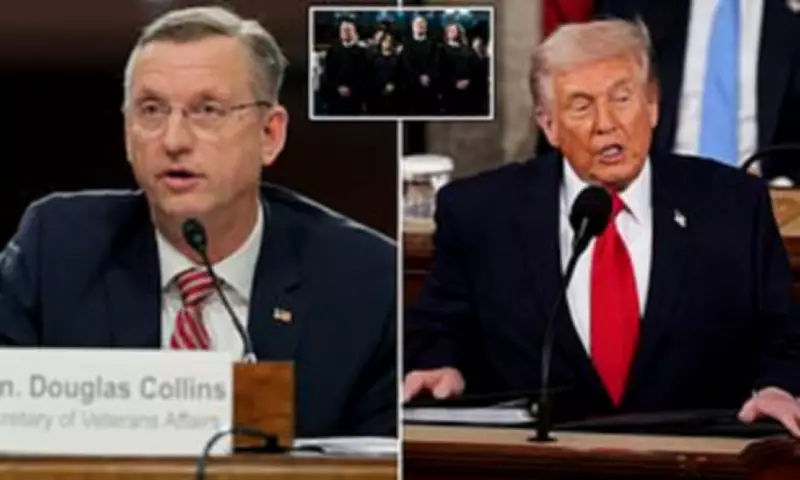
President Donald Trump has selected Department of Veterans Affairs Secretary Doug Collins as the designated survivor for his 2026 State of the Union Address, a critical role in preserving the continuity of the United States government. This marks the second consecutive year that Collins, a former Georgia lawmaker who currently serves as the VA boss, has been chosen for this solemn duty. As the designated survivor, he is kept at a secure, undisclosed location during the speech to ensure that at least one official in the presidential line of succession remains safe in the event of a catastrophic attack on the Capitol.
The Role and History of the Designated Survivor
The concept of a designated survivor originated in the 1950s amid Cold War fears of a nuclear attack that could decapitate the entire U.S. government. However, the protocol was not publicly acknowledged until the 1980s, when administrations began announcing the identity of the designee after the fact. The practice involves selecting a Cabinet member who is at least 35 years old and a natural-born U.S. citizen, positioned within the presidential line of succession, to be absent from major gatherings like the State of the Union.
During such events, the designated survivor is sent to a protected location to safeguard the continuity of government. This precaution is taken because the State of the Union typically assembles the entirety of Congress, including 100 senators and 435 House representatives, all nine Supreme Court justices, the president's entire Cabinet, the first family, and numerous special guests, media, and staff—creating a high-risk scenario if a mass-casualty event were to occur.

Presidential Succession and Legislative Precautions
The presidential line of succession is outlined in the U.S. Constitution and clarified by the Presidential Succession Act of 1947. It begins with the vice president, followed by the speaker of the House, the Senate president pro tempore, and then Cabinet members in the order of their department's creation. Doug Collins, as Secretary of Veterans Affairs, is 17th in line to the presidency.
Interestingly, Senator Chuck Grassley, the 92-year-old president pro tempore of the Senate and the most veteran member of the chamber, who is fourth in line to the presidency, also appeared to skip the event. While not officially designated, his absence highlights that some lawmakers historically sit out to preserve continuity within the legislative branch as well.
Political Context and Additional Designees
Beyond the executive branch, political parties sometimes appoint their own designated survivors for the State of the Union. House Democrats announced that Congressman Mike Thompson of California would serve as their designated survivor for Trump's address, a role he also held last year. Thompson stated on social media, "I’ve been selected as a designated survivor for tomorrow’s State of the Union, so I won’t be there in person, but I’ll be watching. Americans deserve accountability for the militarization of ICE, terrorization of our communities and killing of American citizens."
In contrast, House Speaker Mike Johnson's office did not respond to inquiries about whether the GOP would appoint a designated survivor. This may be less critical, as many Democrats have announced they would boycott Trump's speech in protest, reducing the need for such precautions on their side.
Historical Precedents and Variations
The practice of having a designated survivor has also been applied to presidential inaugurations, which similarly gather top federal officials. However, Trump's inauguration last year did not include a designee. During Joe Biden's final year as president in 2024, Education Secretary Miguel Cardona, who was 16th in line to the presidency, served in this role.
Washington, D.C., and the U.S. Capitol are among the most heavily surveilled and policed areas in the country, yet the designated survivor protocol remains a vital contingency plan. It ensures that even in the face of the most deadly threats, such as a strike on Congress while all top officials are assembled, the federal government can endure and maintain operational continuity.