

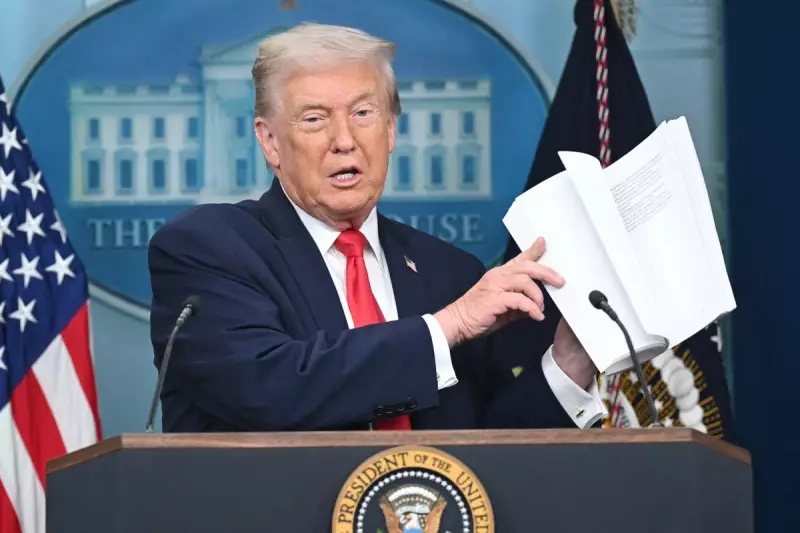
Fresh demands have emerged from Democratic lawmakers urging the invocation of the 25th Amendment to remove President Donald Trump from office, following his recent threats regarding Greenland. This latest controversy has reignited debates about the president's mental fitness and stability on the global stage.
Growing Concerns Over Presidential Behaviour
President Trump's administration is confronting another wave of calls to implement the constitutional provision that allows for the removal of a president deemed unfit to serve. The catalyst for this renewed pressure stems from the president's messages to Norwegian Prime Minister Jonas Gahr Store, in which he questioned Denmark's sovereignty over Greenland and hinted at territorial ambitions.
This is not the first instance where such demands have surfaced. Similar calls were made following the January 6th Capitol attack in 2021, and again in October last year after President Trump delivered a disjointed address to military leaders in Quantico, Virginia.

Democratic Lawmakers Voice Alarm
Several prominent Democrats have publicly called for action. Massachusetts Senator Ed Markey, Arizona Representative Yassamin Ansari, and California Representatives Eric Swalwell and Sydney Kamlager-Dove have all demanded the Amendment's invocation following the Greenland-related communications.
Representative Ansari took to social media to express her concerns, stating: "The president of the United States is extremely mentally ill and it's putting all of our lives at risk. The 25th Amendment exists for a reason – we need to invoke it immediately."
Unusual Critics Join the Fray
The criticism has extended beyond political opponents. Dr Jonathan Reiner, former cardiologist to late vice president Dick Cheney, commented that the president's letter "should trigger a bipartisan congressional inquiry into presidential fitness."
Further concerns were raised when President Trump embarked on a social media posting spree, sharing 33 messages on Truth Social within 45 minutes. These posts included claims about NATO achievements, conspiracy theories regarding voting machines, and Islamophobic content.
The 25th Amendment: Historical Context and Practical Application
The constitutional amendment, ratified in 1967, provides clear procedures for presidential succession and removal. While it has never been used to permanently remove a president, it has been invoked several times for temporary transfers of power during medical procedures.
Previous presidents including Ronald Reagan, George W. Bush, and Joe Biden have temporarily transferred authority to their vice presidents for medical reasons. However, the mechanism for permanent removal requires significant political consensus.
How the Removal Process Works
The amendment outlines a specific procedure for declaring a president unable to discharge their duties. First, the vice president and a majority of the presidential cabinet must jointly agree that the president is unfit to serve. Alternatively, a disability review panel could be established with congressional approval.
Once such a declaration is made, the vice president would immediately assume the role of acting president. The president can contest this decision, triggering a congressional review process that requires a two-thirds majority in both houses to sustain the removal.
Political Realities and Historical Precedents
Despite the renewed calls, political analysts consider successful invocation extremely unlikely. President Trump maintains strong support within his cabinet and enjoys the loyalty of Vice President JD Vance. Furthermore, a Republican-dominated Congress shows little appetite for such dramatic action.
The situation mirrors previous political dynamics. During the Biden administration, Republican lawmakers repeatedly called for the 25th Amendment's invocation, citing concerns about cognitive decline. Vice President Vance himself advocated for such action against President Biden during the 2024 campaign.
As the debate continues, the fundamental question remains whether sufficient political will exists to translate concerns about presidential fitness into constitutional action. The Greenland controversy has certainly intensified the discussion, but the constitutional threshold for removal remains formidably high.






