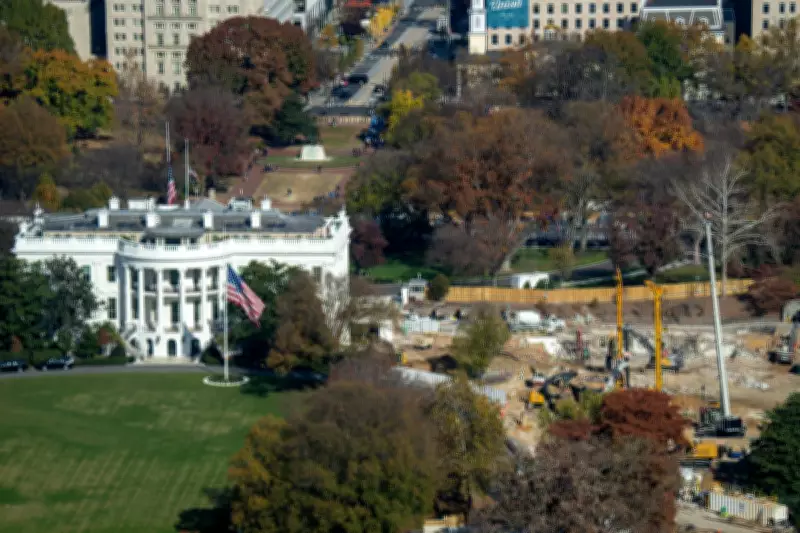
A federal appeals court has delivered a temporary victory for President Donald Trump, ruling that construction on his controversial $400 million White House ballroom can proceed while legal challenges are resolved.
Court Overturns Lower Court's Halt Order
On Saturday, a three-judge U.S. circuit court in Washington, D.C. ruled 2-1 that temporary construction on the ballroom project can continue until April 17, when the court will revisit the issue. This decision overturns a previous ruling from U.S. District Judge Richard Leon, who had ordered construction to stop by April 14.
Safety and Security Arguments
President Trump has vigorously defended the ballroom project, arguing through his legal team that completion is essential for safety and security purposes. In court documents, Trump's lawyers stated that "the ballroom is clearly a vital project for the safety and security of the White House and the President, his family, and his staff."

The appeals court ruling did not assess the validity of these security claims but instructed the original court to review the case and provide clarifications on the matter.
Authority and Funding Disputes
Judge Leon had previously ruled that Trump exceeded his presidential authority by undertaking the construction without Congressional approval. The judge noted that while the president serves as "steward of the White House," he is not the owner of the property.
Trump's legal team has countered this argument by emphasizing that the project is entirely funded through private donations. "No taxpayer dollars are being used for the funding of this beautiful, desperately needed, and completely secure ballroom," they wrote in court filings.
Opposition from Preservation Groups
The National Trust for Historic Preservation, which opposes the ballroom project, has challenged the construction on multiple grounds. The organization argues that all construction projects involving federal buildings require Congressional approval, regardless of funding sources.
In their appeal, the preservation group questioned the legitimacy of Trump's national security claims, stating: "Defendants appear to contend that being prevented from illegally constructing a massive ballroom constitutes a national security emergency. It plainly does not."
The opposition also noted that the ballroom will require two years to complete and that "the absence of a massive ballroom on White House grounds has not stopped this (or any other) President from residing at the White House or hosting events there."
Broader Implications
The legal battle raises significant questions about presidential authority, property rights, and the balance of power between branches of government. Trump's lawyers have argued that decisions about White House security needs should rest solely with the president, stating that such matters "cannot possibly be outsourced to other branches of government."
However, critics maintain that the project represents a substantial alteration to public buildings on federal land, requiring proper oversight and approval processes regardless of funding mechanisms.
The case continues to develop, with the next court review scheduled for April 17, when further determinations about the ballroom's construction and legal standing will be made.