Benefit Claimants Could Match GP Earnings Under 'Warped' Welfare System, Analysis Reveals
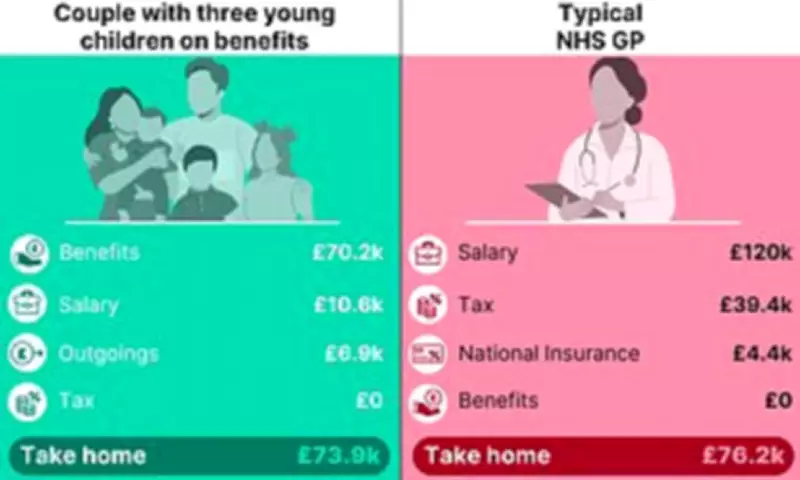
A startling analysis has exposed how Britain's welfare system could allow benefit claimants to amass earnings comparable to those of general practitioners, with critics branding the situation as "warped" and evidence that "welfarism has gone too far." The hypothetical scenario, presented by the Daily Mail, involves a healthy couple with three young children residing in central London who could potentially receive up to £70,000 in handouts annually.
How the System Could Be 'Gamed'
The couple's strategy hinges on intentionally earning £10,572 per year—the minimum required to entirely lift the benefit cap—by both working just eight hours a week at minimum wage. This deliberate low income splits their earnings evenly, allowing them to avoid paying tax or National Insurance while maximising benefit entitlements.
Because of their carefully managed financial situation, they could qualify for up to £26,000 in housing credits to cover their central London rent, with the Department for Work and Pensions paying all bills for a three-bedroom property. As a technically employed family, they are entitled to claim back 85% of childcare fees, up to a maximum of £22,000 annually.

This childcare support breaks down to £1,836 monthly—the government's maximum for households with two or more children—with an additional £736 for their third child under plans rolling out later this year. Official DWP guidance states that "it does not matter how many hours you or your partner work," suggesting minimal work hours don't prevent claiming childcare at taxpayer expense.
The Complete Benefit Package
Beyond housing and childcare, the couple in their 30s would receive the standard Universal Credit allowance of £666.97 monthly (approximately £8,000 annually) plus nearly £11,000 from the child element at £303.94 per child each month. They would also benefit from £3,200 in separate Child Benefit payments available to parents earning under £60,000 before tax.
After accounting for deductions—£3,000 for earnings over Universal Credit's Work Allowance and £3,900 for remaining childcare costs—their total benefits package would reach about £73,900. For context, latest NHS statistics show GPs in England earn an average of £120,200 before tax, resulting in approximately £76,200 take-home pay, which decreases further with student loan or pension contributions.
Political Reactions and Broader Implications
Helen Whately, Tory work and pensions spokesman, told the Daily Mail: "The rider has become heavier than the horse. Labour's failure to grip welfare has completely warped incentives and benefits earn you more than a job. Labour are weakening the link between effort and reward, making it easier to game the system than get on in work."
Shimeon Lee, policy analyst at the TaxPayers' Alliance, added: "This exposes just how warped Britain's tax and welfare system has become under Labour, where doing the right thing can leave you worse off than opting out of work altogether. When an unemployed household can take home as much as a GP who's spent a decade training, it's a flashing red warning light that incentives are broken."
Joanna Marchong of the Adam Smith Institute think-tank said: "It's hard to find this anything but shocking and illuminating to how out of balance the system is. Our welfare system is being abused, for ordinary taxpayers looking at those taking advantage, it's clear that work no longer pays."
Policy Changes and Historical Context
This scenario became possible following Number 10's decision to ditch the two-child benefit cap last autumn, which previously would have reduced the family's benefits by around £3,600. The Conservatives have criticised Labour's move to scrap the cap, warning it will "cost billions, reward worklessness and leave working families picking up the tab."
Recent figures indicate approximately 3,200 families received the maximum childcare element of Universal Credit in November 2025. Earlier calculations from the Centre for Social Justice think-tank suggested 6.2 million workers—one in four of the workforce—would be better off on benefits, with an individual receiving PIP and Universal Credit potentially getting £25,200 annually, equivalent to a £30,100 pre-tax salary.

The overall sickness benefits bill is projected to reach £109 billion by decade's end, according to Office for Budget Responsibility warnings, raising fears that the UK may spend more on health and disability benefits than any other G7 country. Labour's attempt to cut £5 billion from the welfare bill last year resulted in a humiliating U-turn after backbench MP revolt.
Future Proposals and Responses
Robert Jenrick, Nigel Farage's choice as future Chancellor if Reform were to win the election, revealed plans to reinstate the two-child benefit cap and require mental health disability claimants to prove illness before receiving payments. The party has also pledged to restrict benefits to British nationals only.
Conservative leader Kemi Badenoch stated she would reinstate the two-child cap, redirecting savings to boost military funding. Meanwhile, the Child Poverty Action Group charity argues the cap affects one in nine UK children and represents the "single biggest driver of rising child poverty."
A DWP spokesman responded: "This is a highly unlikely, hypothetical example and we are clear that households in work should be consistently better off than households on benefits alone. Our reforms to the welfare system are prioritising fairness and opportunity, including recent Universal Credit changes expected to save nearly £1 billion by narrowing gaps between health-related benefits and work-seeking payments."
The department also announced legislation to encourage benefit recipients to try work and redeployed 1,000 work coaches to assist sick and disabled people previously without contact for years.