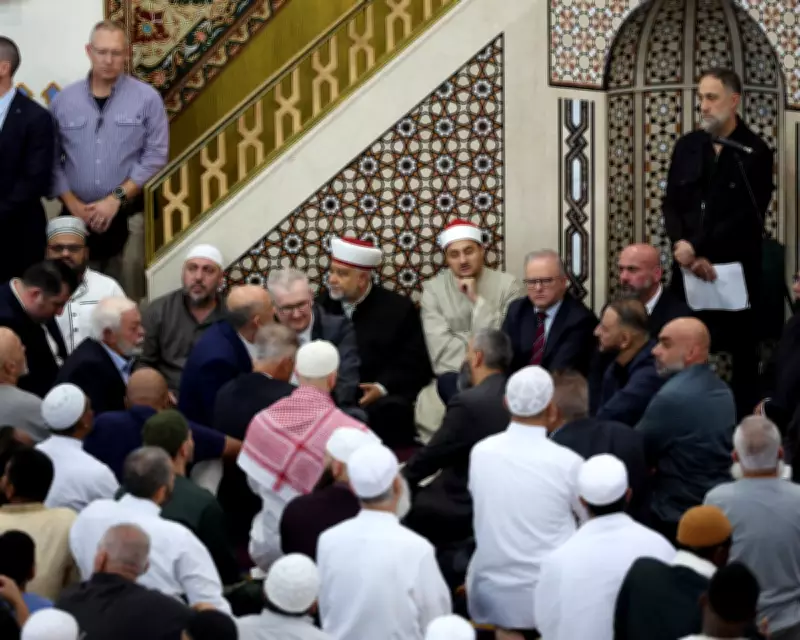
Prime Minister Anthony Albanese and Home Affairs Minister Tony Burke visited Lakemba mosque in Sydney's west on Friday morning to mark Eid al-Fitr, one of the most sacred occasions in the Islamic calendar. The visit, however, was marred by vocal protests from some worshippers, leading to a hasty exit by the prime minister.
Heckling and Hasty Exit
During the event, Albanese sat at the front of the mosque while Gamel Kheir, secretary of the Lebanese Muslim Association, read a statement criticising Australia's involvement in the Middle East war and its impact on the Muslim community. As Kheir spoke, some attendees began to protest against the presence of Albanese and Burke.
Worshippers were heard yelling phrases such as "disgrace", "shame", and "genocide supporters". One man who booed the prime minister was escorted out by police but was released without charge after receiving a move-on direction. Albanese subsequently left quickly, avoiding a large crowd waiting on the mosque's steps.

Albanese's Response to the Incident
At a press conference later that afternoon, Albanese stated that there were approximately 30,000 people in Lakemba and described the reception to his visit as "overwhelmingly ... incredibly positive". He acknowledged that "there were a couple of hecklers inside" but emphasised that they were "dealt with" by the community itself.
The prime minister claimed that the hecklers were unhappy because his government had outlawed "extremist organisations like Hizb ut-Tahrir". However, he provided no evidence to support this assertion, and Guardian Australia analysis of videos from the event found no reference to the group. The prime minister's office was contacted for further comment but did not elaborate.
Lebanese Muslim Association's Defence
The Lebanese Muslim Association issued a statement defending its decision to host Albanese, clarifying that his attendance was not a "betrayal" of its stance on Gaza and Lebanon. The association acknowledged the high emotions within the community, particularly due to the ongoing suffering in Gaza and devastation in Lebanon, which are deeply personal issues for many.
The statement read: "Choosing to engage with the elected leadership of this country is not a betrayal of those concerns. It is how we give them a voice. Walking away from engagement has not advanced our community, nor has it changed outcomes overseas."
It further emphasised that the association's position on Gaza and Lebanon remains "clear and unchanged", advocating for justice, an end to violence, and the protection of innocent lives. The association argued that engaging with the government strengthens their ability to express these concerns where it matters most.
Broader Context and Previous Incidents
This incident occurs against the backdrop of Israel's military actions in Lebanon, which have resulted in significant casualties and displacement. According to the Lebanese health ministry, Israel's assault has killed at least 912 people, including 111 children, and wounded 2,221 others, with over one million people displaced.
Additionally, the federal government recently announced it would send a specialist surveillance aircraft and air-to-air missiles to the UAE to protect Australians in the Gulf state, which has been targeted by Tehran in retaliation for US and Israeli bombings of Iran.
This is not the first time a government figure has faced protests in Lakemba. About a year ago, Tony Burke was forced to leave a Muslim prayer event in the same area due to security concerns after protesters arrived intent on telling him he was "not welcome". Protesters had planned to heckle and interrupt Burke during nightly Ramadan prayers, but he left before addressing the congregation.
Community Reactions and Frustrations
Bilal Rauf, a barrister and senior adviser to the Australian National Imams Council, highlighted the distress and frustration many feel regarding the government's handling of community issues. He cited examples such as Albanese's invitation to Israeli President Isaac Herzog following the Bondi terror attack and the police response to Muslim men praying during protests over Herzog's visit.

Rauf stated: "So many people in our society are connected to what's happening around the world, and they are hurting. They are seeing their family members killed. They are seeing homes of family burned." This sentiment underscores the deep emotional ties and grievances within the community that may have contributed to the protests at Lakemba mosque.
The incident at Lakemba mosque highlights the complex interplay between domestic politics, international conflicts, and community engagement. While Albanese attributed the heckling to his government's actions against extremist groups, the broader context suggests a multitude of factors, including ongoing Middle Eastern conflicts and perceived governmental insensitivity, are at play.