The Collapse of Alex Salmond's Independence Dream
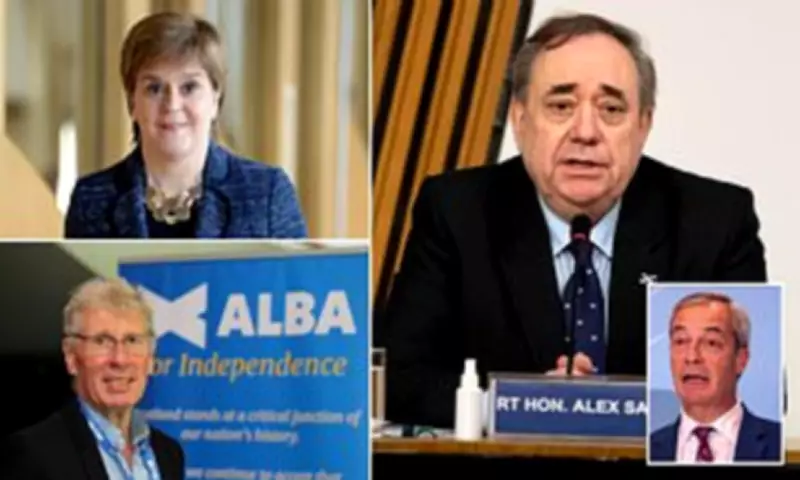
When the late Alex Salmond announced his leadership of the newly established Alba Party five years ago, he made bold promises to Scottish Nationalists. He declared that the party would help create a pro-independence 'supermajority' at the Scottish Parliament in Holyrood. The former First Minister urged those wishing to break up the United Kingdom to vote for the SNP in constituencies and support Alba on regional lists, aiming to maximize the chances of securing a second independence referendum.
A Flag Planted in the Wind
On March 26, 2021, Mr Salmond proclaimed, 'Today, Alba are hoisting a flag in the wind, planting our Saltire on a hill. In the next few weeks we shall see how many will rally to our standard.' However, the reality that followed was starkly different from this optimistic vision. At the Scottish Parliament elections held just six weeks later, Alba managed to secure only 1.7 percent of the vote. There was little evidence of any significant rallying to the party's standard.
Support continued to decline rapidly in subsequent elections. During council elections across Scotland one year later, Alba's share of the vote fell to a mere 0.7 percent. The situation deteriorated further at the 2024 UK general election, where the party achieved just 0.5 percent of the vote, with all candidates losing their deposits.

Financial Crisis and Election Exclusion
Now, with the Scottish Parliament election less than three months away, Alba finds itself in a state of profound crisis. Kenny MacAskill, the former SNP justice secretary who succeeded Mr Salmond as party leader following his death from a heart attack in October 2024, has revealed that the party cannot afford to stand candidates in the upcoming May elections.
Mr MacAskill told BBC Radio Scotland, 'You can have a great deal of wishful thinking but you also have to have a practical reality. Unfortunately as a result, we believe, of a fraud perpetrated upon us, the Alba Party finds itself in a very precarious position.' He explained that the party is unable to meet its current financial obligations or fund any election campaign.
The financial difficulties come amid an ongoing police investigation into allegations of financial irregularities within the party that began last May. This investigation has further complicated the party's already troubled circumstances.
A Troubled Quartet's Rescue Attempt
Amid this chaos, a group of four individuals has emerged offering to take over the party to enable it to contest the elections scheduled for May 7. This quartet comprises party officials Christina Hendry and Suzanne Blackley, former MSP and convicted perjurer Tommy Sheridan, and ex-Nationalist MP Angus MacNeil.
Mr MacNeil first gained notoriety in 2005 when it emerged that, while his wife was pregnant, he had taken two teenage girls to a hotel bedroom for what he described as 'some foolishness.' The fact that he received support from the SNP through this scandal remains shocking to many observers, who note that such behavior in contemporary politics would likely result in immediate expulsion from any serious political party.
The Vanity Project That Never Delivered
The fundamental truth is that Alba cannot be saved, not by Kenny MacAskill and certainly not by Mr MacNeil or Mr Sheridan. Alba was never a serious democratic prospect but rather a vanity project for Alex Salmond, who left the SNP in 2018 following allegations of sexual misconduct that led to a 2020 court case where he was cleared of all charges.
Furious that his former protégée, Nicola Sturgeon, had refused to take his side during this period, Mr Salmond saw Alba as a vehicle for his political rehabilitation. Those who quit the SNP to join him in his new party allowed themselves to believe he could recreate past successes. If Mr Salmond had already delivered one independence referendum, they reasoned, why couldn't he do it again?
Destroyed Credibility and Russian Connections
By the time he became Alba chief, Mr Salmond had already substantially destroyed his own credibility. Not only was there the trial during which his own lawyer conceded that Mr Salmond could have been 'a better man,' but there were also the four years during which he accepted money from the Russian propaganda channel RT for his Alex Salmond show.

Observers have noted remarkable similarities between Mr Salmond and Nigel Farage, the Reform UK leader. Both men consistently promised simple solutions to complex problems throughout their careers. Like Mr Farage, Mr Salmond encouraged his supporters to believe their lives would be better without the influence of others—in Mr Farage's case, the European Union, and in Mr Salmond's, the United Kingdom.
A Dictatorial Leadership Style
Perhaps the greatest similarity between the two men lies in their lone-wolf 'leadership' styles. Nigel Farage has no room in his party for equals, leading with a dictatorial approach where it is his way or the highway. This was precisely how Mr Salmond approached his role. While there was plenty of warm rhetoric about the team he had assembled, no member of the SNP under his leadership was in any doubt that what Mr Salmond wanted, Mr Salmond got.
As Alba leader, Alex Salmond remained detached from the realities of those who supported him. Party members existed not to win independence but to keep him in the public eye, indulging his fantasy that he remained a power-player in Scottish politics.
The Inevitable Conclusion
Kenny MacAskill's weekend announcement that his party is in crisis surprised no one who has been paying attention to its recent fortunes. The truth is that Alba died with Alex Salmond. All that remains now is for its dwindling band of members to accept this reality. The party that promised to plant the Saltire on a hill and create an independence supermajority has instead become a cautionary tale about political vanity and failed ambitions.