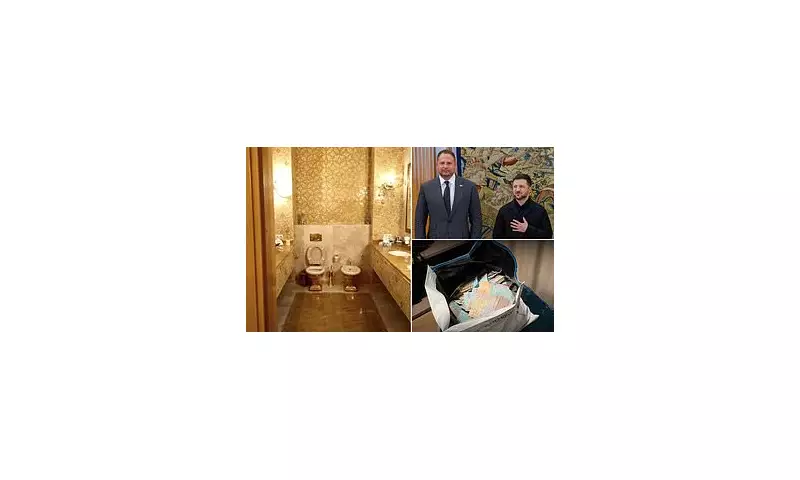
A sprawling corruption scandal, involving luxury mansions, duffel bags of cash, and a notorious golden toilet, has crippled President Volodymyr Zelensky's inner circle at a pivotal moment in Ukraine's history. Ukraine's top anti-corruption agencies allege that senior officials and business figures embezzled approximately £76 million ($100 million) from the energy sector as Russian missiles targeted civilians and the nation endured blackouts.
The Anatomy of a Wartime Embezzlement Scheme
According to a 15-month investigation by Ukraine's National Anti-Corruption Bureau (NABU) and the Specialised Anti-Corruption Prosecutor’s Office (SAPO), the criminal conspiracy centred on the state nuclear energy company, Energoatom. Investigators allege that officials conspired to force suppliers to pay kickbacks worth 10 to 15 per cent of each contract's value to high-level beneficiaries.
Shockingly, some of these alleged kickbacks came from contractors hired to build air defences to protect critical energy infrastructure from Russian attacks. In one intercepted audio recording, a suspect lamented that building protective structures was a "pity," as the money could instead be stolen. The probe, codenamed Operation Midas, involved over 1,000 hours of secretly recorded conversations.

The scandal has a distinctly old-school flavour, with co-conspirators allegedly using code names like 'Professor', 'Sugarman', 'Karlson', and 'Rocket'. The alleged ringleader is Timur Mindich, Zelensky's former business partner and co-owner of the Kvartal 95 studio where the president began his comedy career. Mindich, whose apartment allegedly contained the now-infamous golden toilet, fled to Poland and is believed to be hiding in Israel.
High-Profile Fallout and a Crippled Negotiating Team
The investigation has led to the downfall of several prominent figures. Eight suspects have been charged, including former Deputy Prime Minister Oleksiy Chernyshov, accused of illegal enrichment involving $1.2 million and €100,000, and former Energy Minister Svitlana Grynchuk. However, the most significant casualty is Andriy Yermak, Zelensky's all-powerful chief of staff and chief negotiator.
Yermak, who headed Ukraine's delegation in tense peace talks with the US and Russia, resigned after his name appeared in the investigation, though he denies wrongdoing and is not a formal suspect. His departure has created a major vacuum. Zelensky replaced him with Rustem Umerov, head of the National Security and Defence Council, but this move has drawn criticism as Umerov himself has reportedly been questioned by anti-corruption investigators.
Ukrainian lawmaker Volodymyr Ariev summarised the problem starkly: "He resigned one corruption scandal [figure] and appointed as the head of the negotiating team another one."
Geopolitical Repercussions at a Critical Juncture
The crisis could not have come at a more sensitive time. As Ukrainian negotiators work to dilute a US-backed peace proposal seen as overly favourable to the Kremlin, the scandal has made Kyiv appear weak and unstable. This directly fuels Vladimir Putin's propaganda, which has long sought to paint Ukraine as a corrupt state led by illegitimate rulers.
Analysts warn the scandal may reinforce scepticism within the Trump administration about the reliability of Zelensky's team, giving Washington further reason to push for Ukrainian concessions. US President Donald Trump commented, "We have a corruption situation going on, which is not helpful." Russian officials, like presidential envoy Kirill Dmitriev, are already exploiting the scandal on social media to tarnish Ukraine and its European allies.
Domestically, the scandal has ignited public fury. Civilians facing daily blackouts and freezing temperatures have learned that funds meant for protective infrastructure were allegedly siphoned off. Zelensky, initially criticised for a hesitant response, was forced to act decisively, imposing sanctions on Mindich and removing his citizenship.

While destabilising, some observers see a potential silver lining. If Zelensky can frame the crackdown as evidence of a genuine anti-corruption drive, it could strengthen his standing with Western partners. As NABU lead investigator Oleksandr Abakumov stated, "This isn't a story about corruption in Ukraine. It's about how the country is struggling with corruption, fighting with corruption." The coming weeks will test whether this painful episode ultimately weakens or fortifies Ukraine's democratic institutions on the world stage.