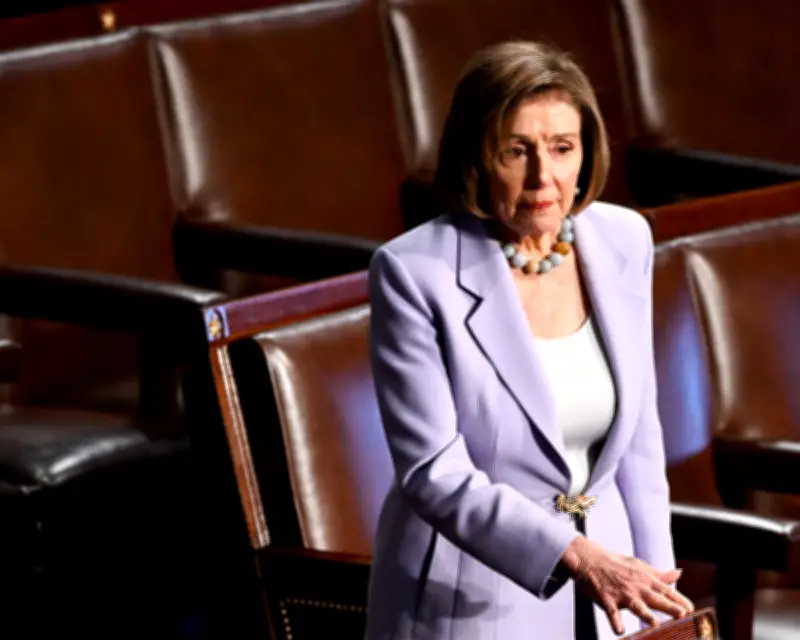
More than 100 House Democrats voted on Wednesday to eliminate $3.3bn in security assistance to Israel, marking a significant fracture in the long-standing bipartisan consensus on unconditional military aid. The amendment, offered by Kentucky Republican Thomas Massie, failed 314-104, but 103 Democrats—nearly half the caucus—supported it, including former Speaker Nancy Pelosi.
Leadership Divisions Exposed
House Minority Leader Hakeem Jeffries had urged Democrats to reject the amendment, but his second-in-command, Minority Whip Katherine Clark, broke publicly with his position and voted in favor. Pelosi, a longtime defender of the US-Israel relationship, also supported the measure, calling it "ill-conceived" but backing it "for the message that it sends." The vote exposed a caucus divide that can no longer be managed behind closed doors.
Public Opinion Shift
The vote comes amid a marked shift in public opinion. According to the Institute for Global Affairs, only 16% of US adults think unrestricted aid to Israel should continue, dropping to 9% among adults under 30 from both parties. The amendment, which was never expected to become law, served as a roll call measuring how much of the traditional consensus still commands automatic loyalty.

Republican Dynamics
Republican leaders made Massie's amendment eligible for floor consideration, a move seen as forcing politically uncomfortable votes for Democrats ahead of the midterms. However, every GOP member except Massie voted against the amendment, reaffirming support for continued military assistance to Israel, a state accused of genocide in Gaza by international human rights bodies.
Generational and Political Shifts
Prominent Republicans like JD Vance have also criticized Israeli influence over US foreign policy, signaling a growing willingness on the right to question the relationship. Meanwhile, Democratic primaries this year have elevated candidates who ran on cutting aid and opposing Aipac influence, winning in solidly Democratic districts in New York, New Jersey, Colorado, Pennsylvania, and Illinois.
Future Battles
A more consequential debate lies ahead with the US-Israel Defense Technology Cooperation Initiative, buried in the National Defense Authorization Act. Senator Bernie Sanders has warned it would deepen defense-industrial integration without sufficient congressional scrutiny. Representatives Massie and Ro Khanna have tried to remove the provision but were blocked in the House Rules Committee.
The bipartisan floor that has held for 50 years is buckling from both directions, as maintaining military assistance to Israel now requires active political management from leaders whose own deputies increasingly disagree with them.