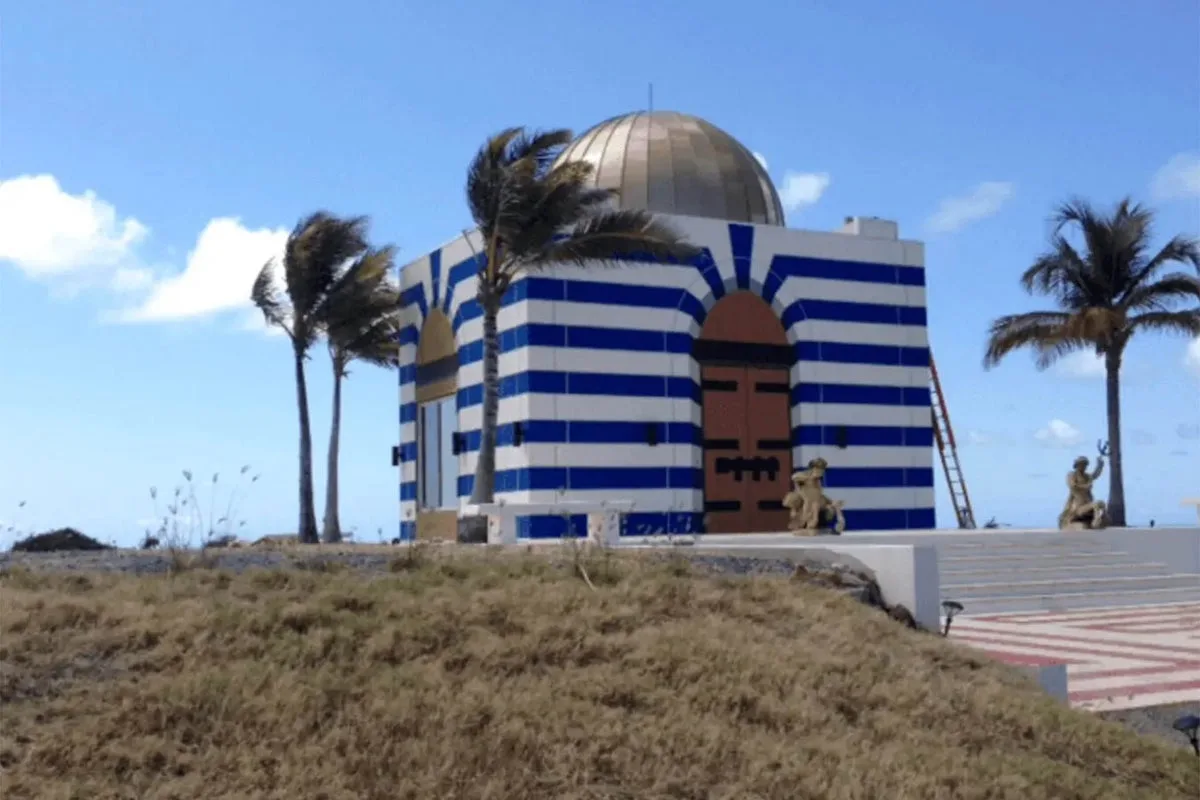
Newly released Epstein files have shed light on the purpose of a mysterious blue and white striped building on the pedophile financier's Caribbean island of Little Saint James. Correspondence showed Epstein referred to the building as a 'mosque' on multiple occasions, though plans for the structure changed multiple times, having at one point been designated as a 'music room,' a chapel, and a pavilion.
Epstein's Obsession with Islamic Art
'It should look old… it will be for the inside walls, like a mosque, I would love to see examples,' Epstein wrote in correspondence to a contact in Uzbekistan, discussing types of tiles to decorate the building, which is topped with a golden dome. It is unclear if the building was ever actually used for its purpose as a place of Islamic worship. Epstein himself identified as a secular Jew.
However, the documents reveal a years-long obsession with Arabic and Muslim art and culture, evidenced in his interactions with powerful figures including Emirati Sultan Ahmed bin Sulayem and Mohamed Bin Salman, who would later become Crown Prince of Saudi Arabia.
Interactions with Powerful Figures
Photos released as part of the files show Epstein with Sulayem – who was forced to resign from his position as head of Dubai-based cargo logistics company DP World due to his association with the financier – inspecting a large, elaborate tapestry on the floor of his New York townhouse in 2014. In 2003, Epstein claimed to Vanity Fair that he owned 'the largest Persian rug you'll ever see in a private home – so big, it must have come from a mosque.'
While serving jail time in Florida in 2009, Epstein had hired architects to draw up plans for a large 'hammam' Turkish bathhouse and spa, complete with baths, massage parlors, and a private terrace.
Acquisition of Sacred Items
These plans were abandoned in favor of a 'music room' the documents show, though the designs were still Middle Eastern in style. In 2011, he asked his Uzbek contact about acquiring the tiles for his 'mosque' – detailing specific details such as correct lettering to retain authenticity.
Epstein exercised his substantial wealth and influence to acquire extravagant pieces for the building. In 2017, the documents show, he met with Aziza Al Ahmadi, an aide to a consultant for the Royal Court of Saudi Arabia. At that time, negotiations were being made for the shipment of a special tent to be shipped to Epstein's island, as well as more items 'for the mosque.'
'We are receiving 3 pieces from the Kaaba,' Epstein's assistant told a customs broker, apparently referring to the stone cube building that stands at the center of the Islamic holy site of Mecca. One of the items had been 'used inside the Kaaba,' according to the document, and another was the Kiswa – the outer covering of the structure, which has enormous religious significance.
The covering is replaced every year, created by hundreds of individuals in a royal workshop, using about 1,500 pounds of silk and 250 pounds of gold and silver thread. Each one reportedly costs around $5 million. After it has been used, the Kiswa is divided up and distributed to various organizations or benefactors.
'The black piece was touched by minimum 10 million Muslims of different denominations, Sunni, Shia and others,' Al Ahmadi told Epstein in an email, highlighting the significance of the item. 'They walk around the Kaaba seven rounds then every one tries as much as they can to touch it and they kept their prayers, wishes, tears and hopes on this piece. Hoping after that all their prayers to be accepted.'
Epstein died in a New York jail in 2019 after being arrested on sex trafficking charges.






