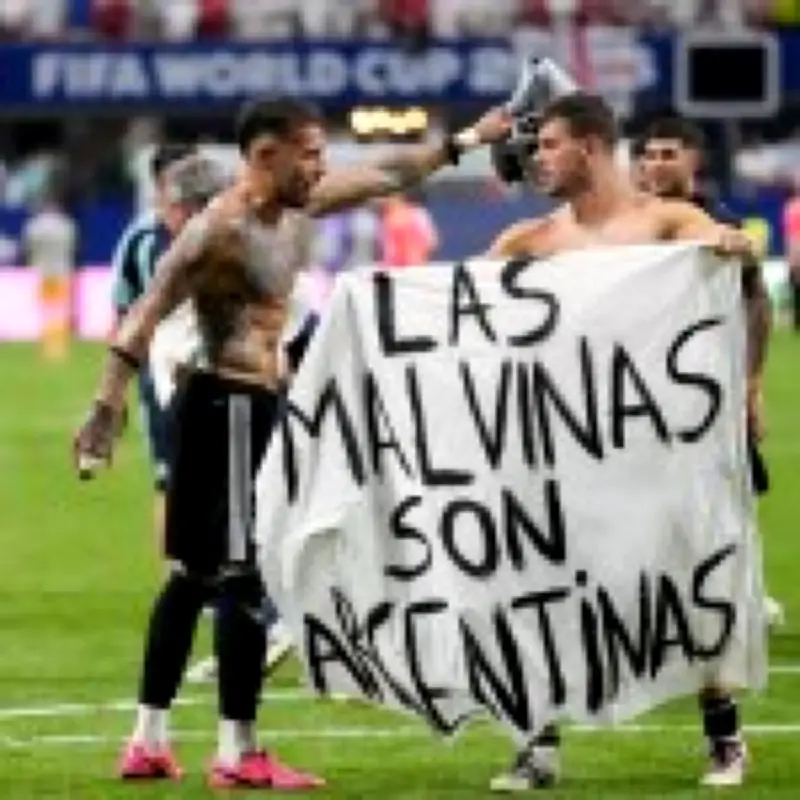
An Argentina fan has bragged of smuggling the notorious Malvinas banner into the World Cup semi-final against England – in his underpants. The supporter, identifying himself only as Santiago, said he used his hotel bedsheets and a £7 pot of black paint to make the sign, which sparked a diplomatic row between London and Buenos Aires.
How the banner was made and smuggled
Fan Santiago identified himself as the creator of the banner, which the team kept, saying: 'We made it on the same day as the match. We went to a nearby store and bought cheap paint and a paintbrush for less than $10. We returned to our hotel, grabbed the bed sheet, cut it in half, threw it on the floor, and painted it.' In an interview with Argentinian news outlet Todo Noticias, which published photos of the paint pot and the banner before it ended up in the hands of players, he added: 'I folded it as much as I could, put it in my private parts to get through security checks, and in the end we managed to get in.'
Political fallout and Downing Street response
Downing Street issued a 'hands off' warning, with the prime minister's spokeswoman saying: 'The World Cup might not be ours, but the Falkland Islands definitely are.' Ahead of the World Cup final between Argentina and Spain on Sunday, she said: 'The PM wishes both teams well for the final, especially Spain.' Argentina fans celebrated their victory jubilantly on Wednesday, with some near the pitch holding a banner which read 'Las Malvinas son Argentinas' – or 'The Falkland Islands are Argentinian'.

Player involvement and FIFA investigation
The sign, referring to the dispute over the British overseas territory, eventually made its way to the players, who held it up as they revelled in their win. Santiago said: 'When I saw Montiel, I threw it to him and he caught it. He passed it to Lo Celso, who was the first to hold it up. When I saw Lo Celso unfold it and his teammates holding it on the field, I felt a joy that I can't put into words. How a piece of a bedsheet could mean so much to all Argentinians.' On Thursday, Downing Street backed calls from other politicians and pundits for a Fifa probe into the behaviour of the defending World Cup champions. Former England international Peter Reid described the Argentina banner display as 'beyond the pale'. A Fifa spokesperson said: 'As is standard procedure, Fifa's independent disciplinary committee is currently assessing the match reports and considering the relevant circumstances before deciding on potential further steps based on the Fifa disciplinary code.'
Argentina president and vice-president weigh in
Argentina's president Javier Milei backed his country's players for flaunting the banner after their World Cup win over England – and bragged they will get a fine from FIFA in a 'worst-case' scenario. The firebrand right-wing leader described what the footballers did as 'understandable'. He said: 'What the players did is understandable; emotion got the better of them. They did it, and that will probably lead to discussion of an economic sanction. In the worst-case scenario, Argentina will face a $30,000 economic sanction from Fifa.' Argentina's vice-president Victoria Villarruel, who described the English as 'usurping pirates' in a social media rant before Wednesday's game, posted footage on X showing Argentinian soldiers on the march, writing: 'Come on Argentina: this wasn't just another match.'
Long-standing dispute over the Falklands
Political tensions between Argentina and Britain over the territory have lingered for decades, after boiling over into a short but bloody war in 1982. Buenos Aires has repeatedly claimed sovereignty over the islands, which are about 8,000 miles from the UK and 300 miles from mainland Argentina. In a 2013 vote, the islanders overwhelmingly backed keeping their status as a British overseas territory, but Argentine foreign minister Pablo Quirno has suggested this referendum was illegitimate. Days before the semi-final clash, he used an essay in La Nacion newspaper to claim the population had been 'artificially implanted by the occupying power', which was flatly rejected by Downing Street.