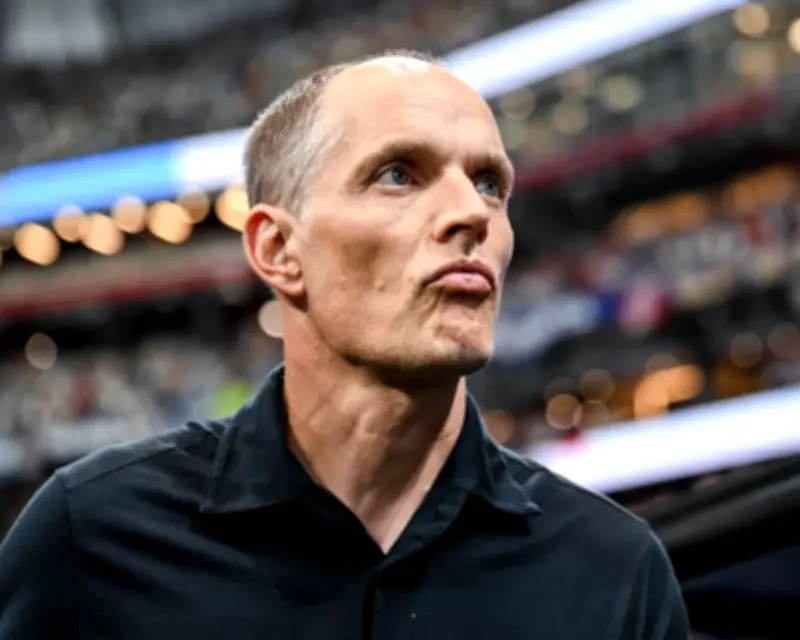
Thomas Tuchel has declared himself “100%” committed to leading England at Euro 2028, despite facing criticism after a 2-1 World Cup semi-final defeat to Argentina in Atlanta. The manager insisted the team’s system was not at fault, but rather the passivity of his players following Anthony Gordon’s 55th-minute opener.
Tuchel lamented England’s inability to retain possession and control the game after taking the lead, suggesting such ball retention was not in the team’s DNA. The Football Association hired him specifically to address this issue, yet the pain of familiar failings persists.
Tuchel retains FA backing after contract extension
Tuchel signed a contract extension in February that will keep him in charge through the Euro 2028 campaign. Despite the semi-final loss, he retains the FA’s support. Asked if he wanted to continue, he replied: “Yes, 100%. There is still enough to improve and I am more than happy to do that. I’ve loved every day of the World Cup.”

He added: “I said after the quarter-final win against Norway that I see a disconnect from what I see in training on a football level and within the games. We can impose ourselves more on the ball. We can show what good football players we are. That is still in us as I see it in training and in every camp. And here also at the World Cup. I still feel there is an extra level that we need to conquer. We need to step up to the next level to get the big prize.”
FA acknowledges tough tournament conditions
At the FA, there is a measure of satisfaction at reaching the semi-finals, coupled with realism about the challenges faced. The draw was considered tougher than in previous tournaments under Sir Gareth Southgate, featuring a group with Croatia and Ghana. A potential knockout path included Mexico in the altitude of Mexico City, Brazil, Argentina, and Spain or France. In the end, Norway replaced Brazil in the quarter-finals.
The FA was acutely aware of situational and logistical difficulties, especially heat and travel. By the time England arrived in Atlanta for the Argentina match, they had taken 13 flights since the tournament began, following a gruelling Premier League season. The hope is that a European Championship, which England will co-host, will be more straightforward.
FA chief executive Mark Bullingham expressed appreciation after the defeat: “It is heartbreaking to be so close. The players and Thomas gave it everything and the squad, coaches and staff could not have worked harder during the tournament. I would like to thank them all.”
Tactical switch criticised but Tuchel defends approach
Tuchel was criticised for switching to a back five in the final quarter, sacrificing Anthony Gordon for centre-half Ezri Konsa in the 72nd minute. However, he argued the problems began earlier, when England were still in their usual 4-2-3-1 formation. A turning point came in the 64th minute when Argentina manager Lionel Scaloni replaced defensive midfielder Leandro Paredes with left winger Nico González, moving to 4-2-4. In the 81st minute, with England still leading, Scaloni withdrew left-back Nico Tagliafico and introduced striker Lautaro Martínez, who scored the stoppage-time winner.
Between Gordon’s goal and Martínez’s winner, England had only 12% possession. Tuchel explained: “We got too passive within our structure. I tried to help … for us to actually be more active in a back five, to be quicker out to their wingers. We encouraged everyone to step out, to be more active but we just struggled. We couldn’t find any duels any more, which was why we dropped deeper and deeper. It was never the plan but it happened. We couldn’t stop the runners from the second line, the midfielders through our gaps. And their deliveries were on the highest level.”
He continued: “We needed to get back on the ball, otherwise you cannot break the pressure and you cannot get the momentum back. We just couldn’t cope with the momentum swing. Ball possession plays a crucial role. It’s maybe not in our DNA like it is in the Spanish DNA or the Argentinian or Brazilian DNA – to take the ball and control the game.”

Tuchel also acknowledged physical struggles: “Through the whole tournament … playing in the heat, playing in the altitude [against Mexico] and with a man down [after Jarell Quansah’s red card]. It cost us a lot in the end. We gave everything but it was not enough. My feeling is that no structure in the world could have helped us because we were too passive. We were not physical enough, we didn’t stop runs arriving in our box and the deliveries were then too good.”